NEWS
8/24/11 11:11pm
Students move-in early to prepare for incoming class
Bobby Rawlings wasn't up to much for most of the summer, but that all changed Aug.


Bobby Rawlings wasn't up to much for most of the summer, but that all changed Aug.

Warmth and beauty were two of Lauren Astley's top criteria in choosing a college. "If I am in a beautiful place, I will learn," she once told her father, Malcolm Astley. In the weeks since her death on July 4, warmth and beauty are just two of the many adjectives used by friends and family to describe Lauren.
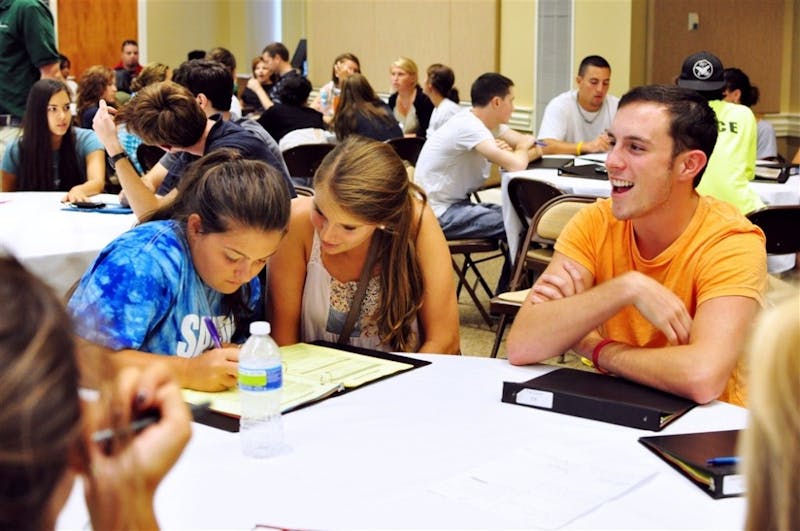
The incoming freshman class and their parents get a chance to see one of the traditions that makes Elon University unique—when upperclassmen involved with the New Student Orientation program help carry students' belongings into their dorms. The New Student Orientation team consists of 16 members of Head Staff and 101 Orientation Leaders. These upperclassmen start arriving to campus as early as August 12 to prepare for freshman orientation week. "The training week is so important for Orientation Leaders because it provides them with the tools they need to facilitate their sessions with new students," said Lauren King, head team captain of New Student Orientation. All of these students are led by Katie Hight, director of new student programs, who began the position this fall. "Orientation week is really important for the incoming students because it allows them to learn about Elon, get connected with the university and their peers and really become part of the community," Hight said. As director, Hight is responsible for helping to hire, recruit and train student leaders, manage the program's budget, coordinate evaluations, organize entertainment groups and schedules and be a point person for the students involved with the New Student Orientation program. Even though Hight is new to her position, she is not new to Elon's orientation program: she graduated from Elon University in 2007 after serving as an OL and a member of Head Staff. "I have gotten to experience Elon's orientation program in many ways now," Hight said.
The Class of 2015 at Elon University is both the largest and the most diverse in the school's history, with a total of 1,428 students in the freshmen class and 90 transfer students according to Greg Zaiser, dean of admissions. Forty states are represented in the class, with North Carolina having the most students.

Residents and students of legal drinking age in the Town of Elon may soon get to order liquor at bars and restaurants closer to home. On Nov.

Story Center Demolition of three residence halls in Story Center began the second week of August.

A multi-faith learning community and substance- free housing will be established this fall, joining the 17 already established learning communities on campus.

The Orientation Schedule for Aug. 26-27 has been revised because of the threat of storms from Hurricane Irene. New Student Convocation will be held Under the Oaks, the scheduled location, Friday, Aug.
This semester, The Pendulum will be working with a select group of international correspondents in study abroad programs all around the world to bring you first-hand accounts of the stories you would otherwise only find in major newspapers.
Class of 2015, Welcome to Elon University! I remember taking my first steps onto Elon's campus just three short years ago and dreading unpacking the past 18 years of my life that I had somehow fit into two cars.
[tabs style="vertical" title="Contents"] [tab title="What Does That Mean? - Elon Lingo"] What Does That Mean?

alt : test.html A guide to Elon and Alamance County for new students featuring places to eat, shop and have fun.
This semester, The Pendulum will be working with a select group of international correspondents in study abroad programs all around the world to bring you first-hand accounts of the stories you would otherwise only find in major newspapers.

Everyone’s done for the semester and it’s time for new jobs, new cities, new friends and new news.
Nicole Esplin School starts in less than two weeks for Elon students. Whether you’re a casual or a competitive athlete, you probably want to begin school in shape and looking fit after summer. Over the summer working at cross country camp, one of my friends showed me this quick, full body workout that strengthens and tightens your arms, abs, and legs…and takes less than 10 minutes! The workout consists of three simple exercises: Crunches (or sit-ups), squats, and pushups. Start with 10 reps of each exercise, and then work down (9 reps of each exercise, 8, 7, 6, etc, all the way to 1). The key to make this workout effective is to complete every rep, and make sure there is little to no rest time between sets. By the end, you will have done 50 pushups, 50 sit-ups, and 50 squats…do this 3 times a week, and you’ll notice a difference in your tone and performance.
Nicole Esplin Strides can be a pain for many runners. The last thing most runners what to do after they finish a run in the summer heat is to run repeats at an even faster pace for at least 100 meters. But they’re necessary. In high school, I didn’t worry about strides when my coach wasn’t breathing down my neck and making me do them, and I paid for it in races. It’s similar to doing abs-you don’t realize how much you benefit from something pretty easy and quick until you start doing them. Once I started doing strides, my kick at the end of races improved, and instead of losing 5 places in the last 400 meters of a 5k, I found that I could even increase my place. Strides benefit runners in the long run, and you may not see improvement until you race, so they are extremely easy to put off until a later run. They are just as easy to keep putting off until you realize 3 weeks have gone by and you still haven’t done any strides. One way to guarantee to do strides at the end of a run is to choose one or two days a week to always do strides. My days are Mondays and Fridays, so when I being my run on those days, I know that my run doesn’t end when my route ends…it ends when my last stride is finished. I have begun to visualize the end of a race and how I want to feel during the last 5 minutes of my run. This way, I am thinking about racing, and reminding myself of my ultimate goal of breaking my PRs during cross country season. Strides can be as long as 200 meters or as short as 50 meters, but most coaches recommend 100-meter strides. They should be almost sprinting (and as a long distance runner, most of the time I end up sprinting). To start, I would suggest 4x100 meter strides with as much rest as you need. Just remember to keep moving during rest periods! Once you are comfortable doing that, you can run 8x100 meter strides, 6x200 meter strides, or even find a small incline and run some strides up a low grade hill to improve hill endurance and leg speed. If this article hasn’t inspired you to stride at the end of a run, I’ve attached a video from the 1972 Olympics where David Wottle runs most of the race in last place until the last 200 meters…you better bet he did his strides at the end of his runs! [youtube=http://www.youtube.com/watch?v=5LHid-nC45k&feature=player_embedded]
This semester, The Pendulum will be working with a select group of international correspondents in study abroad programs all around the world to bring you first-hand accounts of the stories you would otherwise only find in major newspapers.
Everyone’s done for the semester and it’s time for new jobs, new cities, new friends and new news.
by Kassondra Cloos, News Editor Over the past few weeks, Casey and Caylee Anthony have become household names.