

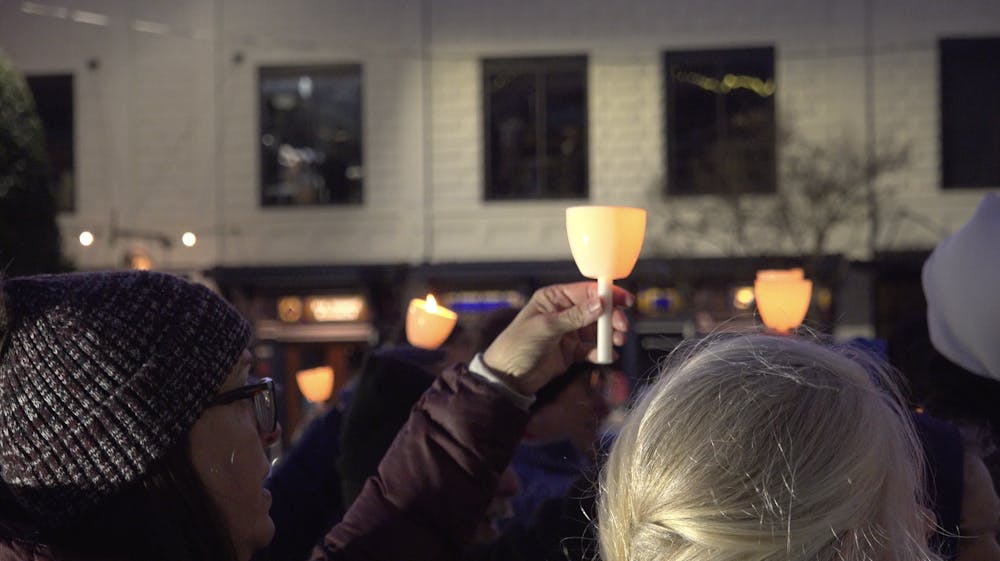
Members of the community and Alamance County Remembrance Coalition gathered outside of the Alamance County Courthouse on Feb. 22 to hold a vigil honoring the life of Wyatt Outlaw.
Outlaw was lynched by a mob of White Brotherhood members outside the courthouse on Feb. 26, 1870. Outlaw lived in Alamance County and served as the town commissioner of Graham.
This is the seventh year the coalition has held the vigil. Attendees were first led in prayer by Lashauna Austria, a co-curator of the Alamance County Remembrance Coalition. The prayer recognized racial terror as an organized and public part of history. During the prayer, Austria also called for the vigil to continue in classrooms, churches and in political policies.
“Not by forgetting but by facing what was done and choosing a different future,” Austria said during the prayer. “May this soil beneath our feet remind us violence leaves a mark, but so does love. So does courage. So does collective healing.”
Elon law alum and musician Ernest Lewis Jr ‘15. then led the group through renditions of various songs such as “Swing Low, Sweet Chariot,” and “This Little Light of Mine.”
Co-author of the book “The Legend of Wyatt Outlaw from Reconstruction to Black Lives Matter,” Sylvester Allen Jr., read two passages from his book. The first detailed the life Outlaw lived in Graham, as a landowner who built a church and school on his property, and a tavern operator.
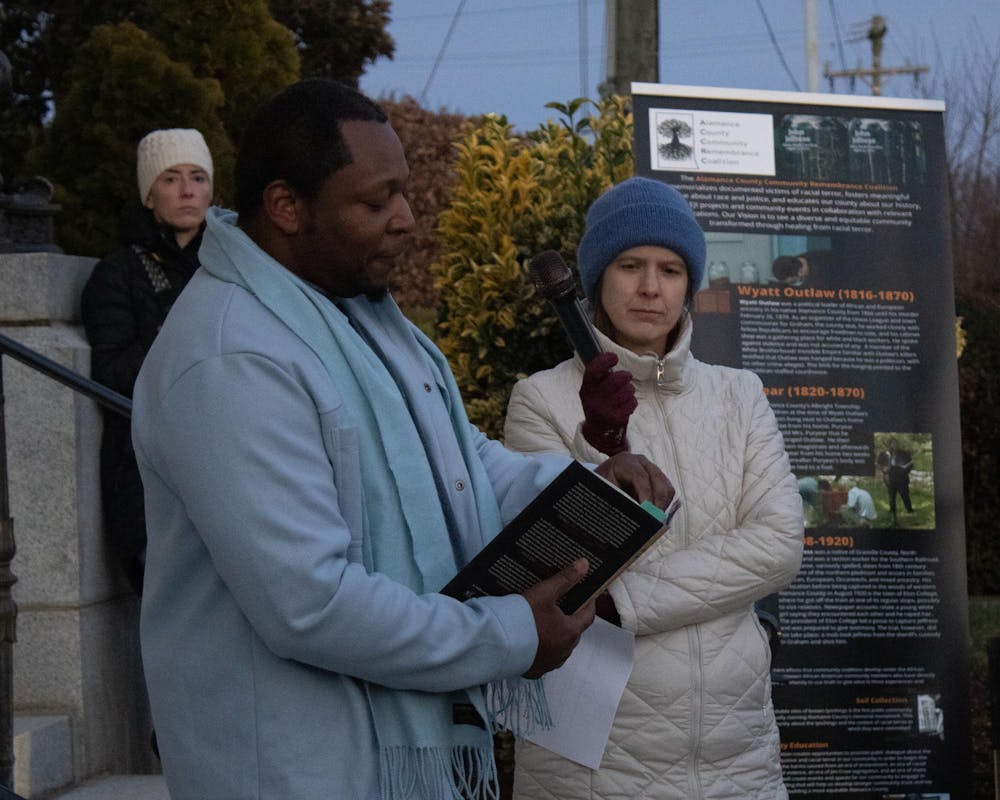
The second passage recounted a testimony from Outlaw's mother, Jemima Phillips, about the night Outlaw was lynched. Phillips was in the first room that members of the White Brotherhood went into when they broke into Outlaw’s house.
The armed men threatened Phillips and demanded to know where her son was. Phillips tried defending Outlaw from the mob, but they overpowered her and dragged Outlaw from the house. The next day, Outlaw was found hanging from a tree across from the courthouse.
“In all, some 100 white men had watched as Wyatt was murdered,” Allen said during his reading. “His body mutilated. They had blocked every exit leading away from the courthouse. Perhaps a sign of their own fear of Wyatt and of the white and black citizens who might defend him.”
After the vigil, attendees were invited to interact with the soil from the site where Outlaw was lynched.
Allen said the community coming together to hear about and honor Outlaw is important to spread awareness about who Outlaw was. Allen grew up in Alamance County, but he said he did not know Outlaw’s story until coming back to Alamance County after spending time in the army.
“I think that’s kind of a tragedy, because he was something of a superhero, in my mind,” Allen said in an interview with Elon News Network. “If I was a little boy, and I was hearing that name for the first time, and I heard that story, it would have welled me up with pride, to be in a place where a superhero, in a sense like Wyatt Outlaw, walked in the same place as I did.”
Austria has also lived in Alamance County her entire life and said she did not know Outlaw’s story until she was an adult. She said the stories of Outlaw and other victims of lynching in Alamance County should be taught in local schools. By talking and sharing these stories, Austria said we can learn and grow from history.
“Sometimes these stories go unnoticed, and I think it’s just important that we elevate the stories and see each other so we can chart a different history going forward,” Austria said in an interview with Elon News Network.
Anjolina Fantaroni contributed to the reporting of this story.