

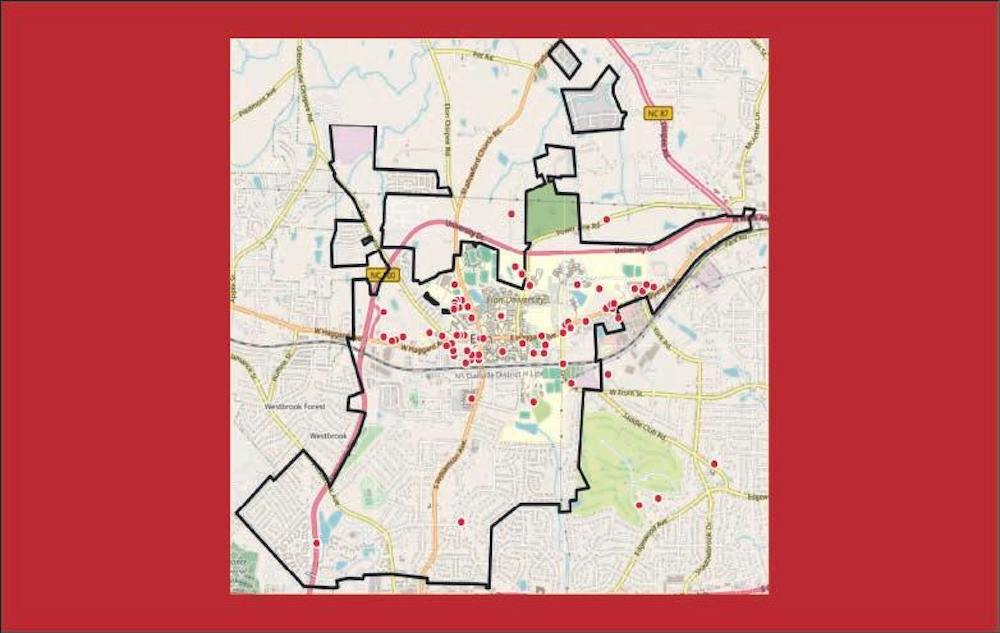
As Elon University continues to expand its presence in the town of Elon, the financial viability of the town could be in flux.
Because of the size of Elon University, the town of Elon requires additional resources, such as police officers and fire trucks. This need results in higher taxes for town of Elon residents, according to Elon town manager, Richard Roedner.
According to the 2026 Tax Assessment Report provided to Elon News Network by Roedner, Elon University owns approximately 640 acres, or 484 American football fields, of property within the town of Elon municipal limits.
For reference, the town of Elon is about 2,600 acres, or just over four square miles. Of those four square miles, the 640 acres owned by Elon University is 24.6% of the total land mass of the town.
On these land plots sit educational buildings, athletic facilities, residence halls, as well as vacant, unused land. This unused land includes nearly 100 acres along University and Power Line drives.
Elon is listed under three names registered with the Alamance County Tax Department: “Elon University,” “Elon College” and “Elon University Campus.”
Across all of the plots owned by those three entities, the plots are worth over $591 million. But the university only pays around $46 million in property taxes annually, which represents less than 8% of the assessed taxable value. This is because the university is a nonprofit.
“There are other parcels that, like in town, the university owns a bunch of vacant lots, downtown and elsewhere," Roedner said. "Those are not used for educational purposes because they’re vacant lots, so they do pay taxes on those.”
Roedner said the university’s taxable valuation is about 59% of the town’s. The town charges a tax rate of 40 cents for every $100 that a property is valued. Therefore, the town’s overall tax revenue could be as high as $3,300,000. However, according to Roedner, the actual overall tax revenue is only $1,100,000.
The gap in revenue is because Elon University’s property tax exemption, granted to Elon by Alamance County. This means that Elon does not pay property taxes to the town on plots with an educational use. Elon University is exempted from property taxes on 31 of its 76 plots.
For example, if the university purchased a house within the town limits, and left it vacant, it is not serving an “educational purpose,” and therefore would not be eligible for tax exempt status, according to Roedner. However, if the university rented the house to alumni while they were in town or used it as student housing, that may be considered “educational,” making the property eligible for tax exemption.
Because of the university’s presence, the town requires more resources, Roedner said. “If the university were not here, we wouldn’t have nearly the amount of services we have,” Roedner said. “We wouldn’t need as big a police department. We wouldn’t need a new ladder truck for the fire department. We wouldn’t because we have a much smaller community, but because the university is here, we have to provide all those services at a much higher level than we would otherwise.”
Roedner said that because the university takes up most of the town’s space, there is no tax revenue coming in from that.
“The fact that they don’t pay taxes means that the rest of the residents have to pay more in tax to cover the costs associated with service in the university,” Roedner said.
Elon University Advancement and External Affairs did not respond to Elon News Network’s request for an interview.
According to Roedner, there is a limit to the amount of land Elon University can purchase or own before the financial viability of the town is jeopardized, but that amount is currently unknown.
According to Roedner, purchasing all the buildings in downtown Elon to build more dorms would be one example that could threaten the finances of the town.
Roedner also said that further expansion by the university would lead to fewer opportunities for other people to purchase vacant land and add tax value to it through building.
“You certainly could make a case that it has already affected our financial sustainability,” Roedner said. “Because the only land that can create value for us is located on the other side of University Drive. We’re bound by Gibsonville on one side and Burlington on the other two sides, and so all the normal land internal to the town that you would normally grow is not open for growth, so we have a very narrow corridor to the north where we can grow.”
The university also owns six land plots within Burlington city limits.
Elon University has also begun expanding in the eastern part of the state, and upon the completion of the Elon-Queens merger, will have a 50-acre campus in Charlotte.
Within the past five years, the university has purchased about 38 acres of land throughout the town of Elon and city of Burlington. These acres are spread unequally between 16 plots, and make up nearly 6% of the total land owned.
According to Roedner, of the 640 acres owned by Elon, about 13 vacant acres were purchased within the past year. The school has proposed rezoning this land for university purposes.
Roedner noted that Elon University gives the town of Elon approximately $200,000 annually based upon the needs of the fire and police departments, as well as downtown Elon and the general government.
He also mentioned that $450,000 was donated by the university towards the purchase of the fire department’s new ladder truck, which cost over $2 million.
There was a communication dispute between the town and university in April of this year, resulting in the funding being withheld initially. This came as a result of fire code violations that had gone unaddressed.
“Because the university is still withholding funds for the fire department, totaling approximately $423,524, with a commitment of releasing the funds only if we maintain a positive collaborative relationship with the university,” Roedner wrote in a memo back in April.