

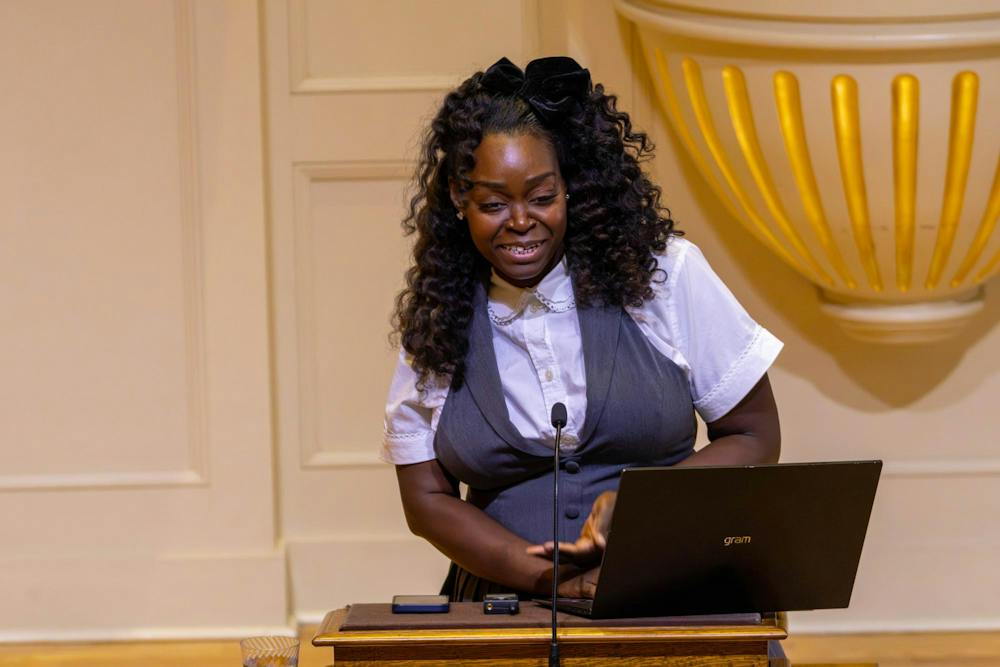
Before Araba Maze became a self-described “radical street librarian,” she was a woman reading to children on her stoop in Baltimore. Maze encouraged those children to keep reading books at home.
“We don’t have any books at home,” she recalled the children saying to her.
That’s when she had her “a-ha” moment. It was the beginning of her journey as the face and character of Storybook Maze, a mobile literacy project to eliminate book deserts in Baltimore.
Maze spoke at Elon University Oct. 6, educating students and locals about Storybook Maze and what book deserts are.
Maze described a book desert as a geographical area where access to reading materials is limited or challenging. She said they are often found in low-income or minority communities where one book is being shared by 300 children.
“In America, 32.4 million American children go without books, and 67% of the schools and programs in our nation's lowest-income neighborhoods can't afford to buy books at retail prices,” Maze said in her speech.
To combat these book deserts, Maze said she has been implementing creative tactics online. With over 400,000 followers on TikTok and Instagram, she said most of the revenue for this project is generated by posting on social media.
She established free public vending machines, free pop-up bookstores and story times. After her project gained traction, it also gained wheels. Now, she runs the bookstore and hosts story times on her trolley, which has earned her popularity on social platforms.
“We drive this around like a little ice cream truck going around town and giving away free books,” Maze said.
She said her trolley and vending machines aren’t filled with random books. Her selection is intentional.
“Something different that I do is use my expertise as a librarian to curate a reflection to match the community's needs, wants and to reflect the people reading them,” she said.
Maze said she picks books that have characters that look like the children, speak the same dialects or languages and have the same holidays.
“If you present it in a fun way, they will read,” Maze said.
Street librarians, Maze said, are nothing new to U.S. history. Pack Horse Librarians were a group of women who would transport books to rural communities in the Appalachian Mountains during the Great Depression. However, just like street librarians, anti-literacy laws and segregation were present throughout communities in the U.S.
She also said she is working on destigmatizing reading for children who might find flipping through pages intimidating or unfamiliar.
“People who have experienced libraries as unwelcoming places, dangerous places, places you could get locked up for entering, may not pass that tradition down to their children,” Maze said. “So in this way, segregation survives as a dark heirloom passed down by generations.”
Senior Kenzie Ross has seen Maze’s content on social media, which brought her to the event. She said she wanted to gain knowledge on how to provide better access to books for locals within Alamance County.
“It never feels like I'm giving the books to the right people,” Ross said. “People who are reading books aren't the wrong people necessarily, but I feel like there's an imbalance.”
Back at home, Ross said her mother is a literacy teacher and has seen firsthand the importance of having access to books.
“Reading is really the first step in growing that imagination and growing a passion for things,” Ross said. “If you don't see yourself and if you don't see your community in books, then it's really hard for you to like projects and get into that cycle.”
Freshmen Tessa Van Voorhis and Milana Thompson attended the event as a requirement for their Elon 1010 class and said they ended up learning about something they didn’t even know existed – book deserts.
“We would learn in school that food deserts were a really big thing,” Voorhis said. “So I'm like, ‘Oh, food deserts make sense.’ But book deserts I never heard of before because I always lived within walking distance from a library.”
Thompson said she has been an avid reader since she was a little kid, and knowing that some children don’t have books at home saddened her.
“I didn't realize this was an issue at all,” Thompson said. “I just felt like you could just go to the library.”
Maze knows that not every request can be met, but said she hopes the project will expand to other areas than just Baltimore. She is currently building a toolkit for local librarians and community members to start their own literacy and book access initiatives.
But for now, Maze said she will continue to drive around Baltimore in her trolley, read to children and send them home with a new book they can add to their shelf.