

The Leandro Comprehensive Remedial Plan, a 2021 proposed public school funding plan to ensure North Carolina meets its educational standards as outlined in the state constitution, called for $5.5 billion over eight years.
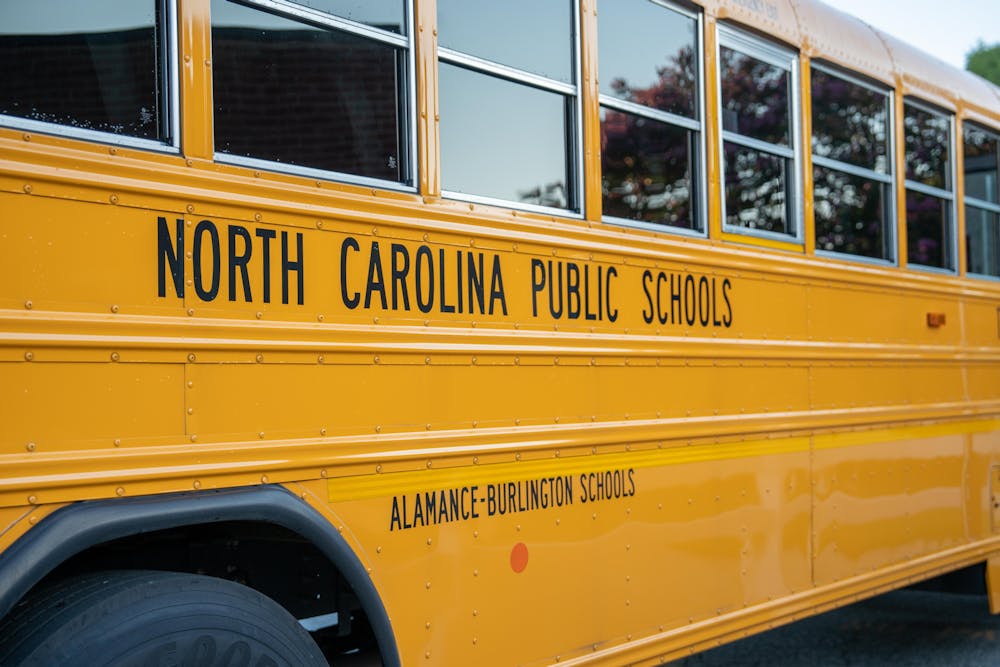
In Alamance County, the plan would have allocated $56.7 million to the Alamance-Burlington School System — a 38% budget increase as of 2022 — and $15.7 million to early education programs by 2028.
However, in early April 2026, the North Carolina Supreme Court overturned previous rulings and officially dismissed the 1994 Leandro lawsuit that inspired the 2021 remedial plan. The state Supreme Court asserted in a 4-3 decision that the courts are not authorized to force state funding without legislative approval.
Lauren Fox, interim president of educational policy think tank Public School Forum of North Carolina, said she believes the ruling will be detrimental to the state’s education system. She said challenges such as the COVID-19 pandemic, Hurricane Helene and increasing mental health issues among students have exacerbated existing flaws in public schools.
“This ruling is really devastating,” Fox said. “It’s been made into a political issue but what I’m thinking about is the kids across the state that are in our schools right now. Whatever the court ruling is, I don’t understand how we can do such a disservice to our students.”
Leandro v. State of North Carolina was first filed in 1994 by families and school districts in five low-income counties — Hoke, Cumberland, Robeson, Halifax and Vance — arguing that their districts did not have enough money to provide an equal education for their children.
The North Carolina Constitution states that “The General Assembly shall provide by taxation and otherwise for a general and uniform system of free public schools, which shall be maintained at least nine months in every year, and wherein equal opportunities shall be provided for all students.”
The Leandro case claimed disparities in public school funding violated the state constitution by denying certain students a sound, basic education, according to Every Child NC, a statewide coalition that advocates for students’ right to strong public education.
Leandro Context
The Leandro case has a complex history. According to the Public School Forum of North Carolina, the state Supreme Court heard the initial case in 1997 and ruled that every child has the constitutional right to a sound, basic education. A superior court agreed in 2002, ruling that the state was not constitutionally compliant in providing qualified teachers, strong principals and resources for all educational needs. This was upheld by the state Supreme Court in 2004.
In 2018, Superior Court Judge David Lee appointed WestEd, an independent educational consultant, to develop a set of recommendations to ensure the state school system was in compliance with the constitution. Based on their report, the 2021 Leandro Comprehensive Remedial Plan was created.
In 2021, Judge Lee ordered the state of North Carolina to take action to implement the remedial plan. The legislature refused and appealed to the state supreme court, which ruled in 2022 the legislature must fund years two and three of the Leandro Plan.
Before funds could be allocated to the affected communities, the 2022 midterm elections shifted the state Supreme Court to a 5-2 Republican majority. Several legislators called for the funds to be halted and the Supreme Court to rehear arguments, creating the Hoke County Board of Education v. State of North Carolina case.
In early April the court dismissed the case and all Leandro decisions after 2017, saying the courts do not have constitutional authority to order the legislature to spend state funds, the case did not follow proper procedure to establish subject matter jurisdiction and the education system has changed too significantly since 1994.
The North Carolina Justice Center is a nonprofit anti-poverty organization and founding partner of the Every Child NC coalition. Matthew Ellinwood, director of the Education & Law Project at the North Carolina Justice Center, explained Leandro had provided a way to interpret the state constitution’s declaration of educational rights and new questions arise without it.
“The legislature could always act to uphold those rights outside of a case — the constitution remains unchanged,” Ellinwood said. “Leandro had been the way of defining what that exact right is and with that being closed, something else will be needed; a new case.”
State Budget
With the Leandro Plan off the table, public school advocates are pushing for increased spending on schools from the state budget. However, North Carolina is the only state without a budget, operating on its last approved budget from 2023.
A key point of debate between the state House and Senate relates to scheduled tax cuts. Senate leadership has refused to modify tax cuts that mostly benefit profitable corporations and wealthy North Carolinians, costing the state $18 billion in revenue each year.
“If the tax cuts proposed on the Senate side were to go into effect, we’d have even less revenue for public education and all of the other services that the state provides,” Fox said. “And teacher pay — the House wanted much higher teacher pay increases than the Senate. Those disagreements are at the core of why we don’t have a state budget.”
Fox said the lack of a statewide budget exposes existing flaws in how funding is distributed across the state, with the impact felt more intensely by local communities.
“We’re not seeing additional revenue flowing into our schools that desperately need it and you’re seeing local budget crises across the state that are very much related to this,” Fox said. “It kind of is an indicator of what’s wrong with our funding in the first place that we’re having these kinds of disagreements over investments that should be a no-brainer, honestly.”
Fox added that public schools are consistently overlooked by policymakers in North Carolina, who should provide the necessary funding regardless of the Leandro case.
“The court case and the order to transfer funding would have provided some relief to our children and our teachers and our families that are looking at the public education system as a way for them to prepare for the future and come back and invest in the future economy of North Carolina,” Fox said. “It’s heartbreaking and really short-sighted that our policymakers haven’t just invested anyway.”
Private Schools
The dismissal of Leandro also invokes questions about the value the state gives to private education.
In 2023, North Carolina became the tenth state with a universal voucher program, which makes all private school students eligible for state-funded subsidies regardless of their family income. The 2023 budget also tripled the program’s funding.
According to Fox, the voucher programs tend to benefit wealthier families who can already afford to send their children to private schools.
“We’re using our limited dollars to cover that instead of investing that money in our public schools,” Fox said. “I think that's a huge mistake. And I think it’s part of this trend of devaluing and not supporting public education — the schools that serve the vast majority of students in North Carolina. It’s siphoning resources out of public schools to make them a less viable choice for families, and that's really wrong.”
Looking Ahead
A key reason the state Supreme Court dismissed the Leandro case was the belief that judicial authority over allocation of state funds violated a separation of powers. While the case became politically charged, Ellinwood described the importance of understanding the fundamental goals and flaws of the lawsuit.
“It kind of devolved into a case about who has authority over what in the state, between the legislature and the courts,” Ellinwood said. “It got forgotten that the constitution says what it says and has to be enforced. The courts are always going to have some role in determining if the state is meeting that, and have always found that it’s not. The problem has been how to remedy that violation and who has authority to order a remedy for it.”
While confusion still surrounds who is responsible for enforcing the constitutional right to a strong public education in North Carolina, Fox said it is indisputable that the right exists and must be protected.
“None of the courts said that the state is not responsible for providing a sound, basic education to every child — that is still very much in place,” Fox said. “Right now, we need to turn to our lawmakers. If the court said, ‘Well, we can’t make you appropriate the money,’ then they need to decide to appropriate the money. It’s up to them, so I just hope they’ll make the right choice.”