

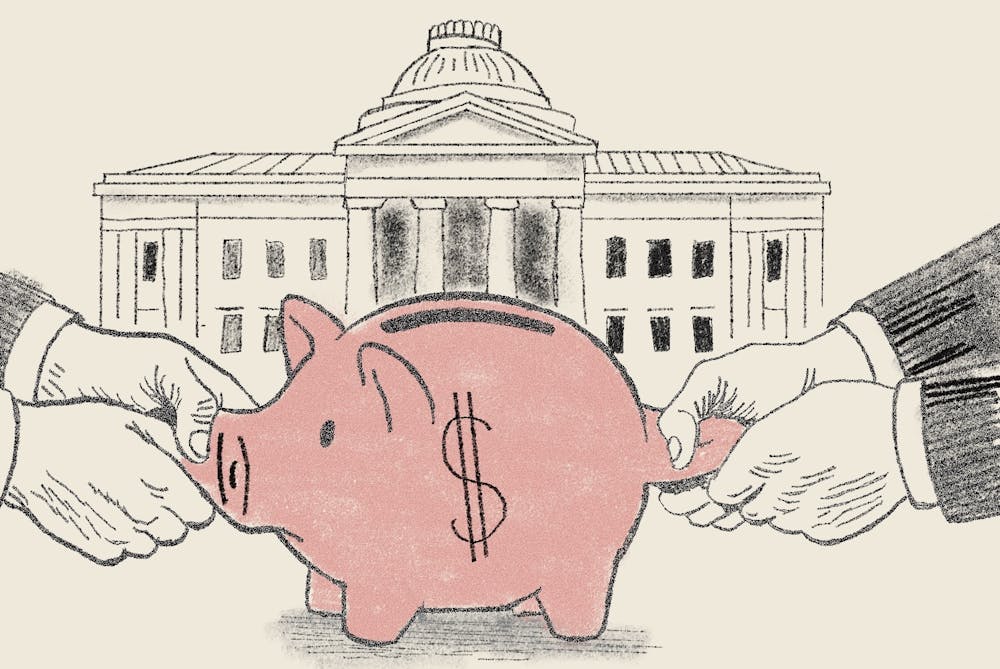
North Carolina still doesn’t have a state budget — the only state that has both chambers controlled by the same party to not have a budget – more than four months after the new fiscal year began in North Carolina.
The budget impasse that North Carolina lawmakers have fought tooth and nail over for the last few months could become the new norm, according to Western Carolina University political science professor Christopher Cooper.
“The lesson here is you don’t have to have a budget, and the electoral consequences of not having a budget are minimal,” Cooper said. “The legislators are not stupid, they’re figuring that out.”
The current fiscal year began July 1, but state legislators have been unable to come to an agreement on a new state budget. In the absence of it, the state operates on the previous fiscal year’s funding levels, but not all funding rolls over. The North Carolina legislature is controlled by Republicans in both chambers, but despite this, the two chambers are unable to get over their differences. The disagreements between the chambers over the budget largely focus around scheduled tax cuts, Medicaid funding, raises to state employees and a plan for a multi-billion dollar state children’s hospital.
According to Sally Hodges-Copple, a public policy analyst for the North Carolina Budget & Tax Center, Senate leadership is refusing to modify the scheduled tax cuts that mainly benefit profitable corporations and the wealthiest North Carolinians. Hodges-Copple said these tax cuts are costing the state $18 billion in revenue each year.
“Polling consistently shows that North Carolinians reject these tax cuts. They want the legislature to invest more in education, infrastructure, health care, the things that support their well-being, even if that means corporations and the wealthy have to pay more in taxes,” Hodges-Copple said. “We don’t have a budget today because some leaders in the General Assembly continue to prioritize those tax cuts at the expense of North Carolina’s well-being.”
On Nov. 12, Democratic members of the NC House held a town hall with community members to discuss the budget crisis at the Elon Community Church. Among them was Democratic Rep. Sarah Crawford who said that the lack of a budget means many doctor’s offices are now not seeing as many Medicaid patients because they can’t afford to provide those services.
“There are people across the state that are losing services, losing access to health care, losing their therapeutic services, losing pharmacy benefits, because these Medicaid cuts have gone into effect, and that’s all because the Republican controlled General Assembly cannot come to a deal,” Crawford said in an interview with Elon News Network.
Medicaid cuts range from 3% to 10% depending on the service provider.
Cooper said the intra-party fighting shows how structurally different the Senate and House are. He said it shows that the two chambers approach politics very differently.
“There’s an old adage in politics that the other party is the opposition and the other chamber is the enemy and I think you’re seeing that,” Cooper said. “Just because you’re a member of the same party doesn’t mean that you necessarily see eye to eye on some major issues. The House and the Senate are structurally very different. They are culturally very different.”
Some of the lasting impacts also include the absence of pay raises for teachers. Additionally, more North Carolina child care programs closed than opened in August due to a lack of funding.
“Teachers in North Carolina, who are already some of the lowest paid teachers in the nation, they are not getting a pay raise,” Hodges-Copple said. “They’ve seen their household costs go up each year because of inflation, and so, without a raise, that equates to a pay cut for them. That’s not good for recruitment and retention, and it is not good for the experience of students in the classroom.”
According to Cooper, the budget crisis could also affect local governments. Because governments are forced to rely on previous funding levels, local governments that are trying to expand who they serve are having trouble with long-term planning. Elon Town Council Member Quinn Ray, who helped moderate the town hall on Nov. 12, said it’s affecting towns like Elon when trying to get state grants.
“We’re looking at what we’re trying to do here at Elon, getting a police station, and working for some funds for that. We were earmarked, but with no budget passed, it doesn’t come to us,” Ray said during the town hall.
Cooper also believes that situation could lead to less trust in government and people feeling that their voice does not make a difference.
A temporary solution that the General Assembly has been using in recent months is a pair of “mini-budget bills.” These are small spending bills that do not act as a fully funded budget, but instead fund a limited number of time-sensitive needs. For example, one of the mini-budget bills targeted funding disaster relief in the wake of Tropical Storm Chantal.
“They keep the wheels turning, and so they avoid disaster in a lot of ways, and they do allow them to move forward certain very particularized policies that they may want to pass. But it’s not a whole scale budget in the way the system is created for,” Cooper said.
These mini-budget bills are not new to North Carolina, as the state has gone up to two years without a budget in the past. North Carolina passes a budget every two years and lawmakers didn’t pass a budget until November in 2021 and again didn’t pass one until October in 2023. Cooper said that it’s normal to not have a new budget before the start of the fiscal year, but not for it to last this long.
Cooper said that this stalemate shows that the Republican legislators don’t feel pressure.
“If they thought there were electoral consequences to pay, then they would have passed a budget,” Cooper said. “But they believe, and I believe they are correct, that their jobs are not in danger, and they are likely to be able to run for reelection and gain reelection, if they so choose. So I think it’s about the lack of electoral accountability in that way.”
State lawmakers will run for reelection in November 2026.
Republicans Sen. Amy Galey and Rep. Stephen Ross, whose districts include Alamance County, did not respond to Elon News Network’s requests for comment.
Democratic Rep. Vernetta Alston, who attended the town hall in Elon, said that the past session of the General Assembly has been one of the most unproductive sessions in her five-and-a-half years in the legislature.
“One of our core jobs is simply to pass a budget,” Alston said during the town hall. “So we’ve left ourselves without doing our jobs, and without a comprehensive fiscal plan for the state. It’s really, really tragic and neglectful.”
State lawmakers have indicated that they have no plans for any major votes until sometime in 2026. Crawford said that she expects her and other lawmakers to return to Raleigh in April and take up additional funding conversations then.
“What needs to happen is that the Republican leaders in both the House and the Senate need to understand how much not passing a state budget is hurting the everyday North Carolinian, and put the priorities of the people first,” Crawford said in an interview with Elon News Network.
Gov. Josh Stein recently called legislators to come back to Raleigh next week in a rare special session to address Medicaid funding, but the session would just cover funding of Medicaid, not a state budget.
Cooper said that lawmakers are learning that a new budget isn’t necessary.
“It’s very possible we just won’t have a budget, and they’ll just pass mini-budgets, as they’ve done, and move on. I mean, in some ways, they’ve proven that they can get away without a whole scale budget,” Cooper said. “Obviously, at some point we’ll have a new budget again. But I’m not convinced it’s going to be this term.”