

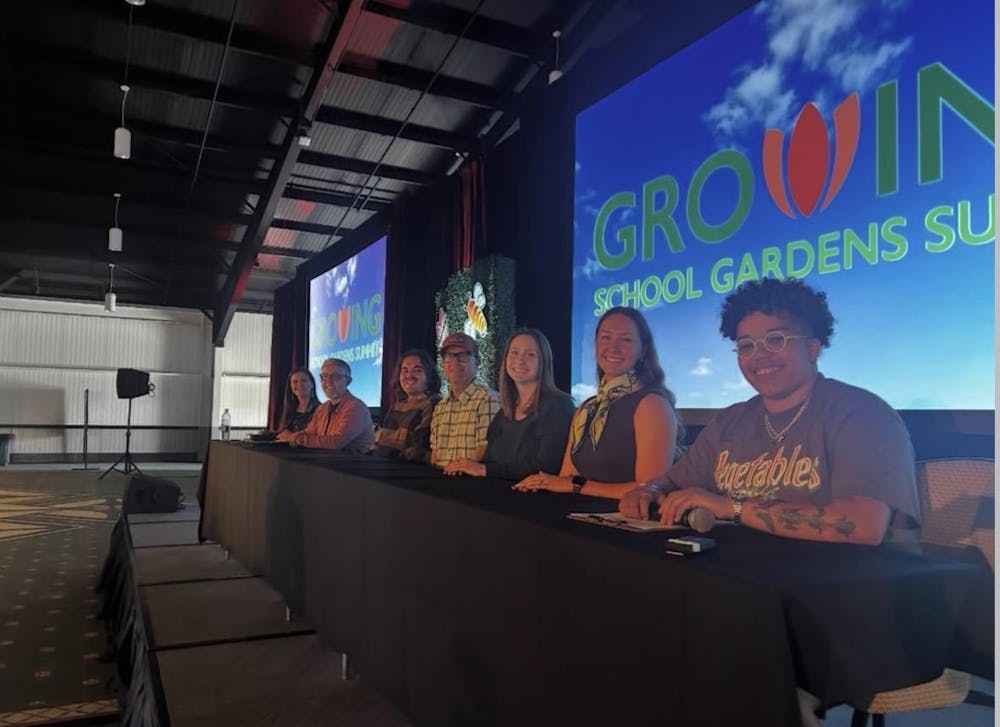
After stepping foot in a local elementary school’s garden, Elon senior Grace Rasmussen said that’s when she realized learning could be full of joy, and she knew she wanted to provide that for her future students.
Rasmussen, an Elon University Teaching Fellow, is now conducting two national surveys exploring how schools incorporate outdoor and progressive education practices. She has presented at several conferences, including the Growing School Gardens Summit and the American Educational Research Association conference. She will also present at Elon’s Spring Undergraduate Research Forum on April 28.
Rasmussen said her research journey began as a freshman when she got a job with her future research mentor through the PACE program, which provides students in financial need with on-campus jobs when they start at Elon.
In her work for professor Scott Morrison, Rasmussen said she helped run garden clubs at Elon Elementary and Eastlawn Elementary.
“Once I went to garden club for the first time, it was kind of magical. I was like, ‘Oh, learning can happen in joyous, fun ways, and school doesn't have to be like prison, and we can learn in good environments,’” Rasmussen said.
Morrison said when Rasmussen approached him in her sophomore year, he suggested doing the progressive study in addition to the survey on outdoor education she pitched to him.
“When we were looking into a study of school gardens or garden-based educators, I started talking about how teachers who take kids outside during the school day, you could consider what they do as pretty progressive and outside of the norm practice,” Morrison said. “I asked her if she knew what progressive education was, and she said ‘No.’”

Morrison said progressive education can be defined differently by everyone but focuses on breaking away from typical teaching methods, such as memorization and testing. He said this includes student-centered, project-based, experiential and inquiry-based values.
“Students generate questions. Students do field work. They can often get them out of the classroom and off campus,” Morrison said. “Even in elementary school, they go places. They learn from people. They learn from books and things they can find online, but a lot of it is experiential.”
Rasmussen and Morrison designed two national surveys, one on outdoor and garden-based learning and one on progressive education practices. Rasmussen said her project entails respondents filling out two surveys, and she conducts interviews with them.
Morrison advised Rasmussen to apply for a Lumen Prize, a $20,000 award given to sophomores toward their research. Rasmussen said she worked on the proposal for and received the prize while spending the spring semester in New Zealand with the Teaching Fellows Project.
She said the semester abroad helped her see an international perspective on education, which helped her research.
“That was interesting to see, because they're outdoor learning and stuff is kind of built in even just the architecture of the schools,” Rasmussen said. “Everything's very open, and there's not hallways. The buildings are just outside, the doors lead to outside and then there's a playground.”
Coming back to Elon, Rasmussen said she and Morrison designed the surveys and sent them to teachers at progressive schools across the country. To continue data collection, Rasmussen completed the Summer Undergraduate Research Experience in 2025. Now she said she is in the interview part of her research.
All of Rasmussen’s data will be used to compare how different schools view outdoor and progressive education, Morrison said. He said this research comes at a time when there is a lot of discourse around education.
“Education is political, and a lot of times you see very traditional schools have a particular political orientation, and then progressive schools often have a different kind of political orientation, and I mean politics very broadly,” Morrison said. “There's a lot of disagreement about what's the best practice in education.”
Rasmussen said the most interesting finding for her so far has been seeing the difference in how educational-minded teachers differ from nature-loving ones interact with students in garden education. She said she expected traditional teachers to be better at progressive practices, but said she has found that usually is not the case.
In doing this research, Rasmussen said she gained hope about the education profession.
“Being able to provide life-giving, fun ways of learning for those students is so crucial,” Rasmussen said. “I feel more prepared seeing concrete examples of what I want to do versus not perpetuating the same harms that have been done in the past.”