

In 2024, Shell, a corporation responsible for roughly 2% of all global emissions, posted a poll on social media asking what the public was willing to do to reduce their carbon footprint.
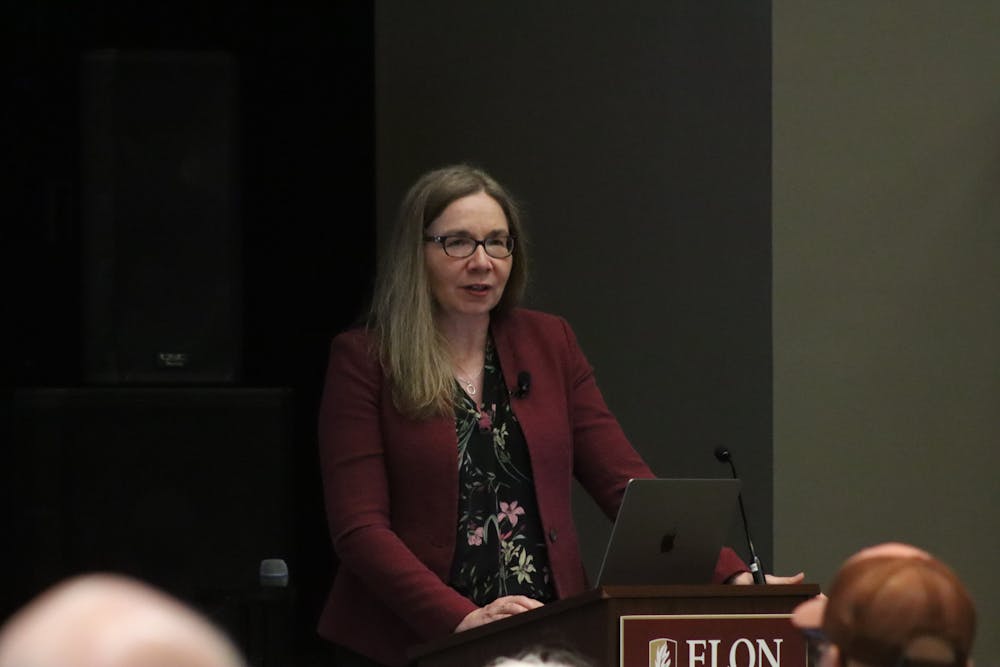
Katharine Hayhoe, chief scientist for The Nature Conservancy, did not let the post slide, she said during her Earth Week keynote at Elon University in McKinnon Hall on April 22.
“‘What am I willing to do?’” Hayhoe said. “Hold you accountable for 2% of all the world’s global emissions, equivalent to those of my entire home country of Canada.”
Hayhoe’s response underscores a central theme of her presentation. While individual lifestyle changes are important, she said, they are often used by large corporations to shift the burden of guilt onto the consumer. According to Hayhoe, 90 corporations are responsible for 60% of emissions since the beginning of the Industrial Revolution.
The climate scientist and professor at Texas Tech University moved away from traditional statistics, instead using a simple metaphor to explain the current state of the environment. She described the Earth’s atmosphere as a natural protection that has been altered by humans.
“By digging up and burning coal, gas and oil, we are wrapping an extra blanket around the planet,” Hayhoe said. “It's heating up.”
Hayhoe said that while a 2-degree Fahrenheit increase might seem negligible to some, it can be compared to a human body running a fever. Over the course of human civilization, the planet’s temperature has been as stable as a healthy body. Now, that stability is fracturing into what Hayhoe calls global weirding.
“Is the weather getting weirder? I have not had a single person say no,” Hayhoe said. “Our heat waves are coming earlier, lasting longer and are more intense. Our dice are being loaded.”
To combat the unconcern that often follows climate discussions, Hayhoe introduced the concept of a climate shadow rather than a carbon footprint. While a footprint measures what you consume, a shadow measures how you influence the world around you through your job, your conversations and your community involvement.
She noted that while 63% of people in the Carolinas report being worried about global warming, the vast majority remain silent. She said they rarely discuss the topic because they feel hopeless.
“The most important thing an individual can do is have a conversation about why it matters and what we can do,” Hayhoe said. “We are the people who changed the world before, and we’re the people who can change it again.”
The event served as part of Elon’s Earth Week celebrations. Provost Rebecca Kohn opened the evening by announcing that Elon University recently earned its eighth STARS Silver rating, a national measure of sustainability achievements in higher education.
Kelly Harer, associate director of sustainability for education and outreach, emphasized that these conversations are vital for students preparing to enter the workforce, regardless of their major.
“We have to talk about sustainability and the climate crisis for other people to be activated and interested,” Harer said in an interview with Elon News Network.
Harer said that whether a student is pursuing a career in marketing or business, there is a way to connect those roles to the environment.
“There’s sustainability in all jobs, in my opinion,” Harer said.
For students looking to extend their climate shadow on campus, Harer pointed toward the Sustainability Stewards program and the Eco Reps, who work to integrate sustainable practices into daily campus life.
“Hope is all around you,” Hayhoe concluded. “And when you find it, share it with other people, because that is how the world has changed before.”