

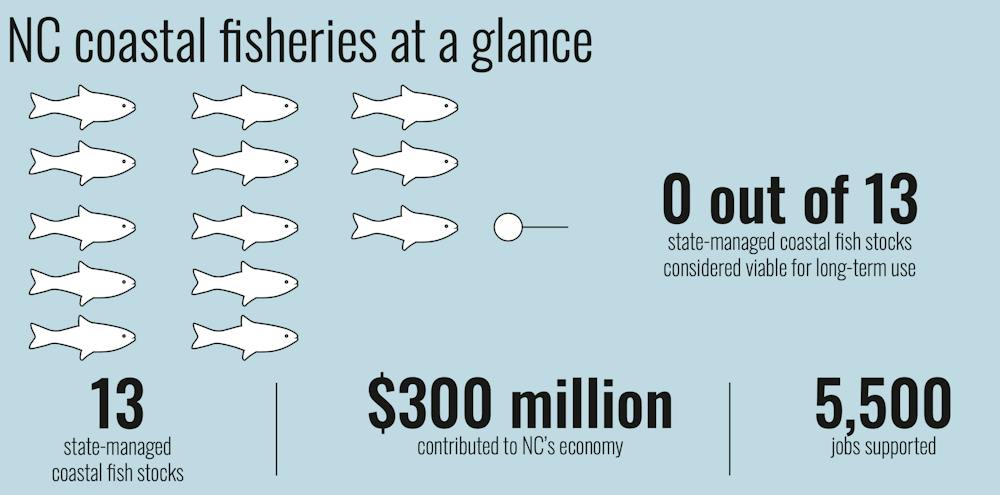
North Carolina failed to protect the state’s coastal fisheries, according to a state superior court ruling. None of the 13 state-managed coastal fish stocks are viable for long-term use.
Judge Brian Collins ruled in favor of the Coastal Conservation Association of North Carolina following a six-year lawsuit. According to the court’s ruling, the state mishandled the coastal fish stocks and caused depleted populations of southern flounder, shrimp, speckled trout and more.
The nonprofit organization and 86 citizen plaintiffs filed the lawsuit in 2020, saying the state has a legal responsibility to keep fisheries healthy over the long term. Plaintiffs said overfishing and methods like shrimp trawling contributed to lowering coastal animal populations.
Fisheries need to maintain a strong habitat and population in order for them to be healthy. If the habitat is damaged, fish can’t hide from predators and the population will decrease. If the population gets too low or too high, it can decrease the reproduction rate of the species.
According to North Carolina Sea Grant, in 2021 North Carolina's commercial seafood industry contributed around $300 million and 5,500 jobs to the state’s economy.
Joel Fodrie, director of the Duke University Marine Lab, recently led a study on the current state of North Carolina fisheries and how the state can improve fishing stocks. Fodrie said that while the state has the tools and management needed, one point of discussion is figuring out how to apply these resources for the future.
“Over the scope of the data we could bring to bear, it’s a system that’s just always changing and evolving,” Fodrie said. “You’re trying to manage towards what appears to be a very, very, very moving target.”
Mike Kingston, Elon University professor of environmental studies, said that shrimp trawling directly impacts the habitat and environments of the coast.
“They’re destroying a lot of the three-dimensional structure of the bottom,” Kingston said. “Oyster reefs are being impacted, and soft coral reefs and other organisms that live on the bottom are being impacted by this trawling.”
According to the North Carolina Wildlife Federation, North Carolina is the only east coast state to allow inland shrimp trawling. The General Assembly introduced a bill in March 2025 with measures to ban inland shrimp trawling. The ban was met with large opposition from North Carolina fishers, and House Republicans dropped the measures from future iterations of the bill.
Collins ordered attorneys from both sides of the case to meet and submit a joint report with future considerations. This joint report will determine a timeline for the remedy phase, potentially deciding what changes are made to fishery policies. Kingston said he’d like to see the state implement no-take areas, parts where fishing is not allowed in any capacity, to allow fish populations to regrow at their own pace.
“When the fish are reproducing in those no-take areas, when they get large enough where do you think they go?” Kingston said. “Do you think they stay in there or do they go elsewhere, they say ‘I’m going to go elsewhere.’”
Fodrie said a survey he conducted found many recreational and commercial fishers were unsatisfied with state management’s transparency, and state management was unsatisfied with low engagement from fishers. Fodrie said that while this ruling is a step forward, he hopes people see it less as an ending and more as an opportunity for cooperative growth.
“I think the real key thing is what happens now,” Fodrie said. “If we find a process that comes out of this to generate more high quality data that can feed into wise decisions, I would hope that many people would be very open-minded to that being a real positive.”