

The Rockefeller Integrated Hotel stood on Burlington’s Maple Avenue before being demolished a few weeks ago. Created by McBride “Mack” Thompson, a prominent African American entrepreneur in the Jim Crow South, the hotel was both his home and a place for Black travelers to stay somewhere safe. A single box of papers was recovered from the demolition site by a neighbor.
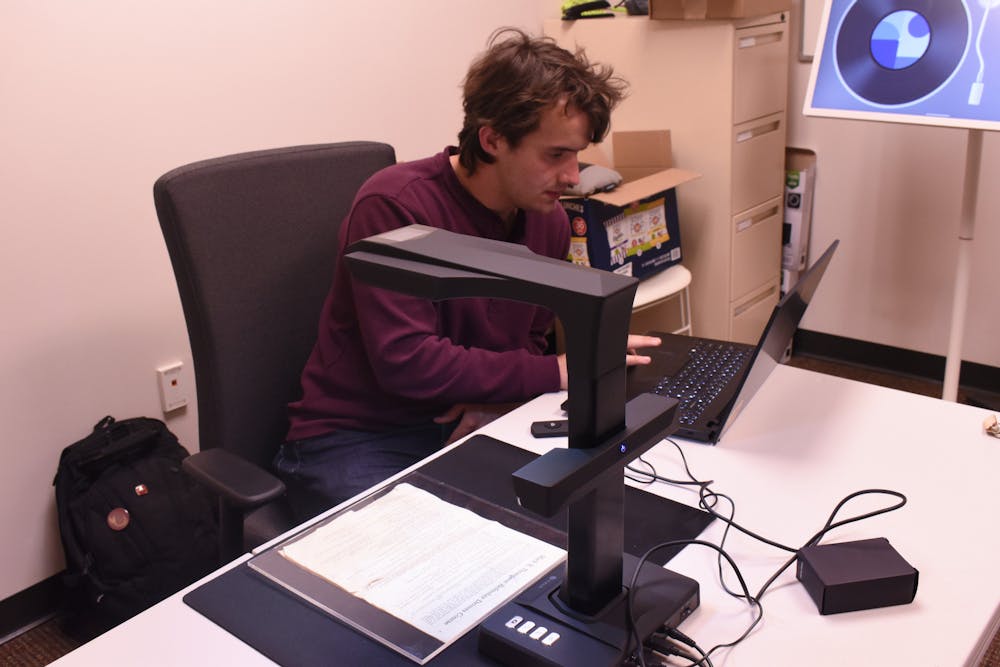
Marshall Sears, a sophomore researching African American entrepreneurship in Petersburg, digitizes documents including those found in the demolition, as a part of his undergraduate research. Petersburg, a neighborhood in Burlington and is the focus of Sears’s research due to its local significance and its rich history of African American entrepreneurship.
“I had the opportunity to research real American history, and not only that, but real old local history that’s impactful to the local community and means something to a lot of people on an individual scale,” Sears said.
Sears said his project has evolved since it has started. Originally, he had focused his attention on the demolition of Mack Thompson’s hotel.
Thompson was a boxer and owned a hotel, nightclub and dance hall. He even provided private driving lessons to promote his used car business.
“The fact that he had so much impact on his community, and say and sway, was really incredible,” Sears said. “He seemed to be this real central figure, particularly in the Petersburg community.”
Sears used data collection and synthesis to build the narratives of historical figures. He did this by looking through old newspapers from the 1900s into the late 1960s.
Sears previously used a newspaper archive, however experienced a “hiccup” in his research when it crashed. To continue working, he had to change his methods of data collection. He used city phone books and ’50s and ’60s research papers. Sears also started to reach out to local community leaders such as James Shields.
Shields, a manager at the African American Cultural Arts and History Center in Burlington, said studying African American entrepreneurship was important to shedding light on their success stories.
“It goes against a narrative out there that maybe African American communities did not and do not have entrepreneurs,” Shields said.
Sears has now expanded his search to look at more entrepreneurs.
John and Dorothea Bahadur also owned a nightclub in Petersburg, like Thompson. Sears said that during the ’50s, the city of Burlington expanded roads through Maple Avenue, an example of systemic displacement, which meant the city took people’s property for public use. Dorothea did not stand for this.
“She hugged herself to a tree and had to be forcefully pried from the tree and was arrested,” Sears said. “It was really great because it’s this person who’s obviously connected with business and entrepreneurs, who’s standing there for her community, even though she put herself at great risk at losing those things.”
The researcher said he finds the work stressful, but a very fun challenge.
“In some ways you have to be a detective,” Sears said. “It’s super cool, like one of those 1950s noirs. You’re drinking a cup of white coffee at a diner, kind of detective.”
But more than that, Sears said he hopes his research inspires people to take care of their local history.
“Support local history like the library in downtown Burlington who does not have a local historian,” Sears said. “They don’t have enough money to hire one, which is really unfortunate.”
Shields emphasized the importance of this sentiment, especially in cases such as the Mack Thompson house demolition.
“Whoever purchased the Mack Thompson house either had no idea about the historical significance, or maybe they just didn’t care,” Shields said. “I hope that Marshall’s research will shed some light on that and will encourage people to be more careful with our history.”