

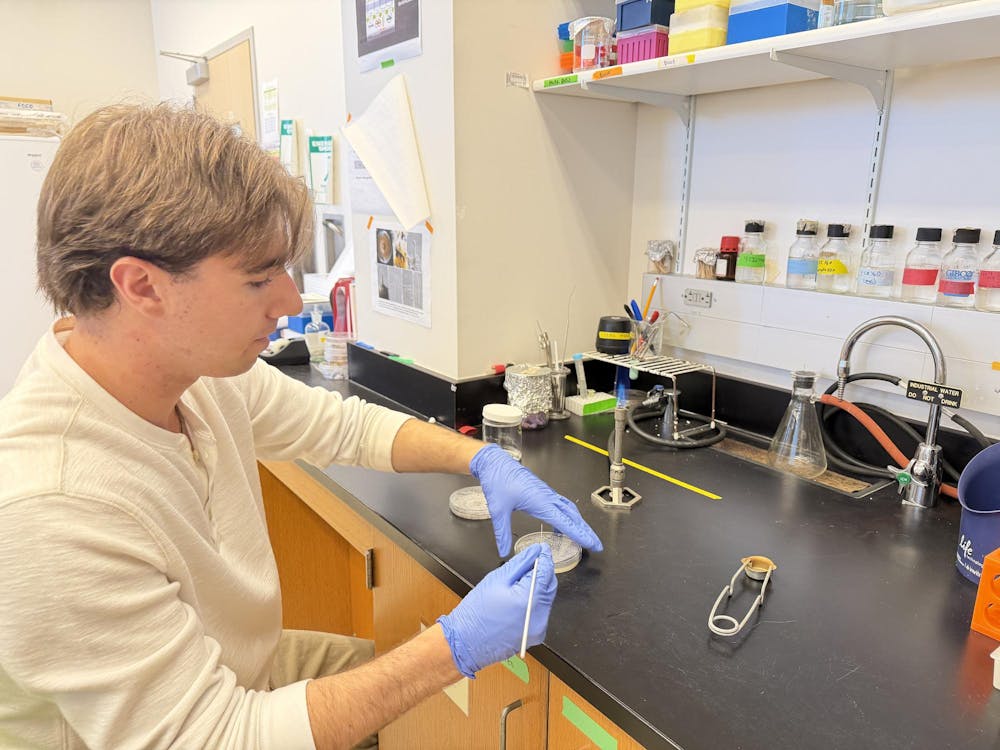
During his freshman year, now-senior Billy Impagliazzo took two classes taught by biology professor Antonio Izzo. When he got to Elon, Impagliazzo said he knew he wanted to take part in research projects. In his sophomore year, Impagliazzo went to Izzo to discuss research opportunities he had in his lab.
Izzo said he believed Impagliazzo would conduct research for only a semester, but almost three years later, Impagliazzo has identified the main microbe infecting the blue curls plant and has presented his research on SURF Day.
“Just do a small project and see what happens,” Izzo said. “It kind of turned into a 2.5 year project because once you get through one, there's the next new question.”
Impagliazzo said the blue curls plant is usually planted in a garden because of its aesthetics, but also serves as a source of nectar for pollinators and as a medicinal herb in East Asia.
If the fungal disease were to be left untreated, Impagliazzo said those who grow the blue curls plant will be impacted.
As many research projects begin, Impagliazzo’s started with an observation. The blue curls plant is commonly a garden and decorative plant, and was observed dying outside of one of Izzo’s colleagues' gardens. He said his colleague had never seen the fungal growth before and brought it to Izzo.
The research initially revolved around trying to understand what fungus was causing the disease in the blue curls plant. Then, isolate and identify the fungus from the diseased plant. To do this, Impagliazzo had to isolate the microbes on the infected plant and put them into culture — which isolates each fungus and allows it to grow — before infecting healthy plants with the individual fungi.
“We basically just did a bunch of science stuff, like DNA isolations and gel electrophoresis, all these fun microbiology processes just to extract all these different kind of fungi that were residing on the plant, and basically using these postulates to figure out which of these fungal diseases is actually causing infection on the plant,” Impagliazzo said.
Impagliazzo said he goes to the lab once a week for a few hours to conduct different experiments. Impagliazzo described a typical day in the lab as doing a PCR application amplification. This creates thousands of DNA samples, which he will take to run a gel electrophoresis to compare the different bands of DNA. Then he will run the DNA across the gel to distinguish if the species of fungus matches with other fungi he has been working with.
“Once that's done, I'll annotate the gel, see if it matches up with our previous results and everything else we've been working with,” Impagliazzo said. “Then, if yes, on to the next step. And if not, we'll have to run it back again the next day or the next week.”
Impagliazzo said when he first started to work in the lab, Izzo was there to help guide him and get used to the equipment and procedures in the lab. Since he only goes into the lab once a week, Impagliazzo said it took until this year for him to feel fully acclimated.
“Once you get the hang of it, that is when you start spreading your wings,” Impaggliazzo said. “You just come in by yourself for a few hours and it’s kinda nice, cause you get the whole lab to yourself and it makes you feel like a little mad scientist.”
This past summer, Impagliazzo took part in the Summer Undergraduate Research Experience. An eight week research program on-campus which allowed him to work more intensively on his research.
“That was when we were infecting the plants and we were waiting for them to actually develop those disease symptoms,” Impagliazzo said.
Impagliazzo said this allowed him to gather data and classify the infection and causes of the agent.
Impagliazzo originally expected the disease to stem from diaporthe goulteri. Through his research, Impagliazzo has identified the main pathogenic fungus infecting the blue curls plant, dionophorseta acuta.
“It's definitely a newer subspecies of the fungus that is affecting these plants, and it's not very typical for this plant species interaction,” Impagliazzo said.
Impagliazzo has presented his research during the last two SURF Days, and this year his presentation will be the culmination of the entire research process he has taken on since his sophomore year.
“This upcoming SURF spring is going to be the whole story,” Impagliazzo said. “Why it started, how it started, the steps from my sophomore year, junior year and the findings that we eventually came to the conclusion on during these last couple semesters.”
Izzo said he believes the research project will have reached its endpoint after Impagliazzo graduates in May.
“It’s one that has wrapped up nicely within the timing of his time here,” Izzo said. “I think that maybe was part of what inspired him to want to keep rolling with it.”