

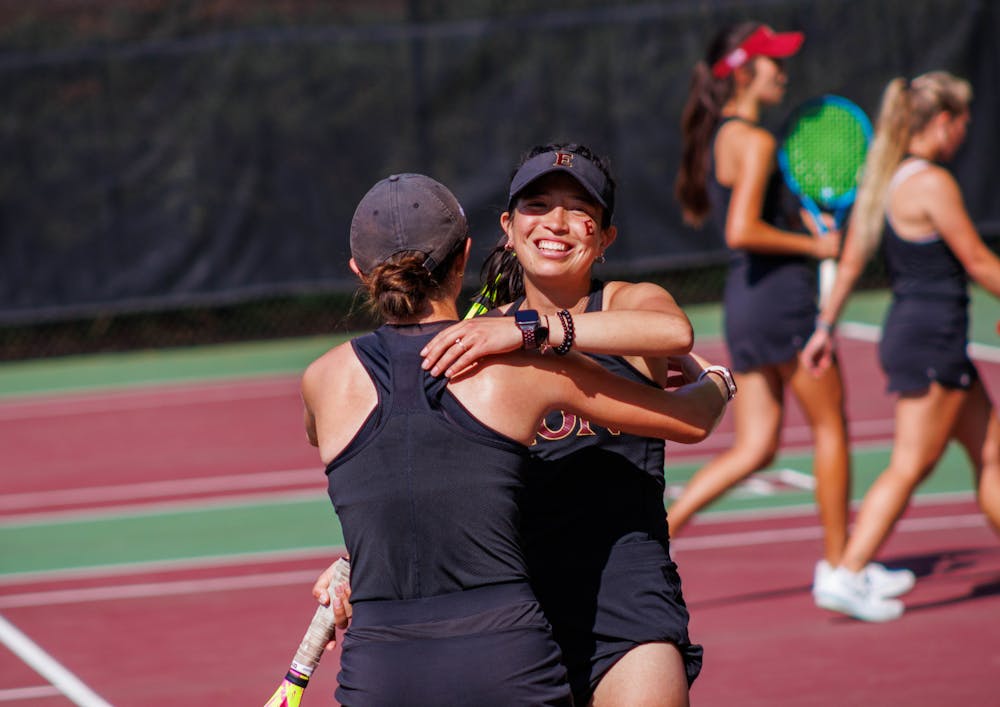
As junior Mariana Reding was preparing for her serve, she first checked in with fellow junior and longtime doubles partner Simone Bergeron.
“Here,” Bergeron asked. “And here?”
Reding nodded, affirming Bergeron’s suggestion. The small gesture was enough. Bergeron called for a kick serve out wide.
The plan worked. Reding served outside, moving her opponent off the court. Bergeron pounced on the shallow angle the team got in response, forcing their opponents to hit a weak return.
Reding had an easy volley to finish off the point. She missed it.
But walking back — it’d be hard to tell. Instead of screaming or crying, Reding laughed.
That laughter, it turns out, is not incidental. It’s foundational.
Now 14-4, as of April 14, and heading into the postseason as defending Coastal Athletic Association champions, head coach Elizabeth Anderson said Elon’s success goes far beyond wins and losses. To her, it’s about togetherness.
“We play as a really good unit as a team,” Anderson said, emphasizing the importance of playing with a collective energy. “We just do a great job of using the momentum in these important matches.”
As a coach, Anderson said she knows the importance of players feeding off one another’s energy. She encourages her team to practice “being loud” during warm-up routines before matches.
Fans see that practice pay off on gameday. When senior Madison Cordisco is on a roll, the entire complex knows it. Not just because of her play, but the emotion that follows.
“Let’s go” was a common scream heard from Court 6 on Elon’s senior day, April 11, as Cordisco played her final match at the Jimmy Powell Tennis Center. The high-pitched, instantly recognizable noise is almost like an anthem for the Phoenix.
Cordisco’s teammates quickly fired back, yelling, “Let’s go, Mads” while simultaneously focusing on matches of their own. When prompted about Cordisco’s impact, Anderson almost seemed like a proud parent.
“She has been extremely dedicated to our team over the past four years,” Anderson said. “I’m really proud of what she’s accomplished here, and you can see her impact on the team.”
Even when points slip away, the response doesn’t. Energy, in fact, is treated almost like a tactic. The team makes it a mission to sprint to the court after the opening coin toss.
“If you see us, and we’re not energetic, something’s off,” Reding said, laughing. “We cannot even play at that point. Energy is everything.”
After two seasons together, Reding and Bergeron’s chemistry borders on automatic. Bergeron describes it as a “fluid” rhythm where each player anticipates the other’s next move. Reding said at this point, it’s second nature.
“It’s just super normal to me,” Reding said. “I feel like we can really chill. Her mind, she knows what I’m doing, and I know what she’s doing.”
That familiarity generates freedom that’s rare in competitive tennis. Instead of tightening up, they swing freely. Missed shots aren’t met with frustration, but encouragement. Sometimes even laughter.
“If we’re making the right moves and doing the right things and it doesn’t go our way, that’s a good choice anyway,” Bergeron added. “It’s going to pay off in the end.”
It’s the same message Anderson has emphasized all season. Mistakes happen, but they’re part of the rhythm, and it’s the response that matters.
The result is a culture where positivity isn’t forced. It’s practiced. Bergeron called it part of the team’s “brand,” which is felt by both the Phoenix and their opponents.
As Elon heads into the CAA tournament, Coach Anderson shared a similar message with her team.
“Just keep remembering to enjoy playing together,” Anderson said in the post-match huddle. “We’ve got a good week to practice, and just need to focus on doing everything to get better each day.”
Or, as Bergeron put it: “Go have some fun.”
Because for this team, a missed shot isn’t the end of the point. Sometimes, it’s the start of a laugh.