

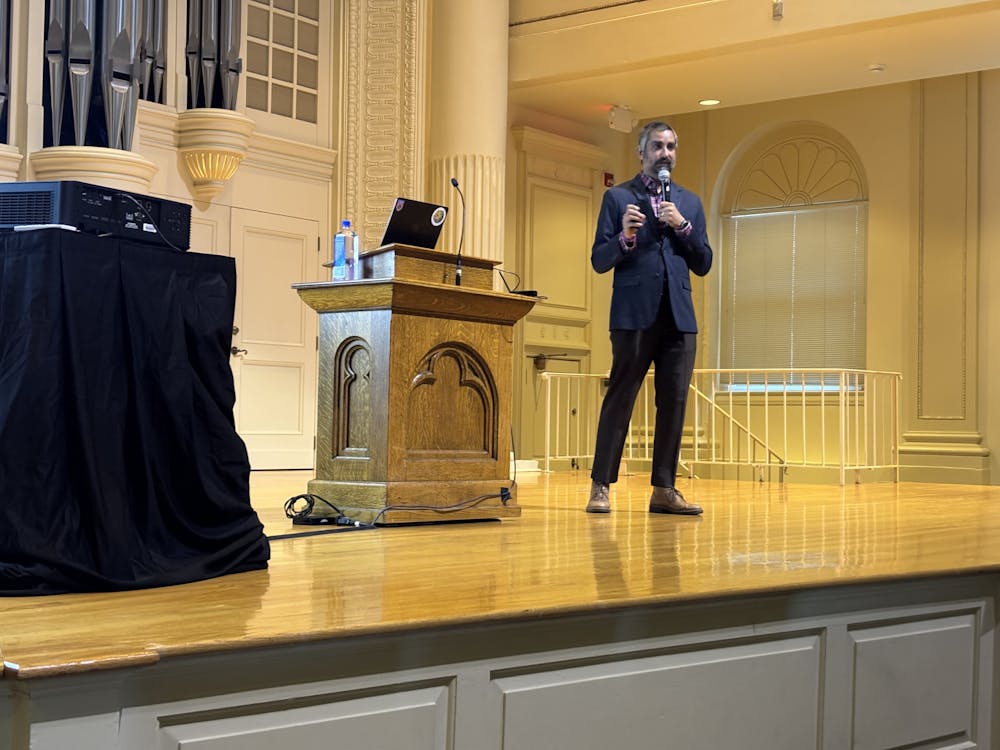
Director and curator of fishes at the Museum of Natural Sciences at Louisiana State University Prosanta Chakrabarty demonstrated the importance of evolution by sharing tests done for his own colon cancer diagnosis, which he is still undergoing treatment for.
“The way cancer evolves looks very much like the same way organisms evolve and populations evolve,” Chakrabarty said early in his speech.
Chakrabarty, who has a Ph.D in ecology and evolutionary biology, addressed the Elon community about the importance of teaching evolution April 16 in Whitley Auditorium.
Elon sophomore Jackson Irizarry said he heard about Chakrabarty’s speech from a professor. The biology major said he plans to go into radiology and that he appreciated the speech.
“He highlighted a lot of undergraduate research, which was really unique,” Irizarry said.
Irizarry also said Chakrabarty did a good job connecting his different topics — which included cancer, fossils and the hip bones of fish.
Chakrabarty used each of these topics as examples of evolution and tied them back to how he thinks it should be taught.
Chakrabarty argued that textbooks need to draw graphs differently.
“When people see this,” Chakrabarty said, showing an image of a monkey becoming an ape and then a man, “They think this is progression, and they think humans are the goal of evolution when it’s not.”
According to Chakrabarty, the belief that evolution progresses toward an end goal can lead to something far more insidious: discrimination.
The solution, Chakrabarty said, is changing the way the graphs are drawn. This, he said, will make it harder to misconceive evolution as having progression.
Chakrabarty ended his speech by showing how some chemotherapy treatments were derived from studies of the Madagascar periwinkle flower and the Pacific Yew tree.