

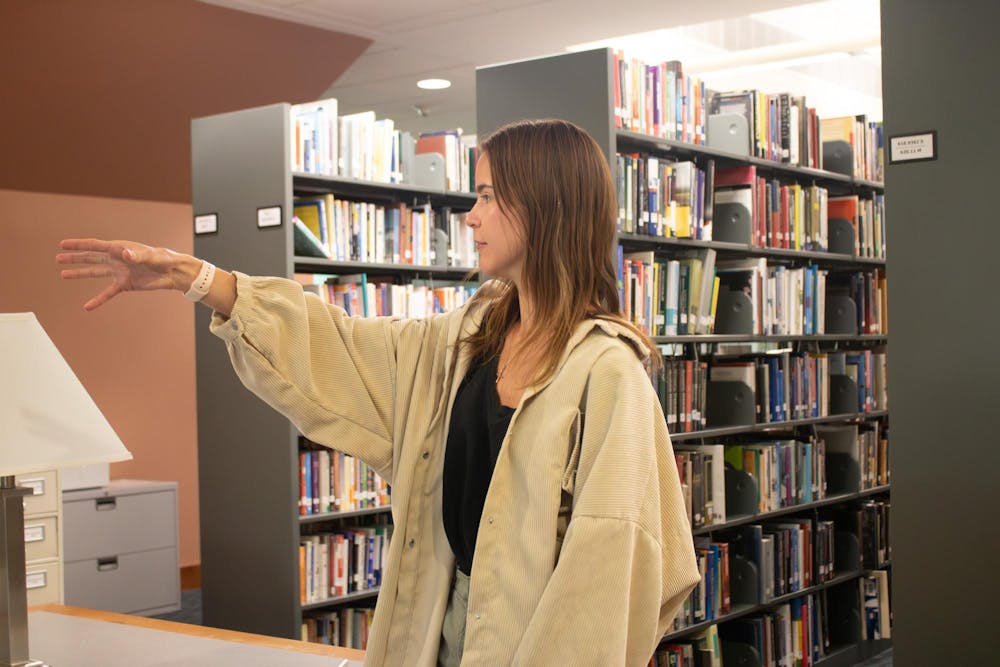
Over the summer of 2026, Elon’s Carole Grotnes Belk Library will create two new neuroinclusive spaces to better support diverse learning needs, building on the success of two classrooms in Lindner Hall that have been in use throughout the school year.
These spaces are a result of research conducted by students: senior Kira Campagna, junior Benjamin Krasnow, and junior Kaz Kelly, who are studying what makes a classroom accessible and effective for all learners.
For Campagna, a senior elementary education major, the project stood out because it made a real-world impact.
“We all really gravitated towards this research project, particularly because we saw how it could be implemented and actually put into effect at Elon and on Elon's campus,” Campagna said.
The research originated through the Center for Engaged Learning, where students and faculty collaborate on long-term research seminars. According to Jessie L. Moore, the director of the center, student research and evaluation play a key role in shaping the work.
“The student members are always really good at making sure that the student experience is centered in the research,” Moore said.
The research focused on designing spaces that support neurodivergent students, those whose learning and processing styles differ from traditional expectations. However, both students and faculty members involved with the research emphasized that these changes benefit all learners.
Krasnow, a human service studies major, equates the effect of their research to the analogy of “a rising tide lifts all boats.”
“When we help support a marginalized group of people, it helps everybody else as well,” Krasnow said.
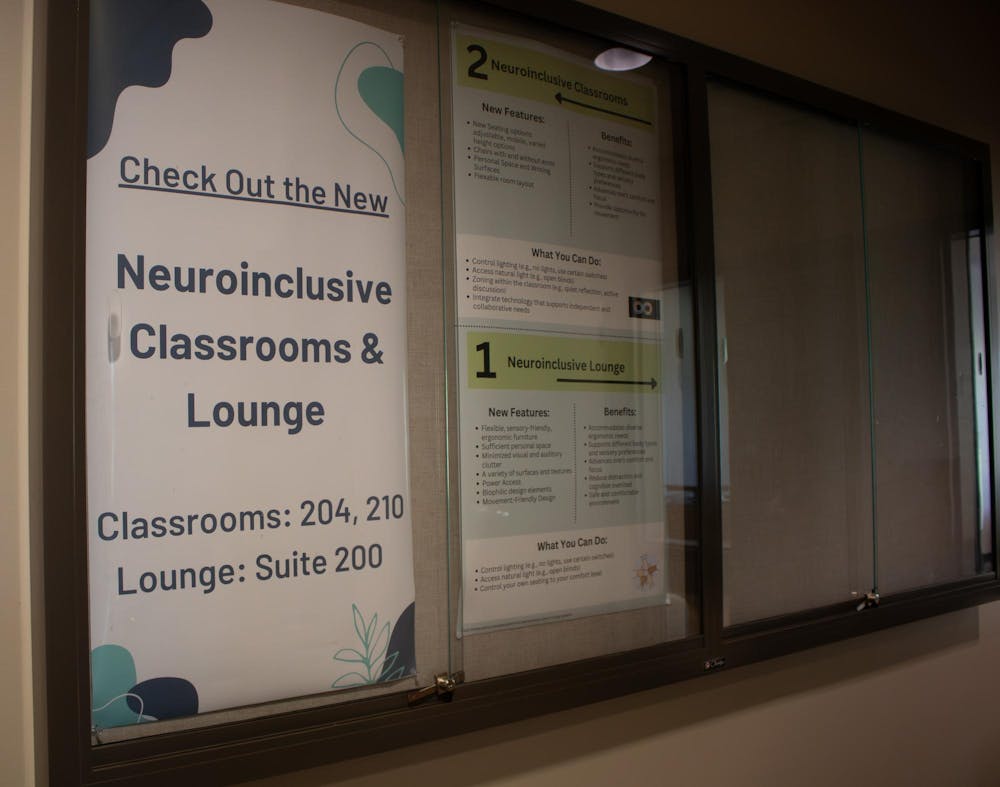
The project began with redesigning two classrooms on the second floor of Lindner Hall, incorporating flexible seating, calming colors, and movable furniture.
The researchers gathered student feedback following the creation of these spaces by conducting surveys and making observations about what strategies worked best. The results are guiding the next phase of their project, which will include two new neuroinclusive spaces in Belk Library.
When completed, the library spaces will include adjustable lighting, varied seating arrangements, and clearly defined zones, allowing students to understand areas that are meant for silent studying or group work.
Campagna said features such as large windows that provide natural light, paired with the ability to control brightness, were especially important, according to the study's findings.
“Fully fluorescent lights can give people headaches and frustrate people very easily, deterring them from working in the library,” Campagna said.
Beyond physical comfort, the design considers psychological factors. Moore said students should be able to quickly understand the intended use of a space.
“Is this a space where I’m supposed to be quiet? Is this a space where I can fidget a little bit more?” Moore said. “Those cues really matter.”
Near the classrooms that have been tested on the second floor of Lindner, there are clearly laid out signs allowing students to have an understanding of what each space is meant for and where certain actions are appropriate.
The project was highly collaborative and involved faculty, students, campus staff, and external partners. Through workshops and focus groups, the team gathered input from both neurodivergent and neurotypical students to ensure the spaces feel inclusive for all students.
While Campagna will graduate before the project is fully completed, she is excited for the success of her teammates as they see the project through to completion.
“I was a little sad that I wouldn’t see the full end of it, but I’m glad to be a part of it,” Campagna said.
Looking ahead, Krasnow said he hopes to study how students use the new spaces and expand their findings beyond Elon. Krasnow said there is limited research on neuroinclusive design in higher education, making their work particularly significant.
“Hopefully, if everything goes well and our research continues, other universities, other schools, other areas that have common spaces and classrooms can take what we've learned,” Krasnow said.
All three student researchers, along with the associate dean of Elon College, will share their findings as the keynote presenters at the 2026 Conference on Engaged Learning this summer.