

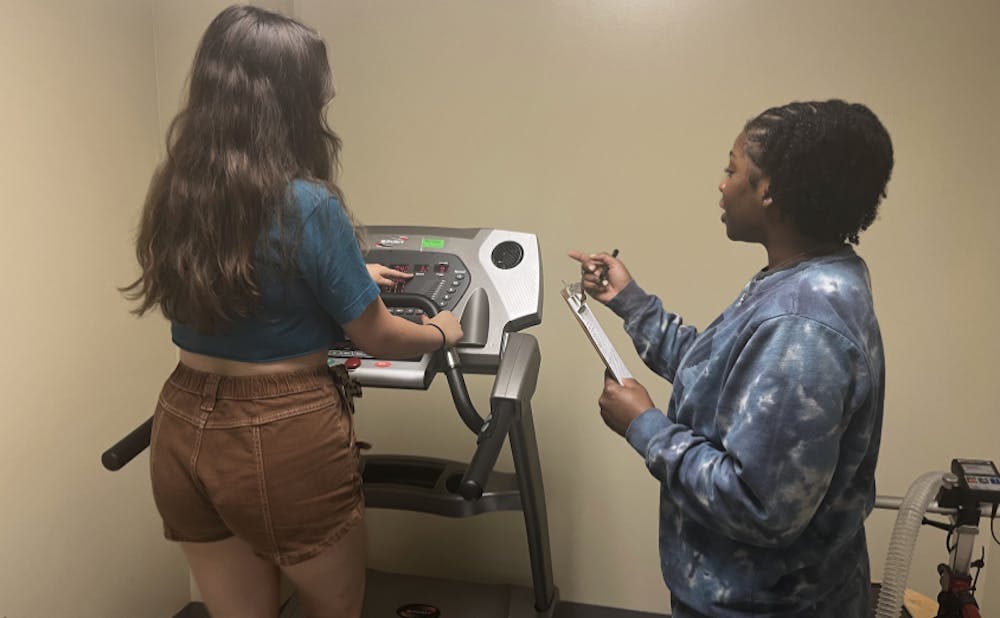
For Asia Green, a senior exercise science major at Elon, being curious about undergraduate research evolved into something more: a nationally recognized research project exploring the coaction between mindset, movement, and outcomes.
Green traced her initial spark of inspiration and interest in the field of undergraduate research back to her sophomore year, when she first attended the Student Undergraduate Research Forum. The forum exposed Green to student-led research that produced meaningful, real-world impact. From there, she said, she sought out mentorship to get started.
“Seeing a range of health science projects helped me understand how research connects to real-world outcomes,” Green said.
Green was set to present her work this spring at the National Conference of Undergraduate Research from April 13-15 in Richmond, Virginia.
“I stayed motivated by reminding myself of the purpose behind my work,” Green states while explaining how she stayed positive and motivated throughout the process.
Her research project is titled “Exercise Expectations: Can the Placebo Effect Boost Exercise’s Effects on Mood and Cognition?”.
Green said she began by reviewing existing studies on exercise psychology, mood regulation, and cognitive performance to better understand what researchers had already discovered — a crucial step in understanding what’s already given versus what we can further discover.
“It focuses on how a person’s expectations about exercise can influence their mood and cognitive performance, beyond the physical benefits,” Green said.
This research topic bridges exercise science, psychology and cognitive health into one measurable and ongoing project, according to Green.
Her research questions how mindset can influence exercise and was composed of two groups in an experiment: a control group and an experimental group that tested various aspects of the participants. Green said it took some time to narrow down the official research questioning whether the placebo effect can boost the effect of exercise on mood and cognition.
Asia Green and her mentor, Madison Chandler, first approached the topic through reviewing literature and exploring different ideas.
“I was able to work with Dr. Chandler, and through reviewing literature and exploring different ideas, we identified a gap related to placebo effects in exercise. This led to the development of my current research topic,” Green said.
Luckily, Chandler and Green were able to find students studying on campus over the summer willing to participate, but this meant their population was slimmer than usual.
“We started collecting probably at the beginning of the summer because we did some pilot participants,” Chandler said. “It was cool for me as her mentor to see it go from this abstract flow chart of what ‘will we do?’ to like an actual person participant with actual research. She’s very gifted.”
When Green and her mentor were finally able to successfully recruit participants for the study, an aspect of research that people sometimes overlook, the project began to feel “real.”
“Probably the hardest part of any study that uses human subjects, I would say, is recruitment,” Chandler said.
However, Chandler emphasizes the fact that Green was especially good at gathering interest across campus and urging people to participate.
“She is very good at interacting with people,” Chandler said.
Working with human subjects taught both Green and Chandler the realities of this type of research, helping them realize that outcomes are rarely as clear-cut as they first seem.
“You learn lots of skills, and honestly, it teaches you because people will cancel and they won’t show up, stuff like that will happen,” Chandler said.
Another breakthrough came when Green moved into data analysis and recognized that the study had meaningful results to present after months of reviewing literature and continuing to work with.
The data from the study were meaningful because Green focused on proving how a person’s expectations about exercise can influence their mood and cognitive performance, beyond the physical benefits.
“The information that we’ve uncovered through these lines of research about how good exercise is for the brain is pretty well established,” Chandler said. “But don’t think it’s as well known among the average population.”
Chandler emphasized that, no matter the outcome of the study, their impact on awareness about the cognitive benefits of exercise can still be very meaningful.
“Even if it doesn’t improve their performance or anything. Even just spreading awareness of the fact that it’s something that we sort of take for granted. Sometimes, people actually don’t know as much as we think they do,” Chandler said.
Chandler, an associate professor for exercise science, said she continues to learn new things through undergraduate research, even though she has participated as a mentor many times before throughout Green’s project. Chandler said she wants to spread awareness about the benefits of exercise and said that through her and Green’s work, they were able to do just that.
“Maybe people aren’t as familiar as we think that they are about how exercise can be used as a tool to improve your mood and improve your cognitive function, reaction time, and focus,” Chandler said.
Green’s story started early when she attended SURF, but for many, the world of undergraduate research can be intimidating and hard to get started in.
“Put yourself out there and do not be afraid to ask questions. Find a mentor who supports you and shares your interests. Be open to learning,” Green said. “Starting is the most important step, even if you do not feel fully prepared.”