

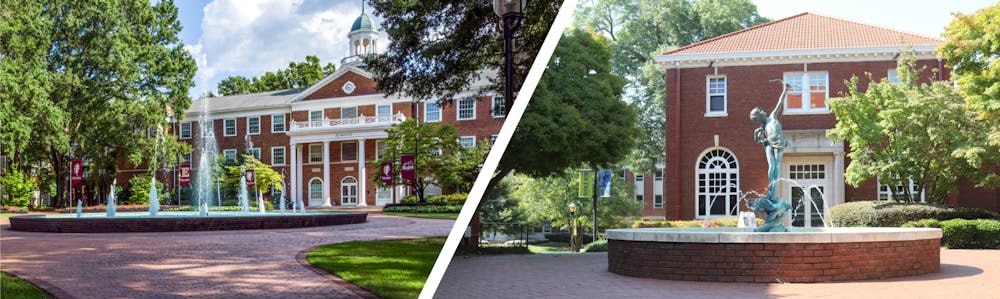
Amid a turbulent era full of increasing college closures and pressure from the Trump Administration, the Elon University-Queens University of Charlotte merger may be a survival tactic in an unforgiving higher education climate.
Matt Hartman, a higher education reporter for The Assembly, described the merger as a "survival move” for Queens.
“They've sort of been in a financially precarious position for a while, and they really needed some help, and Elon was a great partner for them in that way, because Elon has been thriving for the past 10 or 15 years,” Hartman said.
Hartman said that despite this, he also thinks the merger is a way for administrators to secure Elon’s future, because he said their finances have been solid, but that they have weakened a little bit over the last few years.
The merger, which was announced in September 2025, is in its next steps currently as an integration team works to guide the next phase of the merger after a definitive agreement between the two universities was finalized in December.
But the merger comes at an uncertain time for higher education. According to data compiled by the Hechinger Report, 28 institutions closed in the first nine months of 2024, an increase from 15 during 2023. From 2008 to 2011, only seven colleges and universities shut down each year but by 2018, it had reached an average of 32 closures. Bloomberg reported in 2025 that a decreasing number of prospective students will lead to as many as 370 private colleges to close or merge with another institution in the next decade, according to Huron Consulting Group.
Part of the rise in closures can be attributed to the incoming “demographic cliff,” the decreasing supply of college students from a falling national birth rate that began in 2007. Hartman said the impending arrival of the demographic cliff is on the mind of a lot of people who are involved in the finances of colleges, and that it is shaping how much risk they are willing to take with colleges that have financial difficulties.
Laura De Veau, a consultant at Higher Ed Consolidation Solutions with an expertise in closures, said deferred maintenance is also a factor in colleges closing. Deferred maintenance is the process of delaying certain infrastructure repair projects due to budgetary constraints, and De Veau said it is hard to find a way to pay for these and that they start to stack up as tens of millions of dollars of deferred maintenance.
“Those are all very unsexy things to fix,” De Veau said. “You're not going to be able to find a donor who's like, ‘Yeah I’ll pay to fix the roof.’ They want to put their name on a fancy building, right?”
Discount rates — or the tuition revenue given back to students as scholarships — are also factoring into the financial difficulties schools are facing. De Veau said that because enrollment is down, schools are forced to highly discount and offer higher scholarships and grants to get students to come to their school, depleting their revenue.
Hartman said that this trend of closures could be a cause for the Elon-Queens merger. Queens’ enrollment dropped by 13% between fall 2024 and fall 2025. In the 2023 fiscal year, Queens lost $20 million. The university has been drawing from its endowment to make up for losses since the pandemic. Elon, who saw enrollment decrease by more than 11% in 2025, is using the merger to find new sources of revenue, according to Hartman.
Hartman said the merger allows Elon to gain its foothold in Charlotte, an underserved market.
“We're in this place where competition for students is going to increase in the future and financial constraints get tighter, colleges are looking to sort of invest in different kinds of ways and capture different kinds of markets,” Hartman said.
Elon has been strengthening its influence in Charlotte since 2023 with the opening of its regional center in South Center that houses the university’s Law Flex program and Sport and Community Experience academic program. The physician assistant program will now be placed in Charlotte with its first class starting in January 2027. In early 2026, Elon announced plans to establish a full-time law program in Charlotte.
Hartman said this expansion also has its drawbacks.
“There's a bit of a tension, right? Especially for someplace like Elon, which has this reputation as a really great teaching school, really hands-on,” Hartman said. “You get connections with professors and mentors and that sort of thing. Once you start opening up lots of campuses or expanding too rapidly, it's really hard to sort of maintain that, or at least it's a challenge.”
De Veau said she believes that schools under 3,500 students are at serious risk, but said this removes that small-school environment that lots of students enjoy.
“By those institutions being wiped out, there's a population of students who don't really feel like they fit. So that's a concern for me,” De Veau said.
As more and more schools begin to close or merge in this unfragile environment for higher education, De Veau said university leadership needs to stay true to the college’s values.
“My advice to anybody who is in that suite of leadership is that you lean into your mission and you know your mission is unique to your institution,” De Veau said. “We have to be unapologetically in line with our mission, and if we need to find a partner to support our mission, be open to that partnership.”