

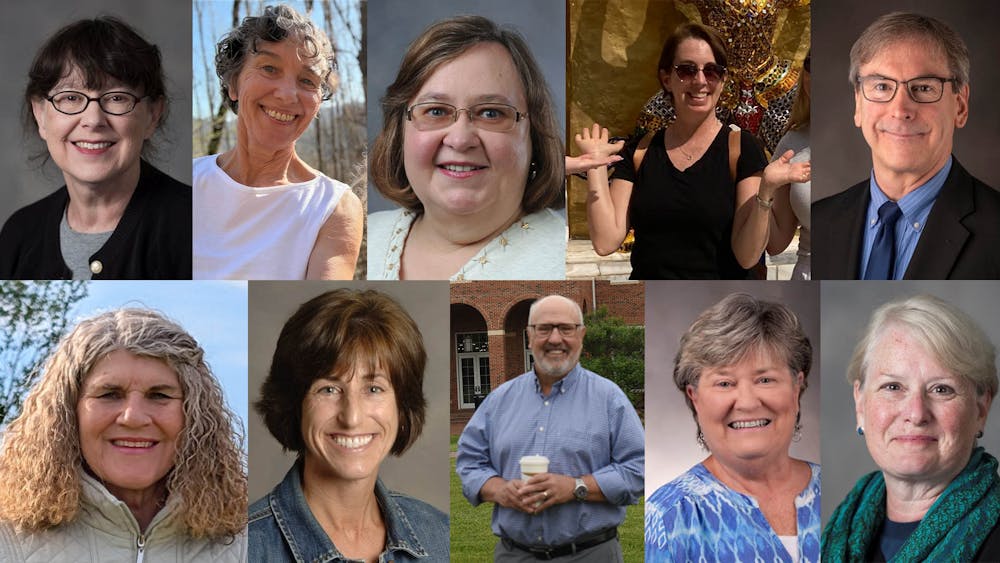
Sharon LaRocco
University accompanist and instructor in music Sharon LaRocco said she has been building her love of music since she was three years old, playing songs by ear, and that joy she found has carried her through 37 years in Elon’s music department.
LaRocco witnessed the Fighting Christian mascot graduate with the class of 2000, giving way to the current Phoenix mascot.
After nearly four decades, LaRocco said she is proud of how much the music department accomplishes despite being one of the smaller programs at Elon.
“What is amazing is how much the music department puts out, how much they service this university, the community,” LaRocco said. “Amazing, amazing.”
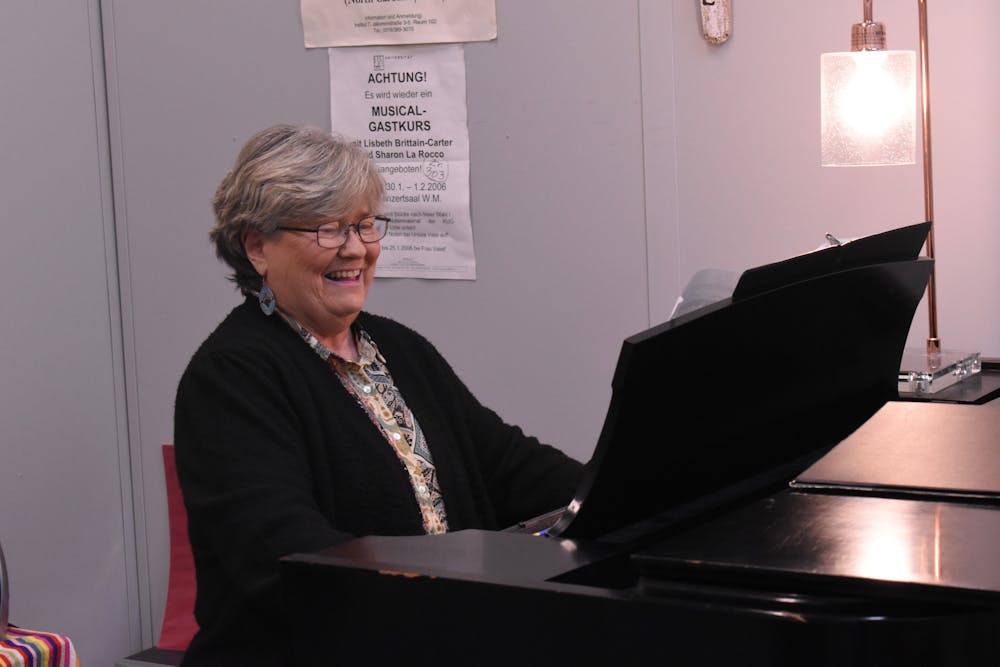
Sharon LaRocco accompanies a student on piano in her office as they prepare for their juries, a formal performance examination, on May 11.
As she looks ahead to a future as a retiree, LaRocco said she is excited to not have to put on an alarm and to have a choice in what she wants to do and when she wants to do it. Whether that’s going on small trips with her family, reading historical fiction or books by Native American authors, or even buying Native jewelry, she won’t be constrained by a school schedule.
LaRocco is also ready to put even more of her time into advocacy. She serves as a leader for her local autism chapter. To her, though, advocacy doesn’t just happen in these meetings; it happens daily. Her son is non-verbal and has high needs autism, requiring LaRocco and her family to speak for him constantly. When an infection followed a recent surgery, doctors recommended removing a device critical to managing his seizures, without considering what that would mean for his quality of life.
“If my son could speak and advocate for himself, he would have said, ‘No, absolutely not. This keeps me going,’” LaRocco said. “So, we have to be that for him all the time.”
As strong as she is for her family, she said, leaving Elon is harder to face. LaRocco said she is scared to retire, even if she knows it’s time.
“Now that it’s here, I’m like, ‘What the heck, I love Elon, I love being up here,”’ LaRocco said. “I feel stimulated by the students and the diversity of students and faculty, and you know what, my biggest challenge when I leave here is, where am I going to find my people?”
LaRocco said she has built the kind of relationships at Elon where she can talk to a student or colleague about the “nerdy” side of music and be understood and met with the same enthusiasm. Though she is going to miss her students especially, LaRocco said it is time for her to “drift” into the next chapter of her life
“I’m like, ‘Oh, you’re not going to fit in,’” LaRocco said while crying. “So, it’s going to take a while for me to do that, but I’ve got a lot of fun things I want to do.”
Beth McCain
When the dean of Elon’s Love School of Business called Beth McCain during winter term in 2025, the assistant teaching professor of accounting had already decided she was going to retire in the spring of that year. But the dean had asked if she would be willing to stay one more semester to be a part of the inaugural faculty in residence in the Singapore program that was recently started.
McCain said yes.
Before retiring in December, McCain taught two courses in Singapore, a principles of finance course and a course on fraud and financial crimes. The latter explored money laundering, an issue prevalent in Singapore. She said students met with a man from Interpol and joined a Zoom session with a friend of McCain’s who worked as a fraud investigator for the U.S. Department of Housing and Urban Development.
McCain said the Singapore trip was a fitting final chapter for her time at Elon. After a decade as an accounting professor, McCain said study abroad trips, especially winter term trips, were part of some of her most memorable moments at the university.
“I really like getting to know the students really well by doing those study abroad programs because you’re together 24/7,” McCain said.
She said she hopes her students love learning as much as she does.
“It was always really important to me that the students understood the material and not that they were going to love accounting, but at least they could appreciate the importance of accounting, and in any class, just how important learning is,” McCain said.
The transition from professor to retiree wasn’t without its challenges. Though McCain said she looked forward to retirement, the first month proved to be an adjustment.
“You kind of get used to coming on campus and seeing the students and your colleagues,” McCain said. “I actually had a really hard time the first month, but now, it’s great. I have the time to do whatever I want whenever I want to do it.”
Her days now include volunteering at an animal shelter, hiking, and sailing.
The retired professor has also returned as a student, taking French classes with juniors and seniors. She said she plans on moving to France with her husband in the future, partly to be closer to her daughter, who lives in England, and also to enjoy and immerse herself in the culture.
McCain’s husband has been retired for three years and has spent time traveling to see their children, who both live far away, but was more constrained while working as a professor. Though the overall decision was difficult, the result was rewarding, and she said her time at Elon was successful.
“I had such a great ten years here, and I felt like I was going out on a high point,” McCain said.
Robert Moorman
Joining students in their journey to graduation, and learning the Instagram-worthiness of the Elon sign outside of the Inman Admissions Welcome Center, is Robert Moorman, who is retiring after a 15-year-long career at Elon University.
“This year, I’m going to be a graduating senior, kind of going through the same thing that they are,” Moorman said.
Moorman previously worked at Creighton University but said Elon has a better balance between personal and work life, while still emphasizing the effort professors put in, something that drew him in when he first accepted the job offer in 2011.
“Elon represented to me the kind of sense that it was a place that values scholarship that doesn’t make it everything and a place that values teaching that does make it everything,” Moorman said. “It allowed me to be in a place where I could do both sides of the job.”
At Elon, Moorman worked in the Love School of Business as the Frank S. Holt, Jr. professor of business leadership and of organizational behavior.
“I really like teaching in the business school because it’s this nice combination of talking to people about philosophies and theories and approaches, but also with a very practical bend to it all,” Moorman said.
Moorman specializes in organizational behavior, which he said aims to recognize how a person's well-being relates to an organization's well-being. While he applies this to management techniques in professional organizations, he said his students also use it in their daily lives.
“They can really see how it fits in, how they manage their relationships, how they manage their work, how they manage their living arrangements, how they manage their friendships,” Moorman said.

Robert Moorman stands outside the Inman Admissions Welcome Center, where he posed by the Elon sign May 6.
On his final day of teaching, Moorman planned a values-based exercise that had students identify their key values to open a discussion on an organization’s integrity and what it means to them.
This was not his first exercise. Earlier in the semester, Moorman and his students were juggling, and not in the metaphorical sense.
“I’m not a good juggler, but I use it to try to illustrate the difference between people who can perform because they have the abilities to do it, and people who perform because they have the motivation to do it,” Moorman said.
He juggled for the class and asked if any students would try it. When no one said yes, he brought out a $20 bill, and the students tried but still couldn't juggle. Despite being one of his most memorable activities, he said he hopes students learned something valuable about management from it: asking an employee to do something because of an incentive doesn't make that person work better, and doing so is ultimately unhelpful to their well-being.
Beyond management skills, Moorman said he hopes students have taken away the importance of joy.
“It’s important to find joy, and I think the way to do it is not to say I’m going to look really hard to find the thing I can be joyful within, but instead, I’m going to work really hard to find joy in what I’m doing,” Moorman said.
Going into retirement, Moorman said he is frequently asked if he will be bored.
“I’m not worried about being bored,” Moorman said. “I kind of look forward to being bored. Let’s see what happens there.”
Rosemary Haskell
While attending the University of Durham in the 1970s in England, Rosemary Haskell saw a notice pinned on a wall that said there was an opportunity for university students to work as teaching assistants while obtaining a master's degree in Massachusetts. On a “whim,” Haskell followed that notice to the United States, where she has lived ever since.
“Once you’ve got an M.A. in English, the only cure is a PhD in English,” Haskell said.
Haskell came to North Carolina when she was working on her doctorate at the University of North Carolina, Chapel Hill. She said she chose Elon because there were not many available jobs for someone with her education, and moving was not an option for her family. She has worked as a professor of English for 41 years.
Haskell joked about being an English major, saying it was one of the things that she did because she was good at it, not because she had a plan for it. She said that something she prefers a lot about the American school system is that university is a time for American university students to figure out what they are good at and what they want to do in their future. In England, she was forced to decide immediately and there was no going back on her choice.
“Oh, I think it was one of those things in the old days in England,” Haskell said. “You specialized early, and so you did your OWLs. You did your O levels, the ordinary wizarding levels in eight, nine, ten subjects, and then you pretty much had to decide whether you’re going to be arts or sciences, and I decided on arts.”
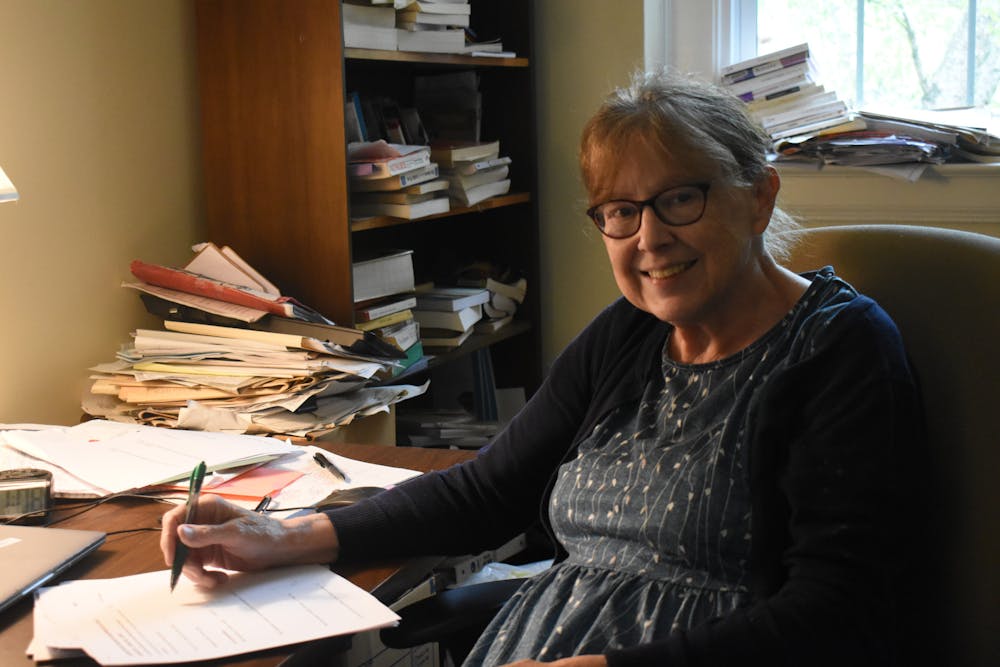
Rosemary Haskell sits in her office and has her students' work prepped for grading May 6.
During her time at Elon, Haskell said some of the best moments in her classroom were when students began understanding difficult concepts.
“Teaching literary criticism, literary theory, can be challenging, but when you are able to convey a difficult concept clearly, it’s very rewarding,” Haskell said.
More than comprehending concepts, Haskell said, watching students find interest in books and learning is most rewarding.
“They think it’s difficult or boring, and then something happens, and it’s not always clear what,” Haskell said, “but they seem to collectively or perhaps gradually decide, yep, this is worth doing. This is worth reading.”
Haskell said she also taught first-year writing and enjoyed seeing the growth of confidence in those students. She also said she gets some laughs.
“I said come up to the board and draw some kind of chart or graph or visual aid that you’re going to use to convey the nature of the problem, the nature of the solution,” Haskell said. “And one of the guys came up and started drawing what was supposed to be a map of the United States, but looked like a one-legged pig.”
While she joked that retirement will mean longer conversations with her cat, Haskell said she is looking forward to the change. She plans on reading, but also working in the local community by canvassing more for the upcoming elections.
Haskell said she has mixed feelings about retiring from Elon, but knows it is her time.
“The students really feed my energy, and I hope I feed theirs as well,” Haskell said. “I’m really going to miss them.”
Linda Dunn
Linda Dunn had not initially planned on retiring, but after months of trying to find a department for her class as a part of the minor in peace and conflict studies, Elon University could not take her on as a part-time professor for the 2025-2026 academic year. On Aug. 1, before the year started, Dunn entered retirement after 27 years of teaching at Elon.
In retirement, Dunn said she can still get the benefits of attending cultural events for free at Elon, which she said has been fun to attend, especially with her flexible schedule.
Dunn has continued teaching three classes for an hour and a half at the Greensboro chapter of the Unity Church.
“I can just continue to teach and continue to mediate in court, but be more relaxed about it,” Dunn said.
As a part of her church's spiritual retreat, Dunn recently went on a trip to Bali. She said it was an opportunity for people internationally to unite and learn about a culture and religion. Her favorite moment was during an island-wide period of reflection.
Despite enjoying her time in Bali, she does not plan on making any more large trips in the near future as she wants to be mindful of her spending.
As a professor, Dunn said she taught students conflict management that steps away from “competing” with your audience. Ironically, she said that while teaching students not to compete, she found herself competing with them about the information in their textbook. So, she said she took on a new approach.
“I had them read chapters and do the presentation, and so I wasn’t having to compete with them,” Dunn said.
Dunn said learning not to compete is something important to her, and something she believes should be important to others.
“It teaches you that you have to be better than somebody else, or that you have to be the best to get what you want, and so you’re constantly comparing yourself to other people,” Dunn said. “Why? You just have to be the best that you can be, and then you’re contributing to the beauty of the world.”
If she had the opportunity to teach at Elon again, she said she would.
“I love teaching,” Dunn said. “I love interacting with students, but it’s nice to have freedom and the flexibility when you don’t have a given schedule.”
Charity Johansson
Charity Johansson, a retired professor of physical therapy, wakes up happy in her home in the woods, 45 minutes from Elon.
“I wake up every morning thinking what a good life I have,” Johansson said.
After taking on a leadership role on top of teaching at Elon, Johansson made the decision to step down and retire in December of 2025 after fall semester. She said that her own mental and physical health, as well as time with family, were major factors in her retirement. The role demanded a lot of attention from her, and though she had the support of colleagues, she said it was time for her to retire.
The experience taught her more about herself.
“I grew a lot because I thought, if I’m going to do this, I’m going to do it to the best of my ability,” Johansson said. “And I grew professionally, but I also grew personally, and that was really valuable to take with me when I retired.”
Johansson didn’t want to “fall off a cliff” when she retired, so before leaving, she wrote down everything she planned on doing, however after creating that list she decided to write “experiment!” diagonally across the page. She said her intention was to allow herself the space to figure out what she enjoyed doing without the pressure of needing to do it well.
From doing stonework around her garden to writing both a textbook and a work of fiction, Johansson said she is keeping herself busy.
“Writing is a challenge, but it’s one that I love,” Johansson said. “Fiction is one of the best purveyors of truth, and I love that about it.”
She described fiction writing as a seed pod that protects the truth with layers of creativity.
“If it’s done well, it touches a deep place in you that maybe you’re not even aware of,” Johansson said.
Creative activities like this are what Johansson said keep her happy.
This year, Johansson will carry the mace at the graduate commencement ceremony for law and business students.
Johansson said the time she has spent at Elon has fostered the kinds of relationships where her students and colleagues have sent her encouraging messages as she moves on to retirement. One example of these colleagues is Connie Book, who Johansson had worked alongside before Book became Elon’s president.
Ultimately, Johansson said not much has changed about her in retirement other than her confidence, her health, and her positive mindset.
“I’m always going to be industrious, I’m always going to be curious, I’m always going to be doing things, I’m always going to be busy,” Johansson said.
Joan Barnatt
For the last two years, Joan Barnatt, an associate professor of education, has been easing into retirement gradually, giving up responsibilities one at a time rather than stepping away all at once. She will officially retire at the end of the summer semester, during which she is teaching two courses.
“I’m ready to do this,” Barnatt said. “We make a choice when we retire, and I’m looking forward to being able to do more of the things that compete for time with my job and not feel that push and pull on it.”
Barnatt said there was no singular deciding factor that made her want to retire..
“It’s about feeling more frustration around the bits and pieces that you don’t enjoy all the time about your job and recognizing that there can be other things that fill those spaces," Barnatt said.
Barnatt said that being an educator who teaches future educators is rewarding.
“This is, in fact, my very favorite time of year,” Barnatt said.
For years, Barnatt said she has followed students during the spring semester as graduation approaches, observing and documenting what happens as they work.
“You see this huge leap forward in their confidence, in their ability, in their anticipation to go into their own classrooms,” Barnatt said.
Barnatt said she is not afraid of retirement.
“I think some people worry about how do I build a routine, how do I build time?” Barnatt said. “And I don’t see that as an issue whatsoever.”
She said she plans on maintaining contact with the people she loves at Elon and hopes that her students learn to do the same thing.
“All of us here at Elon, including myself, stay with them as they go forward, and you become part of a network, you become part of a community,” Barnatt said. “And that doesn’t go away when you graduate.”
Going into her own version of graduation, Barnatt said she is excited for her future freedom.
Barnatt has a coastal home in Maine, a garden in need of tending, and time she wants to spend with family, but she said teaching will always remain a part of her.
“I think you go into the profession as a teacher yourself, and then you may go on to other things, but that see that brought you to the profession is still there,” Barnatt said. “Constantly being able to see what’s going on and what the future looks like through children is very exciting.”
Linda Niedziela
Linda Niedziela said she is the kind of person who likes variety in her day. In the morning, she’s writing letters as department chair of biology, in the afternoon, she is working through data, and between that, she is teaching her students.
“I like to not do the same thing over and over again,” Niedziela said.
And for the last 25 years, she has done that.
Niedziela said she made sure she was retiring from Elon at the same time as her final research mentees. The professor works closely with student researchers, guiding them through the dense literature, and even helping them out in the labs. She wanted to make sure that she had no loose threads when she left.
Being a department chair, Niedziela said she had to build up a versatile skill set that could span her leadership and teaching roles simultaneously.
“I’m organized, I’m a collaborator, I like building people up,” Niedziela said.
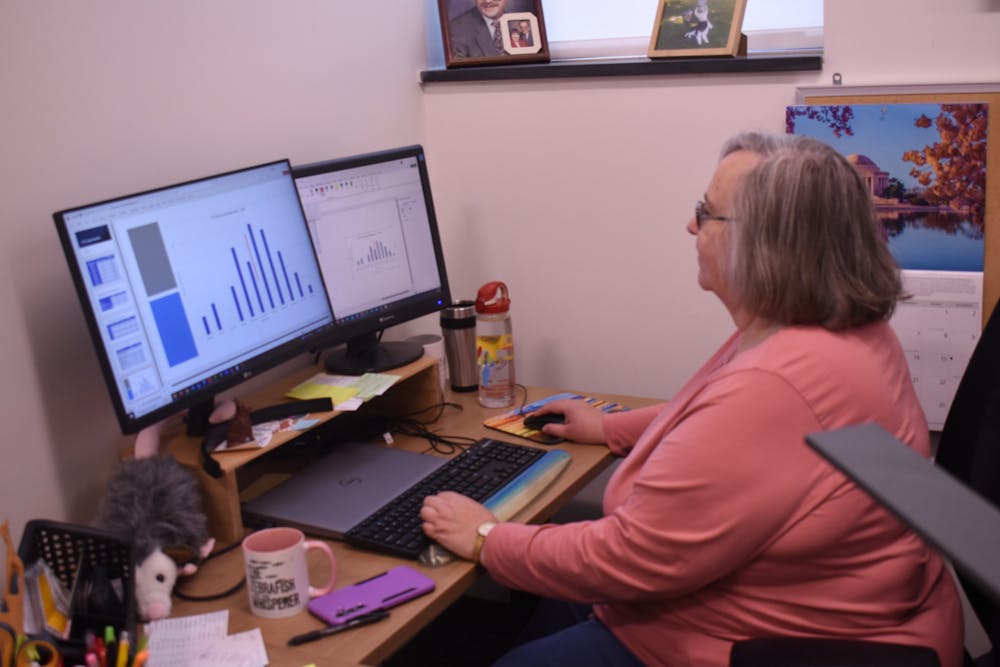
Linda Niedziela compiles student grade data ahead of the biology department's end-of-year review on May 7.
As she looks ahead, Niedziela said that she will miss her students and especially her colleagues with whom she has worked her entire career at Elon, but there are a number of things she is looking forward to doing.
“I don’t have to go camping in the middle of the summer when it’s so hot, I can go whenever I want to,” Niedziela said.
Along with her husband Carl Niedziela, who also works at Elon, she does woodwork and trains her dogs to compete in sports. While her elderly show dog is reaching the end of his own career, Niedziela said she is getting her younger one ready for competition.
“He’s just getting to an age where he can chill out enough to go through competition,” Niedziela said.
Niedziela said as she leaves, she hopes her students have found the love of science she has experienced throughout her career.
“There are so many opportunities, even if they might not want to be in the research lab,” Niedziela said. “The skills that they learn along the way can help them do anything.”
Elizabeth Bailey
Retirement in May is not the scariest matter assistant teaching professor of exercise science Elizabeth Bailey said she has to face. In fact, it is her office that scares her the most.
The room is filled with everything from paperwork and student assignments to her bicycle that she said she can’t get on without the intention of riding.
“How the heck?” Bailey said. “It’s going to take me another month to move out of this office.”
Bailey said she has a lot on her plate, but her priority is getting her students’ work graded and wrapping up her research responsibilities before the school year ends.
“I’m looking forward to not having to work at night and not making or breaking people’s life by their grade,” Bailey said.
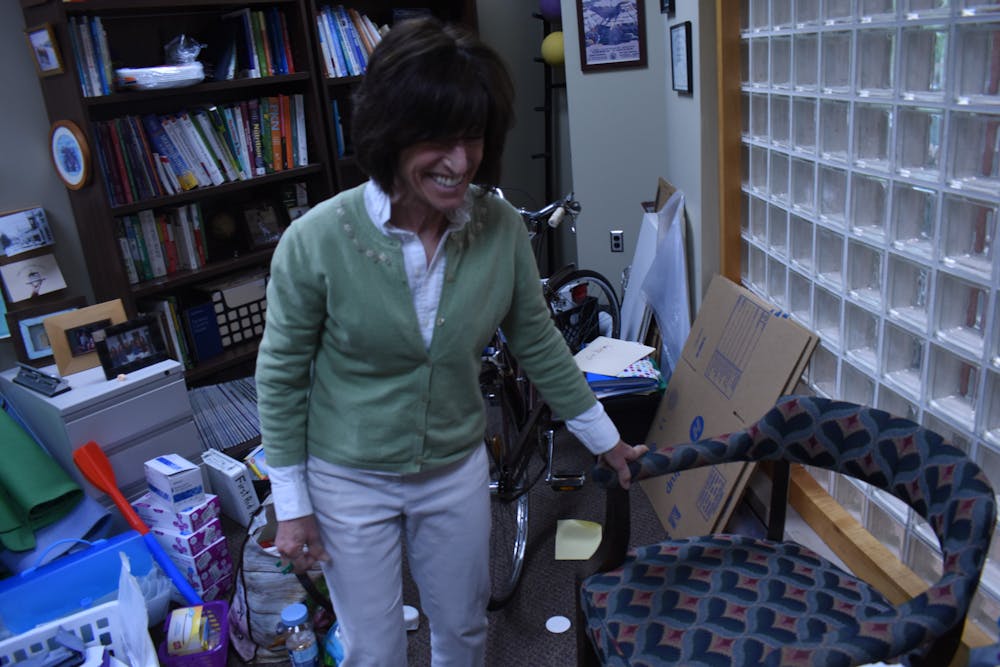
Assistant teaching professor of exercise science Elizabeth Bailey tackles cleaning out her office on May 7.
During her 22 years at Elon, Bailey started new classes and taught study abroad courses, and so her work has never stayed stagnant.
“There’s lots of opportunity to explore things that you’re interested in, to teach new things, to start new classes,” Bailey said.
The professor said she knew it was time for her to retire when all of her college friends had already taken that step . Bailey said she spends a lot of time with them, and it’s often her demanding work schedule that forces activities and plans to be put on hold. While she will miss teaching, she is excited to spend more of her time with friends and family.
Bailey said she also plans on spending her free time reading, painting, playing tennis, and learning Italian.
“I’ll miss the people that I work with, and the students,” Bailey said. “I always learn from them, and so I will miss that. I will have to find a way to fill that void.”
Anthony Hatcher
Chair of the journalism department Anthony Hatcher said there was no “flash of lightning” that revealed it was time for him to retire after 24 years working at the school. Instead, he said it was the realization that time was moving, and he wanted to make sure that his current energy wasn’t lost when spending time with his almost 2-year-old granddaughter.
“I am looking forward to it despite the fact that I will miss my students and my friends terribly,” Hatcher said.
Two years ago, Hatcher said he never would’ve imagined he would be retiring this year. He said he is used to waving his colleagues down in the hallways for a quick chat or an impromptu lunch. Hatcher joked that when traveling abroad, he was used to having a trail of thirty or so students behind him.
That same accessibility was found in his office.
Throughout his teaching career, Hatcher said his door has always been open to all of his students because being available to all voices was important to him.
“Sometimes they needed to talk to me about classes or grades, and other times, they were in distress,” Hatcher said.
This openness extended to students of all political views. Hatcher said the best part of his day was being in a classroom filled with students.
Many of Hatcher’s classes centered on open discussion of course material, and while most students shared similar perspectives, he said more conservative students often held back. The biggest compliment he received, he said, was when a student with opposing views felt comfortable enough to come to his office and share them.
“My response is always, thank you for confiding in me, and let’s talk about this and talk about ways you could contribute because I don’t want you to feel intimidated,” Hatcher said.
His wife often joked about how open he was to differing opinions. Passing protests, rallies, or religious events, she would want to keep moving, but Hatcher said he was always curious to hear what people had to say and would stop to engage.
This was not something he had always done, though. As a person, his experiences abroad, as a journalist, and as a teacher have opened him to the diverse opinions of others. From a teaching perspective, he has learned to adapt to different personalities, world views, and learning styles. He said there is no one specific way to teach a class, and embracing that has made his classroom and impact stronger.
“As a journalist, and as a teacher, you never want to be a preacher,” Hatcher said.
Hatcher said he hopes his openness to all ideas has fostered an environment where students could learn not to follow a one-track mindset. Above all, he said, being a professor has enriched his own knowledge.
“In many ways, I’m still a student,” Hatcher said.
As he makes his way into retirement, Hatcher said he is excited about the opportunities ahead, whether that is freelance writing for news outlets, spur-of-the-moment trips to New York with his wife, or simply being there for his granddaughter.
“The idea of being spontaneous really excites me,” Hatcher said.