

Updated as of 4:14 p.m. on Sept. 16 to include an interview from Senior Vice President of Advancement and External Affairs Jim Piatt.
Updated as of 2:32 p.m. on Sept. 16 to include interviews from current and former students regarding the merger.
Updated as of 1:38 p.m. on Sept. 16 to include more information regarding the merger and an interview with Rick Seltzer.
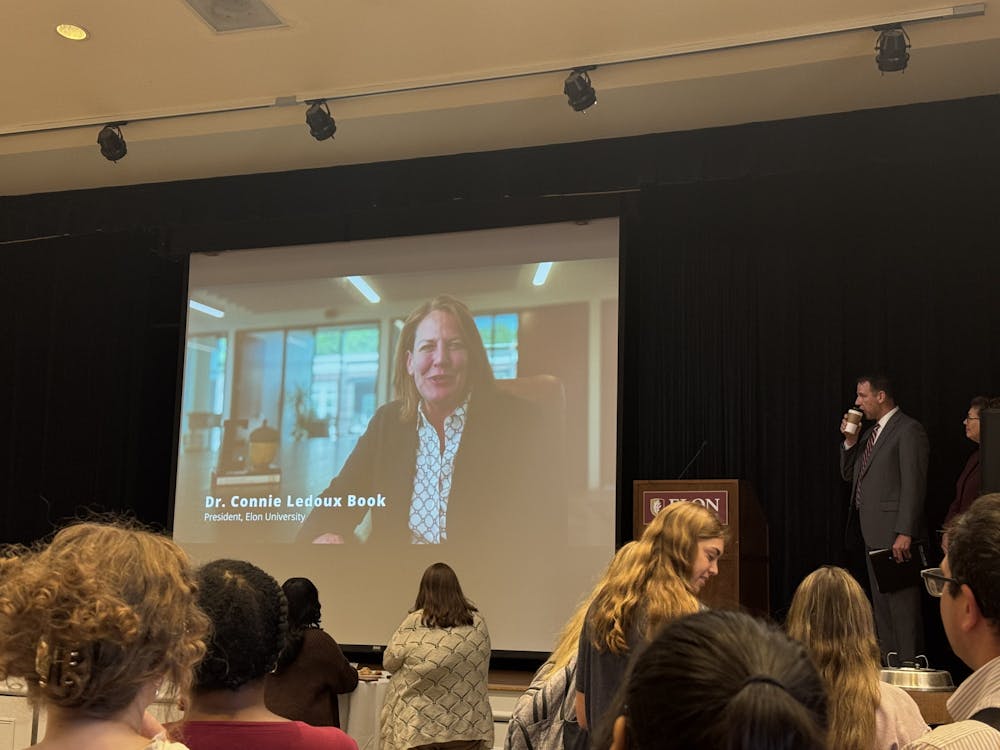
During College Coffee on Sept. 16 Elon University President Connie Book announced that Elon University intends to merge with Queens University of Charlotte.
Book said to College Coffee attendees in a prerecorded video that if the merger is agreed upon between the two universities Boards of Trustees, Elon will assume operational oversight of Queens and the university will become a new home for Elon graduate students.
According to an email sent out from Elon Admissions to student staff, the merger was unanimously approved by both Boards of Trustees. No name changes are also planned for either institution at this time.
This announcement shocked Elon sophomore Sophie Willen, who attended her first College Coffee on Sept. 16 and transferred from Queens this past spring.
“My jaw dropped, actually, and my roommate was standing right next to me,” Willen said. “I remember when I was at Queens, there was a lot of talk about financial issues.”
Willen decided to transfer to Elon from Queens because she was looking for more community in her college experience.
“The difference is Queens of Charlotte and Elon, you don't really have that community unless you're an athlete or unless you know someone in the Myers Park area,” Willen said.
According to Rick Seltzer, a reporter for the Chronicle of Higher Education, universities may look into merging with another institution or acquiring another institution for a number of reasons such as financial position or enrollment numbers.
During the 2024-25 academic year Elon University had 6,452 undergraduate students and 787 graduate students enrolled at the university.
Queens University of Charlotte, a private university located in Charlotte, North Carolina, had 1,225 undergraduate students and 374 graduate students enrolled at the university during the 2024-25 academic year. Queens University’s total enrollment decreased by 13.4% between the 2023-24 and 2024-25 academic years.
Elon University’s total enrollment is four and a half times larger than Queens University’s.
“What's happening is these institutions are often struggling to raise additional revenue,” Seltzer said. “They cannot get more net tuition revenue, or if they can get it, it's not keeping up with the expenses that they are, expense increases they're facing, and we've seen some pretty high increases in certain inflationary measures recently.”
Queens graduate Jenna Livingston '25 said she is upset about the merger and the school she graduated from no longer existing.
“It’s sad to see that the school that I graduated from no longer exists,” Livingston said. “I’m sure plenty of people can feel that kind of pain, especially from those who have gone to defunct schools.”
As Livingston '25 prepares to apply to graduate programs and her friends graduate they all have one question on their minds.
“Come November, the people that I’ve texted who are still there don’t really know exactly what this means,” Livingston said. “I guess the question that comes up the most is what their degree is going to say – Elon Charlotte or if it’s going to say Queens University of Charlotte?”
Elon University is also facing a drop in enrollment, with undergraduate enrollment decreasing by 11.6%.
“In the next 10-20 years because of low birth rates after the Great Recession, we are expecting to see fewer high school graduates who would traditionally enroll in a small private liberal arts college,” Seltzer said.
In addition to enrollment numbers institutions may look into a merger or acquiring another institution for financial reasons.
“Colleges struggle with cost cutting,” Seltzer said. “It's a slow, hard, hard process for them, and in many cases, especially at small private institutions, there isn't a ton that you can cut without it being a problem.”
According to Queens University’s tax records for the 2023 fiscal year, the university made roughly $88.4 million. However the university’s net income was roughly -$20.5 million dollars.
“It was never really spoken about. They kept it very hidden. I think they cut a lot of professors before I moved in for freshman year, and it showed, it really showed. I had a professor for two classes because they didn't back to back like that,” Willen said.
Elon University currently has multiple programs based in Charlotte including a flexible law school program, a sport management program and a physician’s assistant program set to open in 2027. Senior Vice President of Advancement and External Affairs Jim Piatt said that Elon’s current presence in Charlotte made the merger appealing.
“There is demand for other graduate programs,” Piatt said. “We naturally think that could be a really good synergy for Elon and Queens moving forward.”
Book will be present at the Student Government Association's weekly meeting at 8:30 p.m. on Sept. 18 in room 215 in the Moseley Student Center to take questions from students.
She will also be holding a town hall for faculty and staff at 2 p.m. on Sept. 19 in Alumni Gym.
Queens University will also be holding a series of discussions for students and alumni, including an open discussion with students on Oct. 1 and an open discussion with alumni on Oct. 11.
Elon and Queens’ Boards of Trustees will be holding a joint meeting in October and will approve the final parameters of the partnership in November, making the merger official. Once the merger is approved Elon will assume operation of Queens University, according to an email from Elon Admissions to student staff.
According to Piatt, if the merger is approved by the end of 2025 and work between both universities goes well during the winter and spring, Elon would look to begin operating at Queens by Aug. 1 2026.