

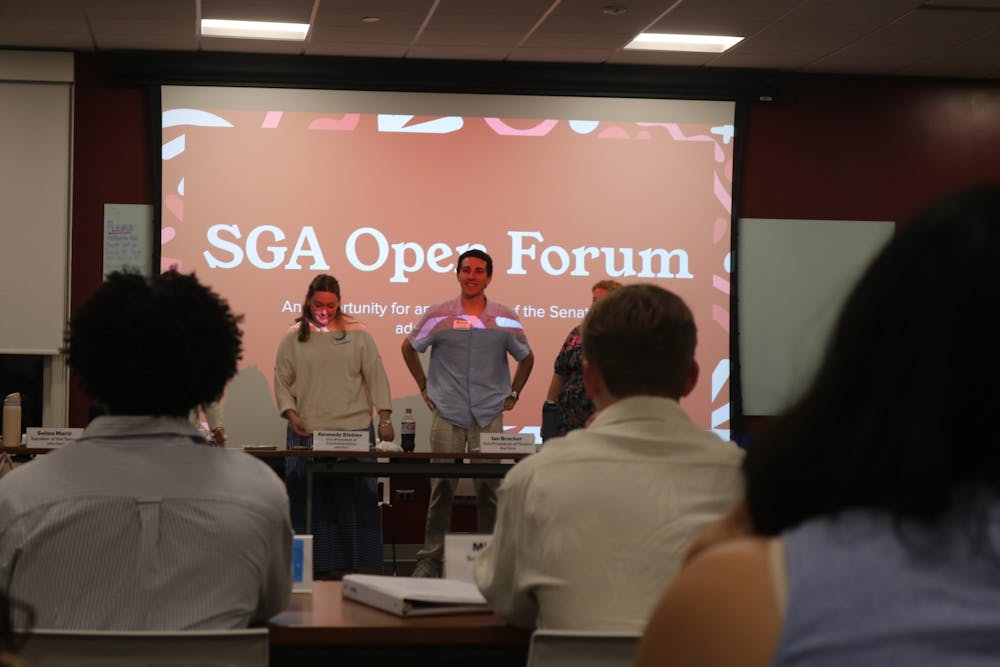
As the final business meeting of the Student Government Association this year came to a close, members reflected on a year of legislation, leadership transitions and the future of student organizations on campus.
The meeting marked the fourth session led by the newly sworn-in executive board, as the organization continues its transition into a new term of leadership.
For former SGA executive president Anya Bratić, stepping away from SGA has been an emotional transition after four years of involvement.
Bratić said the final meeting with the outgoing executive board on April 2 marked the end of a chapter that shaped nearly her entire college experience.
“I’ve never known an Elon without SGA,” Bratić said. “It’s made me the person I am and the leader I am.”
Bratić, a senior studying international and global studies and public policy, said one of her most meaningful accomplishments was launching “Anya’s Top Five,” a social media series aimed at connecting students with overlooked campus resources and opportunities.
“Elon is a very resource-rich campus,” Bratić said. “Students often think we don’t have the things that they need, but the problem is that they just lack awareness that the resources exist.”
The series reached nearly 100,000 views over the course of the year, featuring everything from campus events to practical tutorials like how to print double-sided documents.
Bratić also highlighted SGA’s civic engagement town hall, “Small Changes, Big Impact,” which connected students with local civic leaders and community organizations while encouraging engagement beyond campus.
At the start of her term, Bratić said her goal was to reach students who were not heavily involved in campus life.
“We wanted to tap the untapped student,” Bratić said. “Students that we know have potential, but just haven’t been tapped for an opportunity yet.”
She said senators played a key role in helping identify students for university committees based on their interests, expanding access to leadership opportunities for newer students.
Throughout the year, SGA passed several pieces of legislation, including a proposal from two first-year senators establishing a suggestion box in Moseley Center for students to submit feedback directly to SGA. Another initiative designated February as campus safety awareness month.
One of the most significant changes this year came with the implementation of a new quarter-by-quarter funding model for student organizations.
Former vice president of finance Ian Brecker said the new system replaced the previous first-come, first-served process and required extensive outreach to student organizations across campus.
“It was a big change,” Brecker said. “I went to as many in-person meetings as possible.”
He said much of his work focused on helping organizations understand the new system and improving access to funding.
“I think that reach and communication of meeting everybody was very nice,” Brecker said.
As the new executive board begins its term, incoming leaders said mentorship from the outgoing team has been essential to a smooth transition.
“She’s taught me a lot of things,” newly elected SGA president Michael Swartz said of Bratić. “Talking about parts of the role that aren’t documented in writing has been the biggest help.”
Swartz said observing Bratić’s leadership over the past several years shaped his own approach to the role.
“Seeing her grow as a leader and really put that into action was inspiring,” Swartz said.
Next year, Swartz plans to continue resource-focused outreach through an updated “Top Five” series while also launching a new initiative highlighting campus employees, including custodians and dining hall staff.
“I want people to walk by someone cleaning a floor in a building and say, ‘I know where they’re from,’” Swartz said. “Trying to highlight those community members and make campus feel more connected as a whole.”
Incoming Vice President of Finance Cayce Becker said outgoing executive members have remained available throughout the transition, especially as the organization continues adjusting to the new funding system.
“They’ve been incredibly helpful,” Becker said. “They’re always willing to answer any question.”
Becker said the new executive board plans to continue refining the quarter funding model while working closely with student organizations to address challenges from its first year of implementation.
“We want to work with students to make sure we’re addressing all of those issues,” Becker said.
Brecker said, for graduating seniors, leaving SGA marks both an ending and the continuation of work they hope will carry forward beyond Elon.
“It’s bittersweet,” Brecker said. “You have a whole community here that you’ve built over the past four years.”
Brecker said his time in SGA helped him grow both personally and professionally by giving him direct experience working with university leaders and student organizations.
“I think being on SGA opened up those doors to get those communications, those rooms, those meetings where you can definitely make a change and have your voice heard,” Brecker said.
After graduation, Brecker plans to pursue a career in supply chain and operations management.
Bratić said SGA played a defining role in her confidence and development as a leader during her time at Elon.
“I was really quiet my first semester,” Bratić said. “SGA gave me a platform."
As she prepares to graduate, Bratić said she is proud of what the organization has accomplished and confident in its future leadership.
Following graduation, Bratić will move to Vietnam after receiving a Fulbright award, where she will spend a year teaching English to high school or college students.
“It’s sad because I don’t get to continue moving on with this thing that’s been a part of my life for so long,” Bratić said. “But I know that it’s in really good hands.”