

Following a rise in artificial intelligence, questions and concerns about its use have come up at Elon University. The school has implemented policies regarding AI use within the classroom and university operations, many of which consist of using AI as a tool in learning and staying within the ethical bounds of AI usage. The AI that these policies frequently refer to addresses generative AI.
Despite the recent uproar in AI throughout headlines, classrooms, and search histories, artificial intelligence is much broader than ChatGPT, Gemini, or other open source AI’s commonly used. The AI & The Body panel on March 3 dove into the broader ways Elon faculty have used AI in their professions.
Shannon Duvall, professor of computer science and interim associate dean in the College of Arts and Sciences, said she hoped the panel could focus on the experts at Elon, introducing people to AI in different disciplines.
The panel is the first part of a three-part AI panel series hosted by Elon’s College of Arts and Sciences. All panels will take place in McMichael 115 from 4:15-5:30 p.m. On Apr. 7, AI & Creativity will take place, with AI & Culture finishing the series May 5.
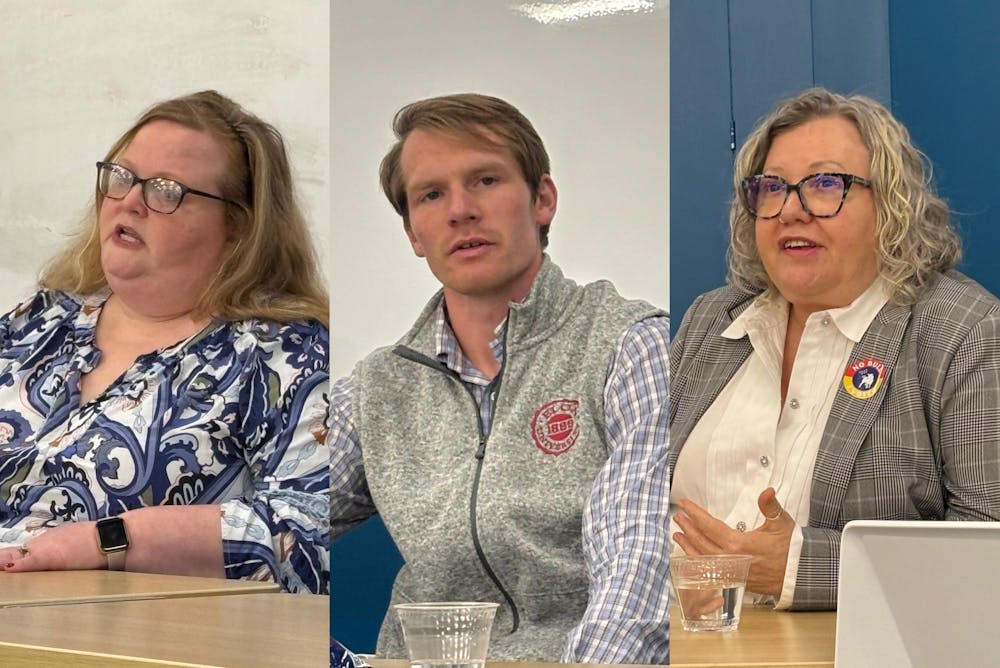
The AI & The Body panelists consisted of Duvall, assistant professor of exercise science, Bill Evans, and Associate Professor of Physician Assistant Studies, Antoinette Polito. The panel was moderated by junior computer science major Saffie Hollingsworth.
Junior computer science major and moderator Saffie Hollingsworth opened by expanding the current popular definition of AI, noting that AI in the computer science industry has been around since the 70’s, not always implying large language models.
Panelists addressed the misconceptions that have surrounded AI. Evans identified AI as a tool to increase productivity, using a calculator as a metaphor.
“The assumption that is going to make us dumb or lazy, I get that, and I think that’s a legitimate concern,” Evans said. “Think about a calculator, I am sure people were like ‘We’re going to lose the ability to do arithmetic.’”
Polito expressed different concerns about AI, noting its ability to learn as a critical difference to older technology. Radiologists and pathologists are two fields that Polito mentioned AI could take over. Still, Polito noted that AI could have good implications for the health field, with hopes of increased access and decreased costs.
For Duvall, AI has already increased access in her research. Duvall’s research uses pattern recognition to see when people with emotional dysfunction may have an outburst and to initiate preventative measures before it occurs, such as remotely dimming the lights or playing calming music.
3D body tracking information she previously gathered with sensors can now be gathered with a single webcam. Duvall's current work includes modernizing technology to achieve the same goals as before.
“That still blows my mind. How can you get 3D information with one camera?” Duvall said. “If you can just do it on your phone, right, that's even more accessible.”
AI has also been used when processing data. Evans mentioned that in the past, data sets were more frequently analyzed individually. Evans research covers a range of physiology topics, from the impact of prolonged sitting on blood vessels to cell functions.
“You have all this complex data that has different features to it,” Evans said, “but with AI we are now able to take all that data and find ways to merge it up better so that we can do complex analyses that actually complement one another.”
Though Evans credits AI with improving the rate of interpretation of data, he emphasized the importance of understanding the data and field in which he works to be able to progress in his research, a sentiment that all panelists agreed with.
Despite debate about AI, its positives and negatives, the panelists agreed on the importance of a human element and human education. Duvall said that a decrease in entry-level jobs could result in a struggle to find senior engineers in the future.
“You don’t just jump magically from novice to expert. You have to struggle to get to the expert status, and AI is not an expert for sure,” Duvall said.
Evans said that humans' ability to entertain and communicate can’t be replicated by technology, and Polito agreed. With Polito’s concerns about the integration of AI into the medical field, she noted empathy as a critical skill to enter the job force.
“In health care, the thing we need is empathy and compassion,” Polito said. “Maybe the machines can do the other work.