

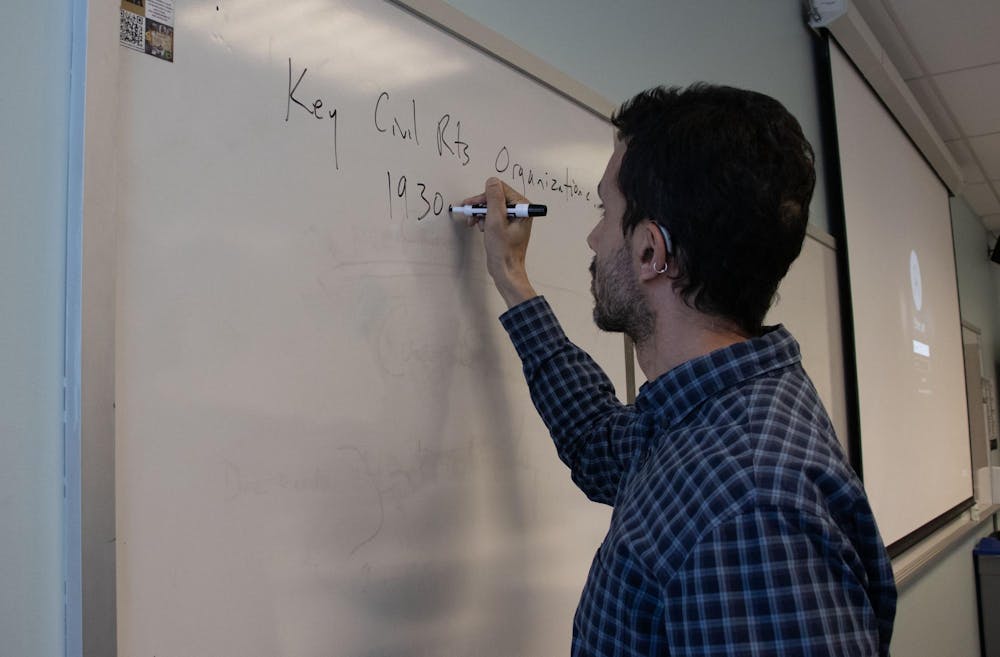
In just three weeks in January, Elon professor of sociology Raj Ghoshal takes his students through 500 years of history, focusing on the Black freedom struggle. Ghoshal said his course, SOC 3300: The Long Civil Rights Movement, helps students recognize the longevity of the fight for civil rights.
“The idea is that the Civil Rights Movement, or the quote, unquote, ‘short’ civil rights movement of 1954 to 1968, is certainly important, but it's only one phase of this much bigger struggle that is not just for civil rights, but also for equality, justice, freedom,” Ghoshal said.
The class begins with studying the 1400s, when the transatlantic slave trade began. By the second week, they reach the Civil Rights Movement in the 1950s and 60s that students are more familiar with. Ghoshal said many students could name activists like Martin Luther King Jr. and Malcolm X, but were unaware of any other key figures from the movement.
“King was certainly very important, but he did not create the movement,” Ghoshal said. The movement was the work of thousands of people, he further explains.
Ghoshal said he educates his students on activists and leaders like Ella Baker, who made significant impacts on North Carolina. Ella Baker grew up in Raleigh and spent her career working for the NAACP. After hearing of student sit-ins at a lunch counter in Greensboro, she returned to her alma mater, Shaw University, to start the Student Nonviolent Coordinating Committee.
“I don't aim to take anything away from King, but I do try to highlight the point that hundreds or thousands of other people did many, many things that played important parts as well,” Ghoshal said.
For other students during the Winter Term, their class helped them see connections between cultures around the world.
Freshman Ágatha Nascimento enrolled in REL 1410: African Gods over Winter Term, not expecting to discuss relations to other religions outside of Africa. Nascimento found herself talking about traditions from her childhood in Brazil and how they were influenced by African religions.
“In Brazil, we have different nighttime kids’ stories that we tell and different songs that we sing to the kids at night, and I never really stopped to pay attention to what those stories really were about until I was in that class,” Nascimento said.
Ghoshal, too, said he has seen his students make interdisciplinary connections between the course material and events they see in the news. While he refrained from inserting his own opinion into the conversation, Ghoshal said he encouraged his students to think critically about what they see today and the content from their course that can be applied to those issues.
Ghoshal said he hopes the lesson they take from this class is that political activism can be a long road, but progress builds over time from each person’s effort.
“I hope that there’s a lesson there in that class that political work, or the organizing work, or the strategizing work that happens even in troubled political times, doesn't go away,” Ghoshal said.
Ghoshal said the work of individuals from the 1890s to the 1930s laid the groundwork for people to use those organizations they built.
Nascimento said her course challenged prejudices and stereotypes of African cultures, and courses like hers give a stage for inclusivity.
“Introducing these sort of courses into Elon will create a space for everybody to know more about history and to be inclusive so that when we go out into our workspaces, we go into them with open-mindedness against all these stereotypes we see revolving around Black history,” Nascimento said.