

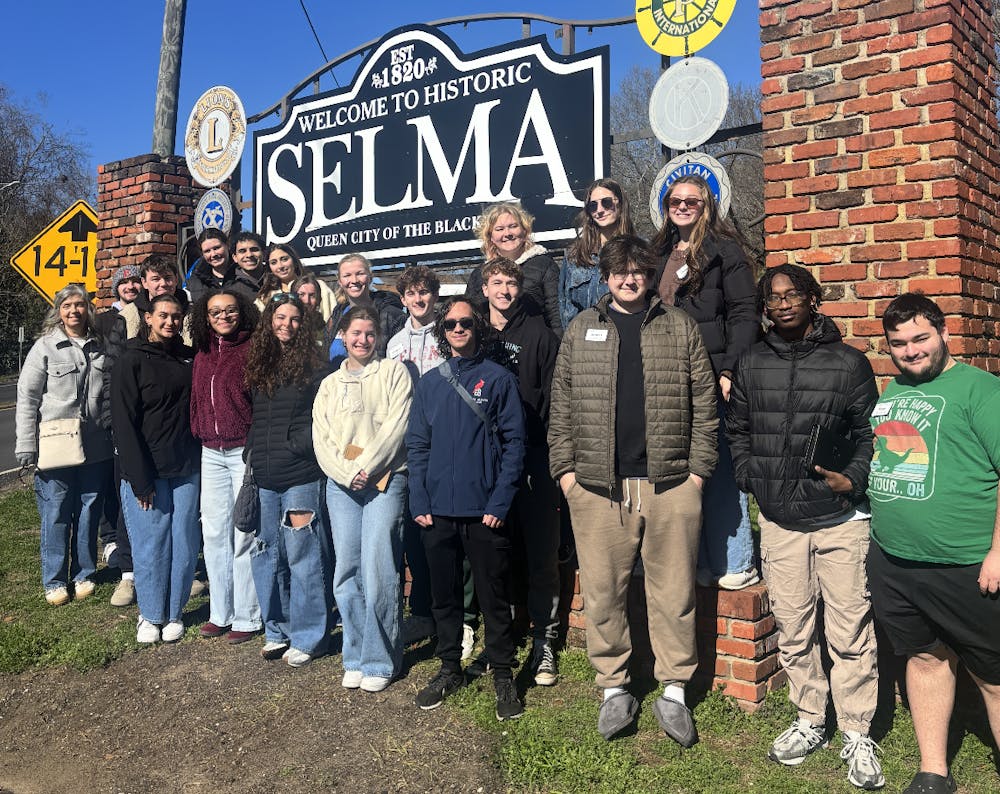
Each year, the sophomore cohort for the Elon Isabella Cannon Leadership Fellows takes a trip to Alabama during the Winter Term, visiting places with deep American history and relevance, including landmarks of the Civil Rights Movement such as the Edmund Pettus Bridge, the Equal Justice Initiative Legacy Museum and the Birmingham Civil Rights Institute.
The program is meant to help fulfill the common good initiative required by leadership fellows and Elon students pursuing a leadership experimental learning requirement, according to Jodean Schmiederer, dean of Student Development and professor for the leadership fellows’ Winter Term class.
“A common good initiative is a substantive change that is sustained even after the students leave,” Schmiederer said. “ It's not something that one person can do, right? It takes a group, it takes advocacy.”
She said students on the trip are challenged to think beyond what they learned in their history books and build a connection with the people and historical events.
For students like Elon junior Bella Hooke, who traveled to Alabama last January, the experiences are still making an impact on her life and how she defines herself as a leader. Hooke said that as a freshman, when she was first learning about the trip, the first thought she and many of her classmates had was, ‘Why Alabama?’
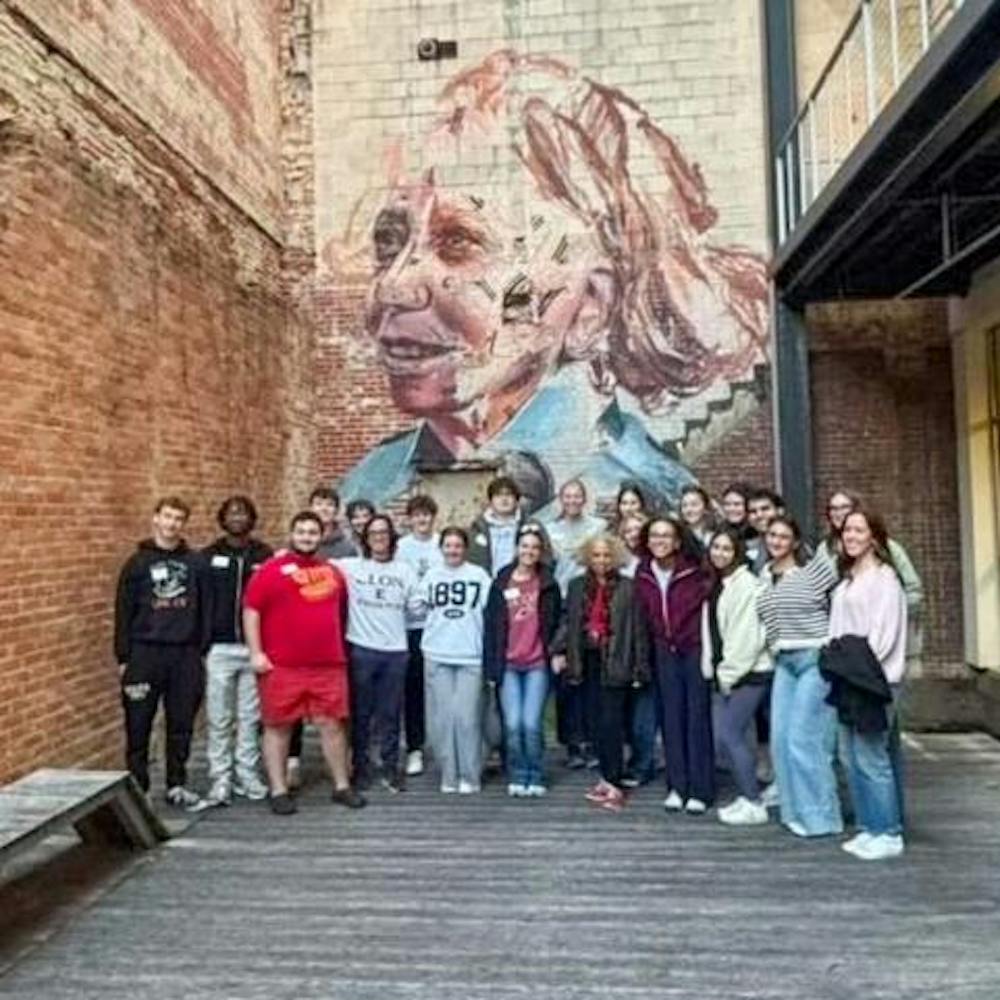
The class of 2028 Isabella Cannon Leadership Fellows pose for a group photo with Valda Harris Montgomery, Martin Luther King Jr.'s neighbor, in front of a mural of Montgomery. Courtesy of Luke Bonifacio.
She said, without knowing what the trip entailed, she didn't understand how the leadership fellows’ trip compared to other programs. However, reflecting on her time in the South a year later, Hooke said the impact it had on her was significant.
“We see everything completely differently now,” Hooke said. “Especially with everything that's going on now, I think that this trip is even more vital to have. So we have a better understanding of how we progressed, how we also regressed in some ways.”
Hooke said the trip inspired her to reflect on her own background and the impact the Civil Rights Movement has on her everyday life. She also said she was adopted from Guatemala into a white family.
“Having all these opportunities to go to these great schools, get an education, get all of these leadership positions made me realize that that wouldn't have been possible if it weren't for a lot of these horrific events,” Hooke said. “That wouldn't have been possible without these brave people that stood up against society and put their life on the line because, unlike the people around them, they were brave enough to say, ‘no, this is not okay.’”
Hooke said one of the most impactful moments on the trip was visiting the Equal Justice Initiative Legacy Museum.
The Equal Justice Initiative Legacy Museum showcases 400 years of African history throughout its exhibits, documenting events from the trans-Atlantic slave trade to modern disputes about justice and inequality.
For Luke Bonifacio, an Elon sophomore recently returning from the trip, an exhibit that stuck out for him during his visit to the museum documented the history of lynching, a phrase used to describe an illegal, informal public execution conducted by mobs, often intertwined with racial and cultural discrimination.
Bonifacio said he found a documented case of lynching in Alamance County from the 1920s, a story that hit close to home.
“We realized that the university was older than the latest lynching,” Bonifacio said. “ That really stuck out to all of us.”
Bonifacio said learning about the sit-in lunch counter protests made him grateful to have gone on the trip as a college student, saying it was inspiring to learn about how young people were able to play large leadership roles during the Civil Rights Movement.
“People our age or younger planned these huge movements in dorm rooms,” Bonifacio said. “I think the biggest takeaway that leadership fellows get from going on this trip, we do have voices and power in what we say, so we should use it wisely.”
Schmiederer said that every year she teaches the class, it’s fun to see how the students engage and connect with the stories they are told. Although many aspects of the course can weigh heavily on students, she said that each cohort leans into learning how to make an impact and a change in the world by appreciating the movement.
The fellows program is named after and endowed by Isabella Cannon. Graduating from Elon, Cannon held various impactful roles throughout her life, including being the first female mayor of Raleigh. During her commencement speech at Elon’s class of 2000s graduation, she reminded students to “think globally and act locally.”
“I think Isabella Cannon would be very proud of them,” Schmiederer said.
Editor's note: Executive Director of Elon News Network Anjolina Fantaroni is a Leadership Fellow