

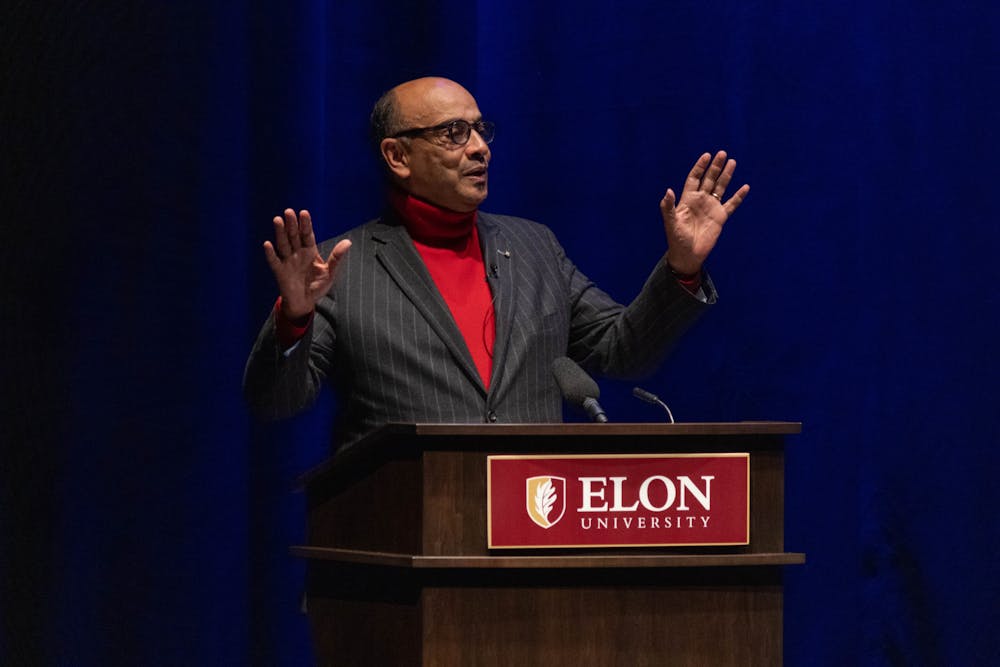
Kwame Anthony Appiah, a philosopher and political ethicist, spoke to the Elon University community about civil rights, race and their connection to ethics and politics.
In an exclusive interview with Elon News Network, Appiah said his work largely focuses on discrimination.
“We have a history of imperfect equality for people, different income levels, different classes,” Appiah said in the interview.
Martin Luther King Jr. died April 4, 1968, at 39 years old. In the years since his death, Appiah said King’s life advice has come to symbolize the United States’ long struggle for racial justice.
“Children are raised with his name on their lips, and almost everyone will recognize the sonorous phrases of the speech he made at the March on Washington in 1963,” Appiah said in his speech. “For many around the world, ‘I have a dream’ means Martin Luther King, and his dream is an American dream.”
However, Appiah said while King stood for Black Americans and provided legal recourse to the segregated South, he was no saint.
By today’s standards, Appiah said, King was a chauvinist, someone who displays prejudice for their own group, denied proper recognition to several women in the Southern Christian Leadership Conference and committed adultery.
“We want to relate a life that makes sense of all this, and the way we make sense of a life is by turning it into a story that works,” Appiah said to the audience. “We want a solid plot, and so we flail about unhappily when confronted with a life like King’s.”
Appiah said people can be enormously and positively important for questions of political justice and still be flawed.
“Dr. King was a flawed individual in some ways, as we all know, we're all flawed,” Appiah said in the interview. “Nobody's perfect, and I think it's good to be able to recognize and celebrate someone for the things that are great about them, while acknowledging things that are not so great.”
Walter M. Williams High School sophomore Sara Ajeti attended the event because she is currently learning about civil rights in her Advanced Placement United States Government and Politics class. During the Q&A, she asked Appiah how he would best remember King’s “Letter from Birmingham Jail.” Appiah’s answer included his opinion of what moral knowledge could have on a powerful political life.
“I asked because I wanted to know what he most highlighted from that letter,” Ajeti said. “I think that his answer was really good, that once you read it, you really understand why he wrote it and his thought process.”
Ajeti also said she learned a lot about King that she would not have known beforehand.
“I did learn that he was a plagiarist, which I did not know, and he was also an adulterer, which I did not know,” Ajeti said. “It really shocked me, because he was a pastor, and he did get a PhD, so I assume that from a person of higher education and as a pastor, as a man of God, he would have not betrayed his wife like that.”
Afrique Kilimanjaro, the editor and publisher of The Carolina Peacemaker, said she told Appiah that she was a product of the Civil Rights Movement. The newspaper was started by her parents in the 1960s with encouragement from King.
“We have a picture at our office that's with Dr. King and my father and a bunch of other gentlemen who were instrumental in bringing him to Greensboro,” Kilimanjaro said. “Also, there's a picture of him with the wives of those people in the picture, and my mother's also in that one.”
Kilimanjaro said Appiah gave a thoughtful recap of what King did, the purpose of it and the impact that it had.
“It was really refreshing just to hear it again, and to get his perspective on social justice movements in the United States and also compare that to where we are today in our society and how we need to move forward and be able to have conversations with people who don't exactly share our same views,” Kilimanjaro said.