

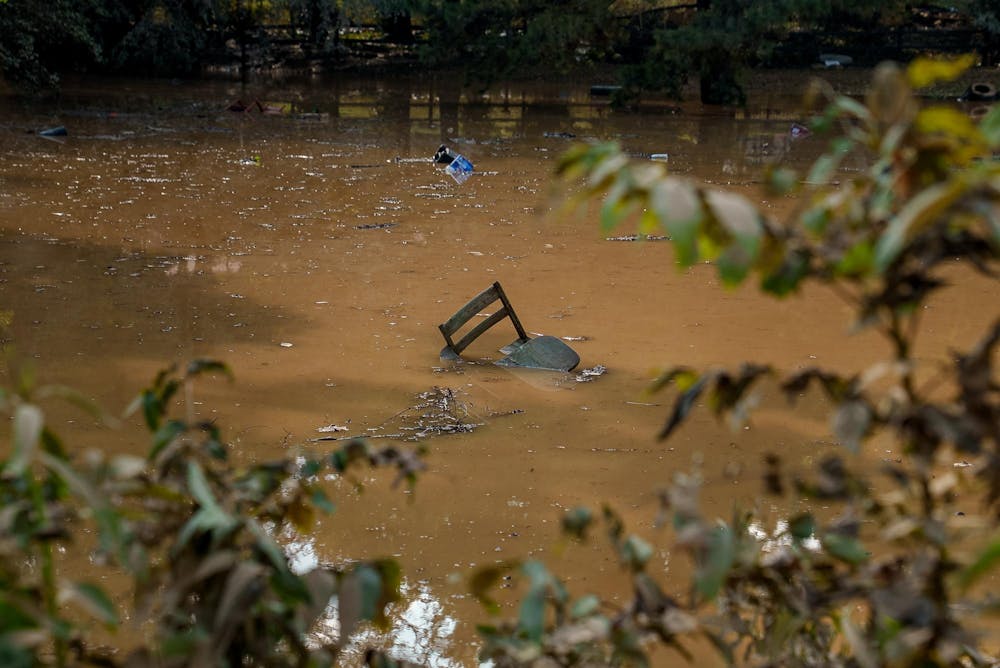
As North Carolina continues to recover from Hurricane Helene and now responds to the 2025 hurricane season, federal aid has become a point of contention between federal and state officials. With storms such as Tropical Storm Chantal and Hurricane Erin bringing further damage to the state, Gov. Josh Stein has demanded more federal disaster relief.
North Carolina has struggled to get the funding it wants from the federal government in the aftermath of Hurricane Helene in 2024. North Carolina Attorney General Jeff Jackson recently joined 19 other states in a lawsuit against the Federal Emergency Management Administration. The suit was in response to FEMA canceling a grant program, which provides over $200 million to protect North Carolina infrastructure, including preventative measures for water and sewer services that could be damaged by storms.
Gov. Josh Stein also expressed concern with the federal government’s response recently, saying that the federal government “has not met the moment.” According to Stein, the federal government has only covered 8% of Helene’s damage to North Carolina — which is about $5 billion in relief compared to roughly $60 billion in damages. The state legislature has passed multiple Helene relief bills, but they only amount to about 3% of the total damage the state incurred from the storm. Following Stein’s remarks, FEMA approved $96 million in Helene relief — less than 1% of the total damage costs.
North Carolina has had to deal with further damage from Tropical Storm Chantal in early July, which killed six people, left more than 100 roads impassable across the state and left over 5,000 homes in Alamance County without power.
In early August, Gov. Josh Stein wrote to President Donald Trump requesting that he declare a major disaster due to damages from Chantal.
It is important to note that disaster response is primarily a state responsibility according to North Carolina State professor Tom Birkland, a political scientist who has studied natural disaster policy for over 30 years. The federal government exists to support the states and local governments, but doesn’t replace them, Birkland said.
“There is a popular belief that if the insurance companies don’t come through, and if others don’t come through, that Uncle Sam is going to come through and make folks whole again, and that’s just not the way disaster response and relief happens in the United States,” Birkland said.
The Stafford Act, passed in 1988, established that the federal government covers 75% of eligible disaster costs and the state covers 25%.
Federal relief only comes into play when disasters surpass what local and state governments think they can manage, and then the governor requests a presidential disaster declaration which activates FEMA and federal aid, according to University of North Carolina, Chapel Hill, professor Miyuki Hino.
Hino, who is a professor in the environment, ecology and energy program at UNC, said FEMA and federal funding is typically allocated toward getting roads passable and clearing debris. FEMA also often reimburses local and state governments for relief spending. This comes amid an era of uncertainty at FEMA, which has seen millions of dollars worth of cuts and thousands of employees lose their jobs.
Additionally, Secretary of Homeland Security Kristi Noem — who oversees FEMA — has required her personal approval for any requests over $100,000, slowing the process down. President Trump has also said that following the 2025 hurricane season, he wants to disband FEMA altogether. The Trump administration aims to limit federal spending and shift more of the responsibility for disaster response to the states. Hino said these cuts might be playing a role in the lack of a federal response to Helene in North Carolina.
“FEMA has lost a lot of staff in the past seven or eight months, and a lot of this does come down to paperwork being filed and processed and payments going out,” Hino said. “It may just be taking a really long time to process some of these things because they’re so understaffed.”
Around 180 FEMA employees wrote to Congress last week, warning legislators that the changes to FEMA in recent months have undermined the agency’s ability to respond to large-scale disasters like Hurricane Katrina. They also said its leaders are unqualified. The following day, some of those employees were placed on administrative leave, according to the Washington Post.
FEMA has had a long and turbulent history that took a sharp turn following 9/11, which caused FEMA to be put under the umbrella of the Department of Homeland Security. Birkland said this caused FEMA to be buried within the organization and led to a lack of proper response to Katrina in 2005 — which killed more than 1,300 people. Much of the blame was placed on FEMA in the days after Katrina as it took days for federal help to reach New Orleans. Then FEMA director Michael Brown resigned two weeks after the storm.
Following Katrina, the Post-Katrina Emergency Management Reform Act was passed, which gave FEMA more autonomy and power. One of the key changes the act made was the requirement that FEMA had to be led by a professional, trained emergency manager. Every FEMA administrator since then has followed this rule until the current acting administrator David Richardson, who has no emergency management experience. Birkland said the cuts to FEMA are now reversing the progress FEMA made after Katrina.
“A lot of what’s happening at FEMA undermines the existence of FEMA, undermines the vision that Congress had for it in the Post-Katrina Emergency Management Reform Act,” Birkland said.
Hino said she trusts the FEMA workers who wrote the letter to Congress.
“These are civil service folks. These are people who got in it because they saw how terrible disasters can be and they wanted to make them less bad,” Hino said. “So if they’re concerned, then I’m concerned.”
Birkland believes that if the Trump administration were to eliminate FEMA, there would still be federal aid in some form such as a replacement emergency management organization, especially because members of Congress find it politically advantageous to respond to people’s pleas for aid. He said there is bound to be a “catastrophic disaster” that states can’t handle on their own.
Hino said it is almost impossible to consider the implications of a future without FEMA because it is so hard to figure out how federal aid would work without it.
Birkland said that although federal disaster relief can be politically advantageous, Trump’s decisions to make cuts to FEMA has a political undertone to it.
“I don’t understand why the president doesn’t understand what most of his predecessors did, which was having a good, well-run FEMA pays political benefits if you could be shown to be compassionate and helpful to local communities,” Birkland said. “This president, by and large, doesn’t like to aid states that he considered to be blue states or states that are against him politically, and it perhaps is a little bit more sympathetic to states that he seems to think are more aligned with his politics.”
North Carolina now faces an uncertain future and hurricane season that, according to Birkland, will see states like North Carolina on their own unless the federal government says otherwise. Birkland said that North Carolina might have the resources to handle disasters on their own, but it would likely require borrowing money from the operating budgets of local governments or raising taxes.
This hurricane season, which recently saw Hurricane Erin cause coastal flooding, has even more uncertainty as North Carolina’s disaster savings fund has been depleted from about $700 million to $110 million with the lack of a new state budget replenishing this fund, according to reporting from WRAL.
“You combine the fact that the feds aren’t spending money very quickly and that their management is not particularly expert in disasters, and combine that with a lack of a budget, that means that the recovery from this, from Chantal in particular, is likely to be very slow compared to some other disasters we’ve had in the state,” Birkland said.
Birkland said he believes the future of disaster policy could be shaped by the next big disaster. He said that if the U.S. faces a Katrina-size disaster in the next few years, the response would be even worse than Katrina. He said it would have severe political consequences that could finally force a change in the trend of partisan disagreements holding federal disaster relief up and make it a bipartisan issue.
As the 20th anniversary of Katrina passes, Birkland is concerned for the future of natural disasters in America.
“We thought we learned the lesson of Katrina, but we are rapidly unlearning what we learned in Katrina, which means the future of disaster relief in this country is very much up in the air,” Birkland said.