

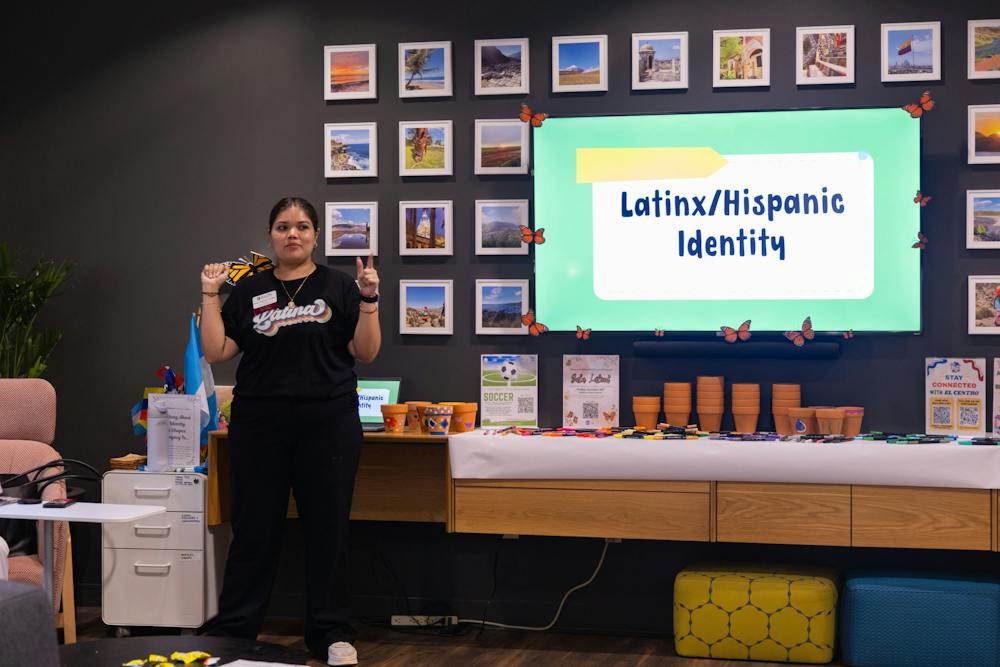
Senior Bella Espinoza is from Athens, Tennessee, has fair skin, red hair and talks with a southern twang.
Most people, she says, when they meet her, don’t believe that she is half Mexican.
“No one associates me with that unless they hear the last name,” she said.
Espinoza said she wanted to embrace her Mexican side, but she was raised not knowing a lot about her Latine heritage, and growing up in rural Tennessee made it even harder to find a community that could teach her more about it. She said being southern, as well, has made navigating her Mexican heritage more confusing.
According to research done by assistant professor of history at Duke University, Cecilia Marquez, Espinoza is not alone in this feeling.
“What does it mean to be both Southern and Latino?” Marquez said. “Those two identities aren’t often thought of as touching, but they really are for so many of us.”
In 2023, Marquez published a book called “Making the Latino South: A History of Racial Formation” in which she explores the history of Latines during the second half of the 20th century.
She said a lot of her students often try to figure out where they fit within the two different identities.
But it also comes down to definition. So, what does it mean to be Latine?
“What does it mean to be Latino enough?” Marquez said. “Is it about language? Is it about where you’re born? Is it about your connection to your home country?”
And how does being Latine fit into living in the South?
Well, Marquez explains that these initial thoughts of Latine, another name for Latino, identity stems from the Southwest.
“Much of how we think about what it means to be Latino comes to us from the West Coast, from the Southwest,” Marquez says. “It’s ideas about Latino history, Latino identity, Latino politics that were really formed in a place that isn’t the Southeast.”
Marquez said that at least since the 1970s, Latines have had a presence in the south in considerably growing numbers. Those numbers continue to today, including within Alamance County.
According to the U.S. census, 16.9% of Alamance County is Latine or Hispanic. At Elon University, 8.7% of the undergraduate population are Latine or Hispanic, the largest minority identity on campus.
Freshman Molly De La Rosa-Rivera lives just 20 minutes away from Elon in Mebane. She said growing up, she felt ashamed about her Mexican heritage.
“Here in the South it’s predominantly just white people, and the schools I started off on, they weren’t really places where I could really connect with anyone,” she said.
Then she went to high school where she recalled it being more diverse, and she was able to meet not only other Mexicans but Latine students from other nationalities.
“It was sort of healing for me to be able to learn how to appreciate my culture, and I feel now I can definitely say my culture and who I am is a very important part of me,” De La Rosa-Rivera said.
She said growing up she wasn’t able to mesh being Latine and Southern together, but now she tries to focus on keeping a balance between the two. De La Rosa-Rivera said when she was just a freshman in high school she felt shy and insecure about her identity, but now as a freshman in college, she’s more confident.
As she begins her Elon journey, she said she is ready to get involved within Latine-centered programs.
Marquez said that places like college can provide a special space for people to come together from different nationalities and help define what being Latine means to them.
“Especially at a place like Duke, a place like Elon, where you have a really diverse group of Latino students coming together, they’re trying to really make sense of what it means to be Latino together,” she said.
She said being Latino can change across different spaces, and she sees her own students struggle with the feeling of possibly not being Latine enough. However, she says she sees these fraught feelings as something productive, as a way for “us to create more welcoming, robust communities.”
Junior Andres Roldan Alvarado is a student coordinator at El Centro and the co-founder of Association Latino Professionals for America (ALPFA). He chose to work at El Centro because it has become an inclusive space for students regardless of ethnic identity.
“Working in El Centro, I was able to meet and make an inclusive space for everybody, and also learn about different cultures,” he said. “Cultures I’ve never known because of just living here in North Carolina.”
Growing up in Siler City, a small town less than an hour away from Elon, Roldan Alvarado said his family sort of keeps to themselves. His family is from El Salvador and Mexico, and he’s also grown up with a Guatemalan stepfather. Now being involved, he said he’s learned more about his own identity.
“Coming here, I was able to get introduced to different cultures, different traditions, traditions that maybe my family has lost throughout the years,” he said.
Now he’s ready to start his own tradition with ALPFA.
“It’s open for everybody so that more cultures can kind of help each other,” Roldan Alvarado said.
Espinoza said that no matter where she is on campus she feels the “big warm hug” from the Latine community. She also said that she is not only navigating her identity as both Southern and Latine for herself, but also her little sister.
“She’s also redheaded and Mexican, so it feels like I’m exploring this life for the both of us,” Espinoza said.
So what does being Latine mean for those growing up in the South?
For some it means embracing who they are no matter what.
“You’re confident and you’re loud and you’re yourself and you just like to defy all odds, no matter who’s against you,” Espinoza said.
For others it’s being proud of your Latine heritage while also finding a balance.
“I’ve been able to now proudly say that I’m Mexican, and also be able to find the balance between the two,” De La Rosa-Rivera said.
And for others it’s finding and creating places where they belong.
“I was able to really find where I belong, and be involved and help create a space for everybody,” Roldan Alvarado said.
Latine history is Southern history, Marquez said.
“The South is Latino,” Marquez said. “We are part of the South. We are embedded in this culture. We are embedded in this region.”
Charlotte Pfabe contributed to the reporting of this story.