

Two new laws are going into full effect Oct. 1 that add a new element to some public servants’ job descriptions: immigration enforcement.
The North Carolina General Assembly passed House Bill 496 and Senate Bill 153 in April and June, respectively. Elements of each increase interactions between Immigration and Customs Enforcement and some government agencies — specifically, Medicare providers and law enforcement. But their full provisions aren’t enforced just yet.
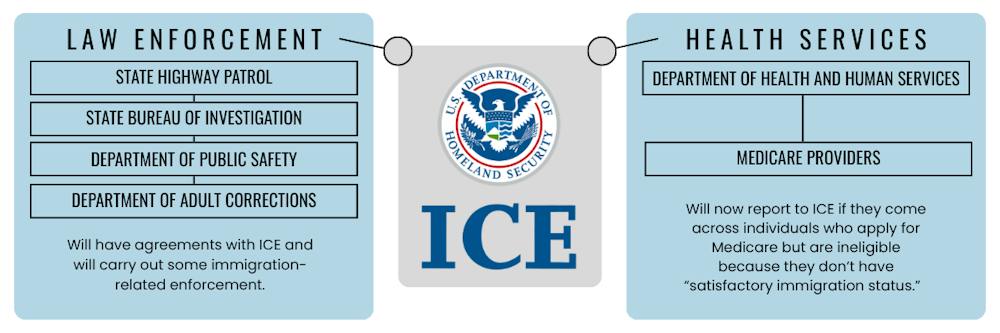
Once they’re official, the State Highway Patrol, State Bureau of Investigation, Department of Public Safety and Department of Adult Corrections will have agreements with ICE and will carry out some immigration-related enforcement.
Department of Health and Human Services employees will now report to ICE if they come across individuals who apply for Medicare but are ineligible because they don’t have “satisfactory immigration status.”
Assistant professor at Elon Law Heather Scavone said this particular provision could have unintended consequences because some individuals who are in the country legally may not be eligible for Medicare but could still be reported.
All three of Elon’s state congressional representatives: Amy Galey, R-N.C., Stephen Ross, R-N.C., and Dennis Riddell, R-N.C., voted in favor of the bills. Elon News Network reached out to all three offices but did not receive a response. The bills’ supporters say they’ll help protect the state’s borders.
But those against the bills are worried about potential wide-reaching implications.
In a press release after SB153 passed, North Carolina’s branch of the American Civil Liberties Union said, “SB 153 deepens the state’s entanglement with a system that spreads fear, confusion and harm, expanding the reach of reckless immigration agencies and greenlighting further abuse in our communities.”
Previous collaborations between ICE and local law enforcement have come in the form of 287G agreements which are part of a program that allows local law enforcement to extend their duties to include immigration-related tasks. They differ from SB 153 because they were voluntary and law enforcement only flagged individuals already detained.
Now they’ll start flagging others they encounter in day-to-day interactions such as traffic stops. Because U.S. citizens aren’t required to carry proof of citizenship, Scavone is worried about what happens when a legal citizen is stopped.
“There’s all these people who can be swept up with this risk of wrongful detention who are U.S. citizens, but based on a lack of immediately available paperwork, because we don’t have to carry it around,” Scavone said.
She also said there are legal concerns that arise when adding a new responsibility to job descriptions without the proper training.
“It is asking people who are not subject matter experts to make legal conclusions about the immigration status of individuals, and they are not equipped to do that,” Scavone said.
By Oct. 1, state law enforcement agencies must have official agreements with ICE and all provisions will officially be enforced.