

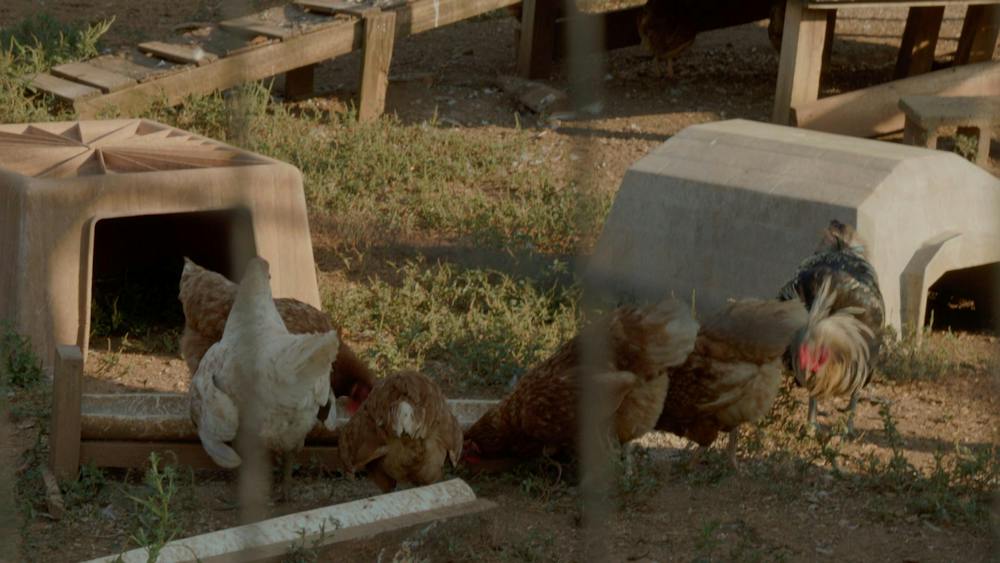
Burlington resident Frank Poppa would sing to one of his six hens, and she would sing back to him. Not only did his hens provide fresh eggs to the Poppa family of five, but he said they also felt like family.
So in 2023, when the police showed up at his doorstep ordering him to get rid of his backyard chickens or risk being arrested, Poppa was shocked.
“We love them, they all have names and they feed our kids, so it’s strange to be kind of like, ‘You’re doing a bad thing,’” Poppa said.
Dubbing himself, “chicken daddy,” he said he misses his chickens.
“They were awesome. It’s a good thing to wake up, sing to them in the morning and come home and see them,” Poppa said.
Poppa’s encounter with the law came after a 3-2 vote back in the spring of 2021 where the Burlington City Council voted against a proposal that would have allowed chickens on people’s private property.
“They just didn’t have a reason,” he said. “It’s just like, ‘That’s the way it is.’”
Five years later, the new city council is now revisiting this ban.
The move comes after a city survey this summer found that 72% of nearly 1,500 respondents supported allowing backyard chickens.
“There’s clearly an understanding and a support from the council that mirrors the support of the community,” Poppa said.
Council member Ian Baltutis was in favor of backyard chickens back in 2021, and that feeling has not changed. He said he sees backyard poultry as a form of food security for residents.
“People are asking for the freedom to do with their property what they want and keep backyard chickens, kind of in the same way you keep a dog in your backyard, except with the added benefit of some discussion about how it impacts resiliency of our food supply chain,” Baltutis said.
Poppa said two streets down from where he lives, backyard chickens are allowed.
“I just happen to be close to the county line, but it’s just kind of silly,” Poppa said.
An ordinance was drafted in 2021 that would have permitted residents to have up to four hens. Roosters were not allowed.
The ordinance also stated coops were required and had to be well ventilated. Enclosures had to be covered and attached to the coop.
According to a study done by Texas A&M, only 2.8% of owners vaccinate their flocks. Forty-nine percent of owners said they struggle with predators targeting their flock and 41% said their main struggle is deadline with disease and health of their flock.
For those worried about rodents and sanitation, the Center for Disease Control said proper management of chicken enclosures can help minimize those risks.
“I think the biggest thing is people think they’re gross or they think they’re dirty,” Poppa said. “If you don’t take care of them, then they can be, but they’re not just inherently dirty animals.”
Besides cleaning up after the birds, the CDC says it’s important for owners to wash their hands after collecting eggs or touching their chickens and to keep up with vaccinations to prevent disease.
According to the U.S. Department of Agriculture, in January of this year there were only 10 backyard chickens in North Carolina that were affected by the avian flu, and they were all in Franklin County.
Baltutis said on Monday, Sept. 14, the council reviewed a presentation on which areas would be included in the backyard chicken ordinance. Now, they are working on drafting a new ordinance that will likely land back into the city council’s agenda in either the October or November work session.
For supporters, the issue comes down to more than just keeping chickens, but it’s about having the freedom to produce their own food.
“We should be allowed to take care of ourselves,” Poppa said. “If you want to produce your own food, you should be able to do that.”