

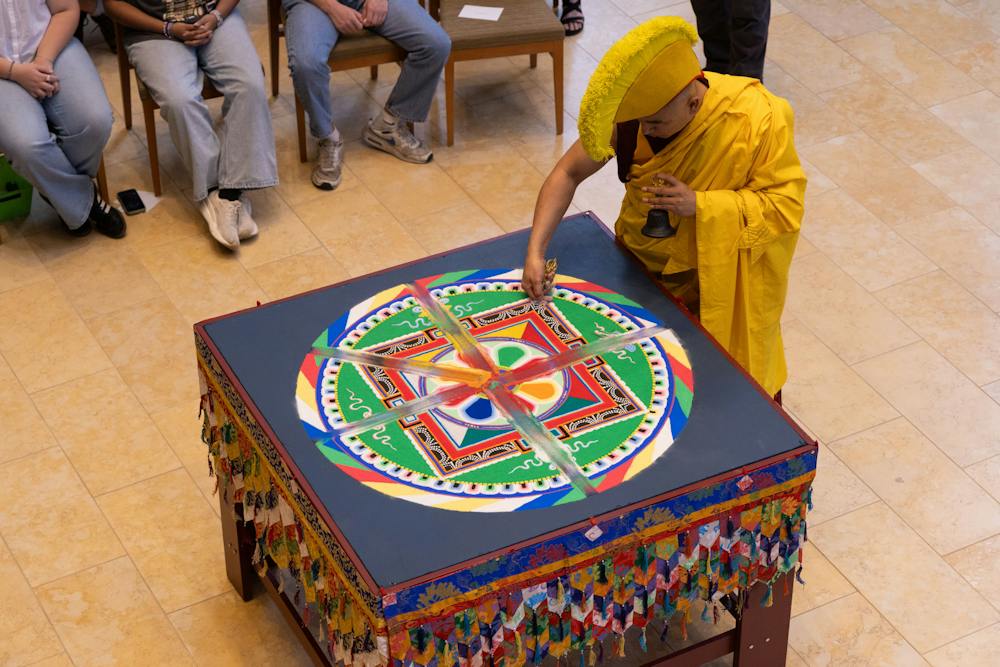
Elon University’s Truitt Center for Religious and Spiritual Life welcomed a Tibetan Buddhist tradition to Elon this week through the Green Tara Sand Mandala, a three-day event focused on healing, compassion and learning about Buddhism.
Tibetan Buddhist monk Geshe Sangpo crafted an intricate mandala from colorful sand in Numen Lumen Pavilion’s Sacred Space. Students, faculty and community members stopped by throughout the process to watch the design take shape.
Sangpo is originally from Tibet and studied in South India. He visited Elon as part of the Truitt Center’s annual Multifaith festival series, which introduces students to religious and spiritual traditions from around the world.
Along with the mandala construction, the event included opening and closing ceremonies and lunch discussions with Sangpo. The lunches were an opportunity to ask questions about Buddhism, Sangpo’s life as a monk and the meaning behind the mandala.
Senior multi-faith intern Aeiris Faloni said roughly 10 people attended each lunch session, which drew crowds from the Elon community and surrounding areas.
Faloni led a session on Friday, focusing on the idea of balance. She said the lunch was a good opportunity to learn about a different culture.
“We just have discussions about life, as well as different belief systems and the ways that we think about things,” Faloni said.
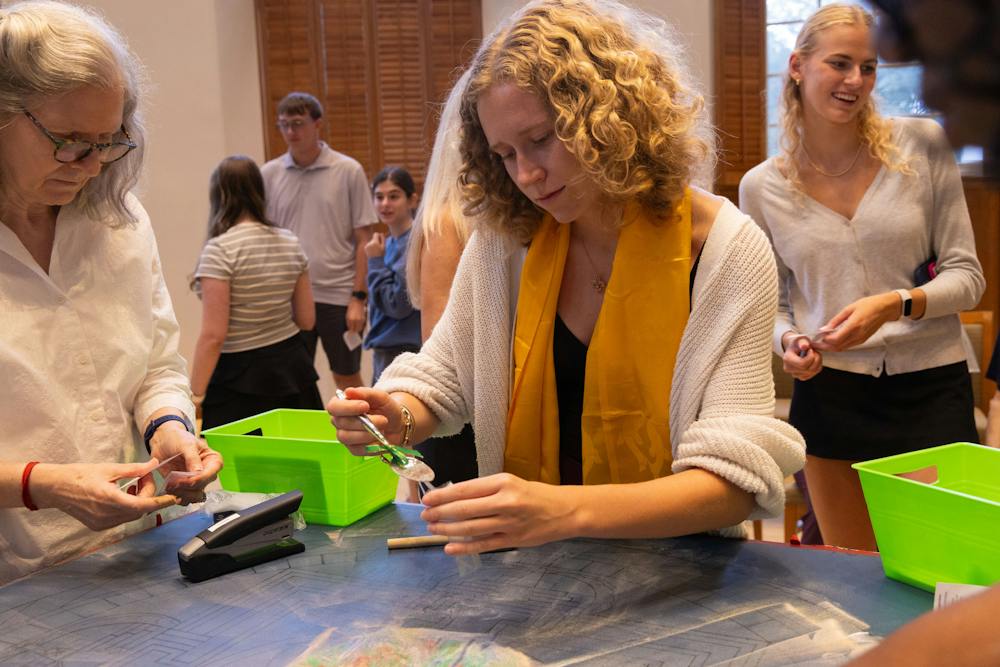
Multifaith intern Aeiris Faloni helps distribute the deconstructed sand mandala in the Truitt Center’s Sacred Space on Sept. 18.
The event also attracted students who had little prior knowledge of Buddhism. Junior Addison Anderson, another multi-faith intern, said she’s excited that students were willing to learn about a tradition that may have been unfamiliar to them.
“I saw freshmen take a risk and come here not knowing much about what’s probably happening, and it was really beautiful to see students actively engage with a topic that they know nothing about, and that might seem quite foreign to them,” Anderson said.
Anderson also said Sangpo’s personality helped students feel comfortable interacting with him.
“He's really funny. He loves to crack a joke,” Anderson said. “It's been really fun to see students kind of experience that and kind of get over some of their maybe stereotypes or assumptions about this experience.”
The mandala was designed to be temporary. During the closing ceremony, portions of the sand were distributed to community members. The intention is for them to take the sand to a body of water, allowing it to eventually spread beyond Elon.
Anderson said the destruction is an important part of the process.
“You spend two and a half days working tirelessly to construct this, and then you're like, why would I destroy something like that?” Anderson said.
Faloni said the ceremony’s focus on healing and compassion was especially relevant to students navigating the beginning of the semester.
“I think that what I'm taking away the most from the ceremony is that it is a mandala to inspire healing within the community, as well as to encourage compassion, which is something that is really important to the Elon community,” Faloni said.
Chloe Brown contributed to the reporting of this story.