


U.S. Immigration and Customs Enforcement operations have surged since President Trump began his second term. Meanwhile, the Alamance County Sheriff’s Office has worked hand-in-hand with the agency. Throughout that time, Elon University has remained silent as ICE operated in its own backyard, risking the safety of students, staff and faculty alike.
In November 2025, leading faculty at Elon University received an email from administrators Jon Dooley and Randy Williams. The message discussed questions the university had received from the Elon community on recent ICE operations in North Carolina cities.
But the email was just that: a discussion. Despite one “after-action item” to explore the addition of “know-your-rights resources” to the Rave Guardian app, no such changes have been made. In fact, the university has not released a public statement on ICE’s late 2025 arrests across North Carolina.
Elon’s many webpages show few results when it comes to resources for undocumented immigrant students. At time of publishing, Elon Academy’s “Planning for College” site provides links under the subheading “Undocumented Students.” Of the seven links, three are broken, including one labeled “Resources for Undocumented Students.”
While Elon sends emails, ICE looks to dramatically expand its presence in North Carolina. News outlets such as the Charlotte Observer and The Assembly report ICE keeping detainees — often indefinitely and without oversight — in three secret “hold rooms” across the state, negotiating contracts with private prisons to hold immigrants awaiting deportation and considering turning warehouses into detention centers.
The university confronted ICE during President Trump’s first term, with Elon University president Connie Book and other university leaders joining a 2020 lawsuit challenging a policy requiring international students to return to their home countries if their colleges moved to fully online learning. A statement was issued to the Elon community condemning the ICE directive and emphasizing the benefits of a diverse international student population.
No such action or statements of solidarity can be seen today.
Alamance County
Elon University should be held to an exceptional standard in the protection of its community due to Alamance County’s history of biased policing and ICE cooperation.
Alamance County Sheriff Terry Johnson gained national attention in 2012 after a lawsuit by the Department of Justice alleged that deputies of the Alamance County Sheriff’s Office were four to 10 times more likely to stop Latino drivers than non-Latino drivers. While the case was ultimately dismissed, the investigation indicated widespread bias at the sheriff’s office. The DOJ report said that Johnson fostered bias against Latinos, calling Mexicans “taco eaters,” for example.
In 2019, Johnson leased 40 beds of the Alamance County Detention Center to ICE. In November 2025, the agreement was terminated, but not out of anti-ICE sentiment. Johnson ended the agreement following the passing of NC House Bill 307 (Iryna’s Law), which made sweeping changes to North Carolina’s criminal justice system. Johnson feared that the changes would result in overcrowding at the already over-capacity center, and sought to prioritize beds for local inmates. Johnson, alongside Rep. Richard Hudson, has been in talks with ICE to renegotiate the contract, The Assembly reports. In an interview with The Assembly, Johnson said he feels “compelled” to help ICE enforce immigration laws.
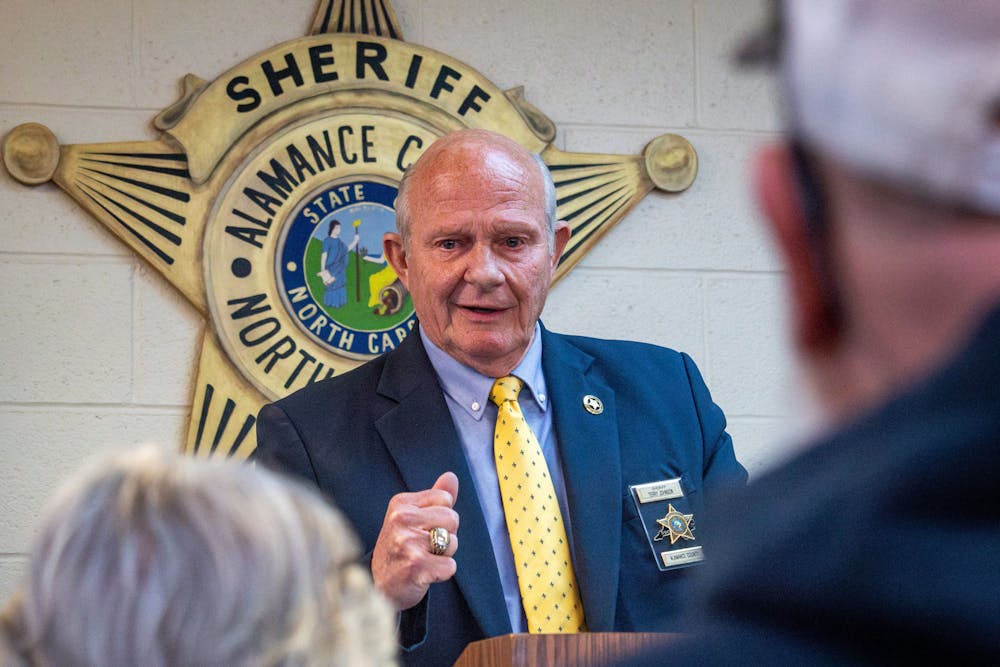
Alamance County Sheriff Terry Johnson speaks at a press conference April 4, 2024, in Graham. Johnson will be running for his seventh term in March 2026.
ICE and Alamance County are inextricably linked, at least under Johnson. But Alamance isn’t the only part of North Carolina where ICE is expanding.
In late 2025, the Department of Homeland Security conducted “Operation Charlotte’s Web” in Charlotte, NC, meant to target undocumented immigrants posing a threat to public safety, in which fewer than one-third of those arrested by border patrol were categorized as “criminal aliens,” according to CBS.
In January 2026, the American Civil Liberties Union acquired a heavily redacted document from DHS detailing plans to establish new ICE detention centers across the United States. One proposal suggested a site in Greensboro, about half an hour from Elon.
Legally, ICE cannot enter nonpublic areas at a university, such as dorms, offices and in-session classrooms without a warrant signed by a judge. However, the agency has not always followed the law. In January 2026, Columbia University student Ellie Aghayeva was taken from her dorm by DHS without a proper warrant. In October 2025, ProPublica found more than 50 instances of citizens being detained after having their citizenship questioned, a tally believed “almost certainly incomplete.”
Elon cannot rely on the expectation that ICE will act in good faith. Under the Trump administration, broken websites and the absence of clear, public statements are detrimental to student safety.
How did we get here?
So why, while espousing the “global experience” and “inclusive excellence,” has the university turned a blind eye to the support of immigrant students in this dangerous environment? Like many other issues the Elon community takes with the University’s administration, it may be about money.
Elon received $6.3 million in federal funds during the 2025 fiscal year. In the past, institutions that have opposed the Trump Administration’s agenda have been aggressively targeted with funding cuts and federal probes. Perhaps Elon’s administrators fear retaliation for protecting immigrant students against unlawful immigration enforcement practices.
Given its demographics, Elon is more likely to have a smaller immigrant population than other schools. Could the university believe the population of at-risk students too small to risk the consequences of substantial action?
What can we do?
Where Elon fails to fulfill its duty to protect immigrant students, others have filled the gap. Individual faculty have hosted Siembra NC, providing training on identifying and reporting ICE vehicles, allowing the organization to notify local communities. Through training, you can join the effort to protect Elon and North Carolina’s immigrant communities, so be on the lookout for upcoming events.
American University, a peer institution of Elon, issued a statement less than a month after President Trump’s inauguration, reaffirming its commitment to a diverse community, outlining its approach to immigration-related matters, and providing detailed guidance on what to do if agents arrive on campus.
In the five months since Dooley and Williams’ email, the Elon community at large has received no guidance from the University on immigration enforcement. Since Trump took office, 41,047 people between the ages of 18 and 22 have been arrested, according to the Deportation Data Project. In January 2026, the State Department announced the revocation of 8000 student visas.
Elon’s mission statement commits the University to fostering “a respect for human differences, passion for a life of learning, personal integrity, and an ethic of work and service.”
When we consider Alamance County’s hosting of ICE and its inhumanity, Elon becomes an island, and Elon’s leadership has done little to fight the rising tide.
Students and faculty now construct their own levees against the crashing waves, unsupported by administrators. Even when it comes to the most basic steps, such as expressing solidarity with immigrant students or explaining our rights, the university has chosen to avoid the costs of protecting students.
If Elon cares to fulfill its own mission and duty to student safety, it should condemn the actions of ICE and Alamance County’s association with it. It should act as a bastion of humanity, not a doormat for authoritarianism. Even the bare minimum, such as ensuring website links work, would be miles ahead of what we see today.