

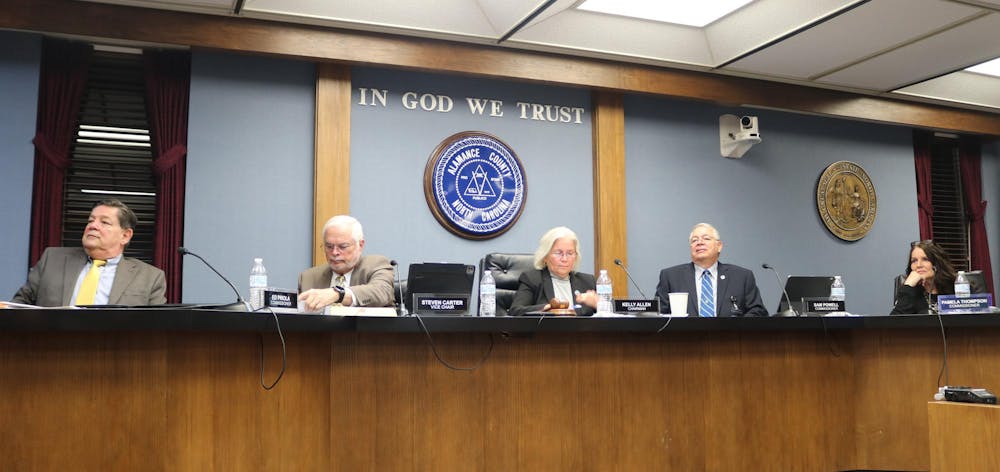
With landfill debates and local boards, the Alamance County board of commissioners makes decisions that shape policies affecting residents across the county.
The board is made up of five elected officials: Chair Kelly Allen, Vice Chair Steve Carter, Ed Priola, Sam Powell and Pamela Thompson. Commissioners are elected to four-year terms, with seats appearing on the ballot during general election cycles.
Allen was appointed to the board in 2024 and is up for re-election in 2026. She received one of two Republican Party nominations during the March 3 primary election. Allen did not respond to Elon News Network’s request for comment.
Carter received the second Republican nomination. He was first elected to the board in 2018, reelected in 2022, and is now vying for a third term. There are no term limits enforced on county commissioners.
According to the Alamance County website, Carter is assigned to five committees. Carter said that the work he does extends beyond the Commission’s semi-monthly meetings and that he is receiving calls from constituents daily.
Carter said he hopes the work he does on the commission leads to real impact on residents.
“I love where I live, and I love the people, and I’ll always look at it from doing the right thing for Alamance County,” Carter said.
Priola was elected to the board as a Republican in 2024 and will be up for reelection in 2028. Priola did not respond to Elon News Network’s request for comment.
Powell was appointed to the board by the Republican Party in 2026 after the death of John Paisley Jr. He will also be up for reelection in 2026, but that race will be a separate, unexpired term election. Powell did not respond to Elon News Network’s request for comment.
Thompson was elected to the board as a Republican in 2020 and reelected in 2024. Her seat will be up for re-election in 2028.
Thompson changed her political affiliation to unaffiliated in 2025. Thompson said she made that decision because she wanted to focus on leadership rather than party alignment.
Thompson said much of her work focuses on human services, including addressing the opioid crisis, expanding mental health resources and supporting recovery programs.
She said her role as a commissioner often involves working directly with residents outside of formal meetings.
“I’m always working with the public,” Thompson said. “I like to go to any kind of event that people invite me to, because I want them to know no matter where I’m at, they can talk to me about anything.”
While commissioners cast votes during meetings, much of their role extends beyond the boardroom through coordination with county staff and ongoing engagement with residents.
Heidi York, the county manager, said her office is responsible for implementing the board’s decisions and managing daily operations across departments. York was appointed by the board of commissioners.
Staff in the county manager’s office act as a bridge between commissioners and departments, helping translate policy decisions into action.
Brian Baker, an assistant county manager, said his role includes representing departmental needs to leadership and ensuring services are delivered regardless of budget constraints.
Commissioners also rely on staff for information as they respond to residents and evaluate issues. York said she is in contact with commissioners on a daily basis, often helping answer questions tied to constituent concerns.
Outside of formal meetings, commissioners spend significant time in the community. According to Baker, staying informed is essential to decision-making.
“If they just sit in the boardroom, and that’s the only time they pay attention, they wouldn’t be able to make the proper decisions,” Baker said.
On April 20, the Commission held a business meeting where many members of the community shared their opinions on debates such as land use and education. Allen extended the public comment section from 30 minutes to one hour to accommodate the high number of people who signed up.
During that meeting, commissioners approved the heavily debated LCID landfill. Baker said that this approval was the third step in the process, and now his office will be tasked with issuing the permit.
Commissioners heard concerns from residents about the proximity of the landfill to their property, as well as arguments from lawyers on both sides of the proposal.
“It’s a very difficult decision between what landowners are allowed to do with their property, and what security you have about what’s gonna happen on your neighbor’s property,” Baker said.
Baker said this decision was complex and recurring.
“These planning and zoning discussions are very cyclical, and they’ve been cyclical for the past 50 years,” Baker said.
Residents also voiced concerns to the commission about large-scale development and underfunding of the Alamance-Burlington School System.
Baker encouraged people to continue to engage with the county commission even when large decisions like the landfill are not actively being discussed.
“I think a lot of times, people don’t know how to get started in activism or representing their community, and the answer is to do it at the local level,” Baker said.