

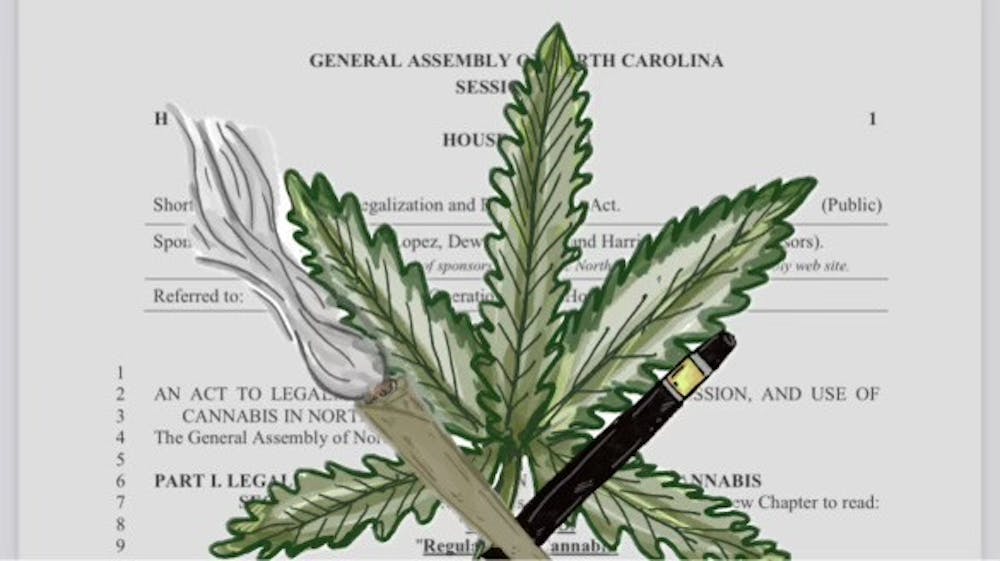
A report from The North Carolina Advisory Council on Cannabis’s recommends to lawmakers the legalization of marijuana, allowing adults to legally purchase, possess and use cannabis through state-licensed retail outlets.
Currently, North Carolina is one of ten states without a regulated market, according to the report. The council outlined several drawbacks of this, including how there is no minimum age requirement on intoxicating hemp-derived tetrahydrocannabinol, or THC, products.
The Trump administration signed an order to reclassify medical marijuana from a Schedule I drug to a Schedule III drug April 23. In a post on X, acting Attorney General Todd Blanche said the order will “enable more targeted, rigorous research into marijuana’s safety and efficacy, expanding patients’ access to treatments and empowering doctors to make better-informed healthcare decisions.”
Marijuana is illegal for both recreational and medical use in North Carolina. Hemp is federally defined as cannabis containing no more than 0.3% delta-9 THC and is legal in the state.
When the federal Agriculture Improvement Act of 2018 removed hemp from the federal Controlled Substances Act, North Carolina removed hemp from the state list of controlled substances. The report notes how North Carolina, unlike many other states, did not implement a system to oversee the production and sale of cannabinoid products.
Kelly Riddle founded the North Carolina Cannabis Chamber, an organization advocating for workforce development, economic growth and community advocacy. Riddle said the lack of oversight on the cannabis industry is concerning, but the presence of hemp producers in the state sets a foundation for future development.
“We don’t have a regulated framework,” Riddle said. “That means there’s no governing body, anything from FDA to a state regulator doing any kind of controls over the products that are out there. The good news is we have a lot of really reputable operators who also operate in highly regulated states. So we have a very strong, reputable market here just in the hemp space.”
The Marijuana Legalization and Reinvestment Act, filed in the NC House of Representatives in March 2025, would legalize possession and regulated use of marijuana for adults. Riddle said this legislation would be regulating a market that already exists and is lacking oversight.
According to a 2023 U.S. cannabis report, North Carolina has the second-largest illicit cannabis sales worth an estimated $3.2 billion in 2022.
“If a key objective of regulation is to disrupt illicit markets, that end is being achieved by providing people who want to consume cannabis with a legal alternative that protects consumer safety,” the council’s report states.
As discussions continue throughout the state about the future of cannabis, Riddle said the biggest thing she hopes for is access.
“That’s what I want to see, is access to people who choose this as an alternative for an adult-use market, access for people who need this as a medicine, access to, you know, true research and information to understand this product and how it interacts with our bodies,” Riddle said. “That would be the perfect future to me.”