

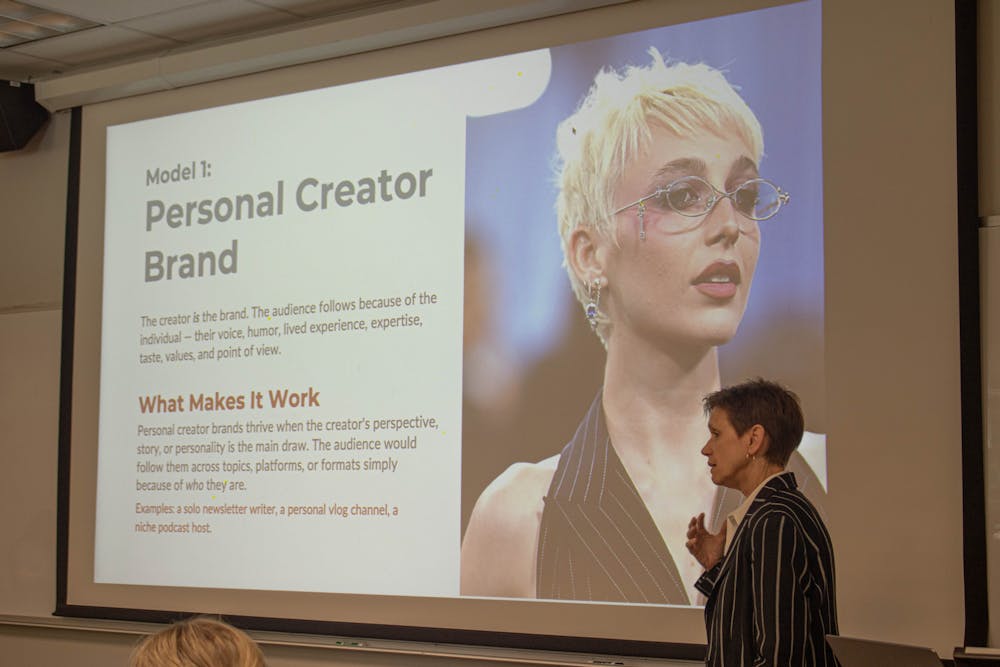
After just one year of being launched, the newest majors at Elon University, neuroscience and digital content management, are already gaining traction among students and faculty. They reflect both long-standing interest and rapidly changing industries.
Digital content management developed in about a year and was designed in response to the rapid expansion and shift towards digital media in communication industries. Faculty who teach the course describe it as a way to align academics with a marketplace where digital media, content creation and analytics overlap.
Laura Lacy, a professor of digital content management said,
“The goal of the new major is to basically recognize how fast things are changing in a modern environment all the time and help our students have another avenue to prepare in ways that interest them,” Lacy said.
Rather than focusing on only creating content, the major emphasizes understanding how digital content functions. Students are introduced to concepts such as audience targeting, platform algorithms and branding strategy.
“We’ve talked a lot about social media,” Lacy said. “We’ve talked about some calls to action, everything from how to get people to persuade people that a brand has knowledge or expertise in something, or come across as authentic.”
Other courses help students analyze independent creators, brand-based content teams and media organizations, comparing how each uses platforms differently.
Strategic communications professor Michelle Lashley teaches digital content and the creator economy.
“Successful content doesn’t just happen,” Lashley said. “There is a strategy behind it and it’s not just about going viral. It’s about learning, about audiences and who your audience is.”
Vic Costello the program director of digital content management said the major was intentionally designed to complement other areas of study and many students are double majoring in fields in the communications school as well as outside. He said this reflects the reality that digital content skills are now in multiple industries.
“It goes with anything and everything,” said Costello.
Costello said roles in nearly every industry now require some form of digital content expertise.
“In 2025, digital overtook traditional advertising globally,” Costello said. “That shift tells you everything about where the industry is going.”
Costello said at the beginning of registration, there were 38 digital content management majors and they are expected to reach 50 majors by the end of its first year. That number reflects student curiosity and growing awareness of the role digital media plays in professional environments.
Sophomore Claire Moorhead, who is majoring in cinema and television arts with a digital content management minor, said she was first introduced to the program in a course taught by Costello, before officially declaring the major in her first year.
“It just sounded really interesting,” Moorhead said. “It seemed like a really interesting way to examine my film background through a corporate lens, because every company in the world essentially needs a social media manager.”
Moorhead also said the program’s breadth has been a major advantage.
“You’re really getting classes from every single area within communications,” Moorhead said. “It feels like you’re optimizing yourself for the professional world.”
The curriculum has courses ranging from cinema and television arts to strategic communications and media analytics, blending different areas of study into one program.
Moorhead said that the major has already provided tangible professional opportunities, particularly in competitive internship markets.
“I got a ton of interview requests and offers for internships,” Moorhead said. “For a lot of these jobs in LA, it’s important to know a little bit of everything.”
At the same time, the neuroscience program has undergone changes. After years of student demand and faculty development, the minor has officially been declared a major.
Matt Wittstein, associate professor of exercise science and director of the neuroscience program said there was a lot of demand.
“We knew there was interest. We had something like 170 minors, so the demand was already there,” Wittstein said.
William Schreiber, associate professor of psychology, said the transition from major to minor has changed the rhythm of student engagement.
“I no longer have students asking me when the neuroscience major is going to exist,” Schreiber said, noting that demand had been present long before the official major launched.
The program was built around encouraging students to to integrate diverse disciplines like biology, psychology, chemistry, exercise science and more.
“We don’t want our students to feel like a biologist that does neuroscience or feel like a chemist that does neuroscience or an exercise scientist that does neuroscience,” Wittstein said. “But instead they feel like a neuroscientist that answers questions from a certain field, using neuroscientific approaches.”
In its first year the neuroscience major has enrolled 62 students, with three seniors this year.
Senior Hallie Beeker, started as a biology major and added on neuroscience. The program has provided flexibility and a well-rounded academic structure.
“I’ve loved every professor I’ve had,” Beeker said. “They’ve really allowed me to explore the brain in new ways and tailor my experience to what I’m interested in.”
Beeker said her experiences in the major have prepared her for a future in medicine which she plans to pursue after a gap year working in surgical camps in India.
“I think it’s prepared me really well for medical school,” Beeker said. “It allowed me to explore my interests and go beyond what I originally thought I would study.”
Even in their first year, both majors are already drawing attention from prospective students. Faculty said they see strong interest at admissions events, and some students have said the new programs are a deciding factor in choosing Elon.
“They see it and they know what it means,” Costello said. “It resonates right way.”
As neuroscience and digital content management move into their second year, professors said both programs are still in their early stages, but are expected to play a growing role in Elon University’s academic landscape.
Looking ahead, both majors are expected to continue evolving. Neuroscience hopes to expand hands-on learning opportunities and eventually develop dedicated lab spaces for student research.
Digital content management will continue adapting to rapid changes in technology and media consumption. Faculty are updating coursework to include new tools and trends including artificial intelligence and emerging social media platforms.