

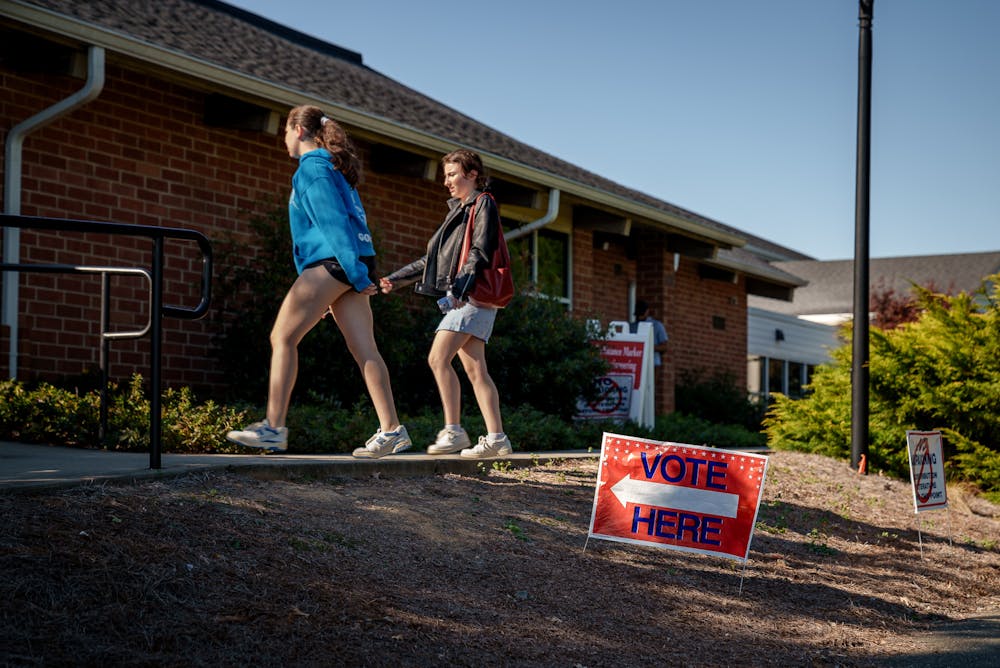
The College Democrats of North Carolina and four college students sued the North Carolina State Board of Elections and several state and local election officials over the denial of on-campus early voting sites for the 2026 primary election.
At their meeting Jan. 13, the NCSBE heard from 12 county boards of elections that had not come to unanimous decisions on their early voting plans. They sided with majority decisions made by the boards of elections in Guilford and Jackson counties to reject early voting sites at the University of North Carolina Greensboro, Western Carolina University and North Carolina A&T State University.
An on-campus early voting site at Elon University was also rejected by the NCBSE. Three locations in Alamance County will be open to early voters: the Graham Recreation Center, the Kernodle Senior Center in Burlington and the Mebane Arts and Community Center.
On Jan. 27, the College Democrats of North Carolina and students from UNCG, WCU and NC A&T sued the NCSBE.
The plaintiffs claimed early voting site restrictions violated the 26th Amendment by targeting young voters and the 1st and 14th Amendments by erecting needless voting barriers.
On Feb. 2, U.S. District Judge William Osteen scheduled a hearing for Feb. 5 on the NC College Democrats’ request for an injunction or temporary restraining order. The request was filed to secure polling locations on the three college campuses named in the lawsuit before early voting begins on Feb. 12.
While NC College Democrats have taken the lead on finding plaintiffs and bringing a legal case, North Carolina Democratic Party Chair Anderson Clayton said the party is helping to fund the lawsuit.
“It’s important that we fight because we always want to be the party of protecting people’s right to vote, and that’s what Democrats stand for,” Clayton said. “Especially young people, who have been told their entire lives that, ‘You should be thankful for the rights that you have, and you have no idea how hard it took for us to fight for them.’ Young people understand it, because they’re still having to fight for those same rights that people have oftentimes told them were inevitable to them.”
The NCSBE claimed on-campus early voting sites did not yield enough turnout to justify the cost of staffing. They also cited accessibility and parking concerns. Clayton said the North Carolina Democratic Party is concerned these reasons do not accurately reflect the NCSBE’s motivations.
“People try to sugarcoat the fact that they just do not want college students to have the right to vote on their campus by using excuses to say, ‘There’s no parking, or there’s no x, y or z,’” Clayton said. “That’s not really the reason why.”
The NCSBE also denied Sunday voting hours in five counties: Brunswick, Columbus, Craven, Harnett and Greene. Sunday early voting is often used by Black churches for “Souls to the Polls” voting drives.
North Carolina A&T is the largest historically Black college or university in the United States, and Clayton said the move to deny an on-campus voting site there targets Black voters.
“At A&T, it’s just tragic because it is disenfranchising a Black population of students who oftentimes have been the number one target for trying to have their voting rights taken away,” Clayton said.
According to Clayton, the Republican Party, especially in North Carolina, has a history of supporting efforts that restrict young voters.
In 2016, then-executive director of the North Carolina Republican Party, Dallas Woodhouse, urged county elections boards to limit early voting hours, Sunday voting and college campus polling locations.
“No group of people are entitled to their own early voting site, including college students, who already have more voting options than most other citizens,” Woodhouse wrote in an email to GOP election board members in 2016, according to the Charlotte Observer.
In September 2025, Woodhouse was appointed to serve as the state auditor’s liaison to the local and state board of elections. Clayton explained that Woodhouse’s position allows him to once again target college voting sites.
“We now know Republicans, at every advantage, will try to disenfranchise college students and young voters because they know that they can and they are afraid of their vote,” Clayton said.
According to the NCSBE, early voting in North Carolina will run from Feb. 12 to 28 and the primary election will take place on March 3. The injunction request filed by the NC College Democrats asked the NCSBE to hear their case before early voting begins.
North Carolina College Democrats president Nathan Linville and plaintiff Zayveon Davis declined Elon News Network’s request for comment.
University of North Carolina Greensboro College Democrats, Western Carolina University College Democrats and Elias Law Group — the legal group representing the plaintiffs — did not respond to Elon News Network’s request for comment.