

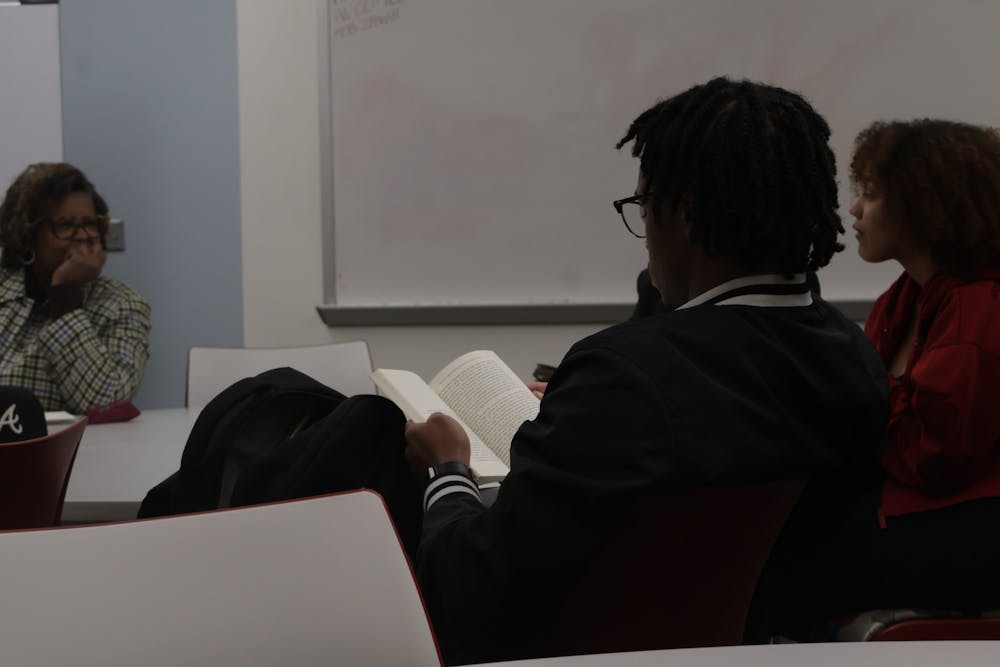
Students gathered at Elon University’s Belk Library on Feb. 17 to share poetry and prose with the Elon community —turning literature into an opportunity for expression during Black History Month.
The event opened with a reading from assistant professor of English Dan Burns, who shared an excerpt from “The Nickel Boys”. He chose the book knowing that he was about to head over to Global Neighbourhood for a film screening of the movie adaptation.
Alison Van Norman, outreach and marketing librarian and assistant librarian, first started this event three years ago. Norman was inspired by other libraries that have incorporated African American-centered literature into the month’s programming. Starting the event, she said she was excited. She said this event is a space for students to learn about new authors and books, hopefully prompting them to check one out afterwards. She even came prepared with her own selection, “The People’s Project.”
“I’m looking for community and hope and moving forward, since it’s a difficult time in history,” Norman said. “That’s what this book is meant to do, acknowledge the struggle, but think about collectively moving forward.”
Assistant English professor who specializes in African American literature, Ben Murphy, helped Norman host the event. He encouraged his students to attend, stating that anyone and everyone can take something away from reading with their peers in a welcoming setting.
“It’s a space for people to express frustrations, desires, hopes, all these things that come from the outside world, and are very much a part of our little Elon bubble, even if we try to pretend otherwise sometimes,” Murphy said.
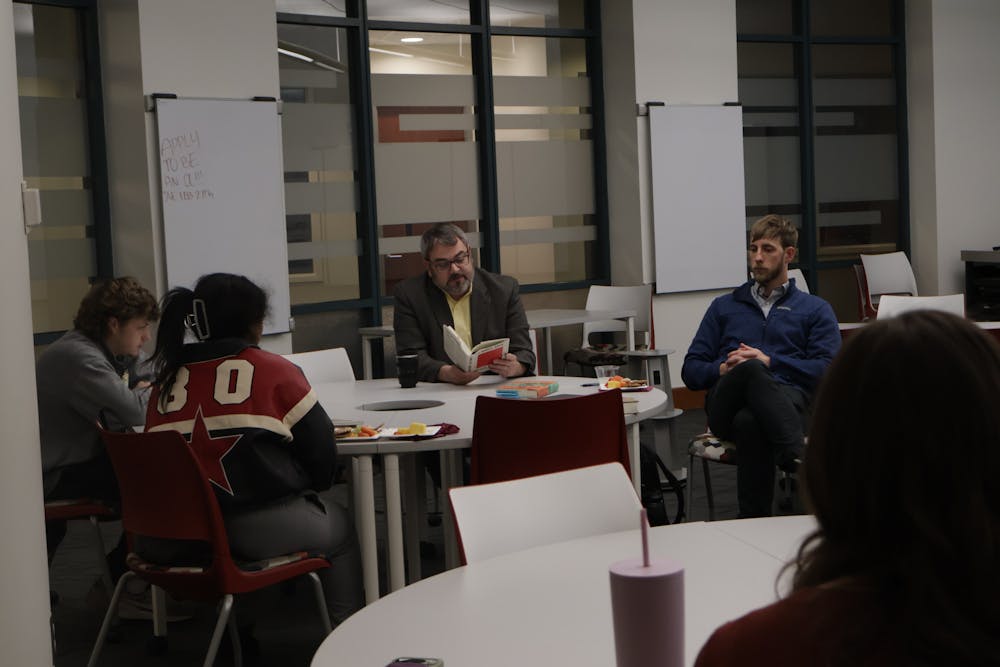
Students and faculty listen to Professor Dan Burns read a passage of The Nickel Boys.
Elon sophomores in Murphy’s Harlem Renaissance class, Will Leonard and Makiah Grindstaff, attended the event thinking they would only be listening for extra credit. Instead, they became active participants. Leonard brought a book from Murphy’s classroom, “The Autobiography of an Ex-Colored Man” by James Weldon Johnson. This prompted discussions on biracial identity, racial passing and hate crimes, particularly those related to lynchings and burnings. While students did not always agree, the conversation remained respectful, with classmates building on one another’s interpretations rather than dismissing them.
Murphy noted that themes explored during the read-in often reflect broader cultural conversations.
“Two years ago, there were a lot of readings focused on the power of education as voiced from an African American perspective,” Murphy said. “That came amid lots of concerns about control over curriculum, and telling people what they can and can’t teach.”
Although the topic this year was different, students still connected literature to present-day realities. Grindstaff expressed her disbelief that lynchings were not federally classified as hate crimes until 2022, when the Emmett Till Anti-Lynching Act was passed, highlighting how the legacy of racial violence remains painfully recent.
Even as students unpacked complex issues, the tone remained light. Friends laughed and playfully “peer pressured”, as Murphy said, to contribute when the room got quiet, moments that led to some of the most engaging exchanges of the evening. For Murphy, those exchanges are precisely what make gatherings like this meaningful.
“It’s cliched to say, but we have a very fast-paced and image-obsessed culture, but I think there’s a lot of reflection and insight,” Murphy said. “All these things that can be gained from just spending time with poetry, or lyrics, or even just quotes.”