

Elon University is ranked the ninth best high-tech college campus by University Magazine, a publication that reports news about colleges and universities to inform students and prospective students. It is the highest ranking high-tech campus in the state of North Carolina, above Duke University at twelfth.
According to University Magazine, the ranking was based on how technology on campuses interacts with students to improve learning. Elon was praised for its practical application of technology in the classroom, and across majors.
Christopher Waters, assistant vice president of Information Technology and Chief Information Officer, was unavailable for an interview but sent a statement to Elon News Network. He wrote that IT at Elon works to support Elon University’s core values of engaged and experiential learning.
“At Elon, we are always researching and planning as we expand facilities and the existing technologies change that support our work, community and educational opportunities,” Waters wrote. “Our goal is to maintain our existing infrastructure while always keeping an eye on the future.”
An example of technology in the classrooms is the Innovation Quad — home to Elon’s engineering program and department of physics. The IQ gives students access to engineering equipment and workshops, as well as biology labs and classrooms.
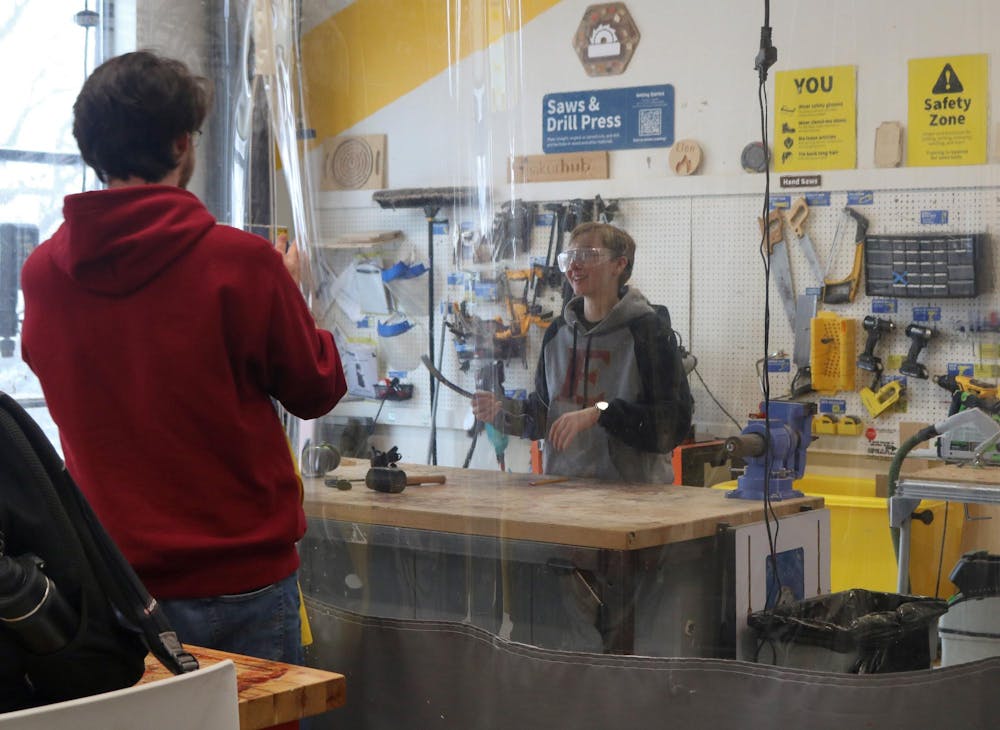
For students across all majors, The Maker Hub is open to students and faculty. The Maker Hub has 3D printers, laser engravers, sewing machines and more in its stations in the Colonnades Neighborhood and downtown Elon.
All students need to do to access the Maker Hub’s resources on their own is to complete training courses on Moodle. After that, they are free to use the equipment they just trained on. Junior Annika Benander, an employee at the Maker Hub in the Colonnades neighborhood, said it’s a great place for educational, social and personal use.
“I really think it's important to have a safe space to try things, learn how to problem solve and use your creative brain,” Benander said. “I think it's also great for sustainability, learning how to upcycle and not throwing away something just because it's broken.”
The Maker Hub also works with classes to make learning more hands-on. Examples posted on the Maker Hub’s website include business students turning their product prototypes into real objects, arts and humanities students making chainmail armor, and science students 3D printing a hand to show the tendons in the arm.
Junior Michael Fath has been working at the Maker Hub’s downtown location for a little over a year. Though his political science major has little overlap with his work at the Maker Hub, he said he has still learned a lot from his work.
“If I want to make something I now have the skills and the knowledge of how to make that, but also I know what to look for when making something,” Fath said. “If I want something to help organize my room, my first thought isn't ‘I should go to Target,’ it's ‘I can spend 30 minutes or 45 minutes making a little thing for that.’”
The Maker Hub is funded by Elon University. Though its main audience are students, the Maker Hub has also collaborated with local organizations who need the tools the Maker Hub has. According to Benander, collaborations include 3D-printing soap molds for Benevolence Farms, and working with Tikkun Olam Makers to create toddler mobility trainers.
Elon University’s artificial intelligence platform, ElonGPT, brought Elon University into the artificial intelligence sphere. The platform was launched in September 2024 as a way for students to connect to Elon alumni and ask questions. ElonGPT uses a database of Elon University resources, in order to give students answers that fit to their on-campus experience. Since launch, the platform has expanded to include its own chatbot and advising help.

Elon University works to maintain ethical AI use by following the six AI principles laid out by the United Nations Internet Governance Forum in October 2023. Mustafa Akben, director of artificial intelligence integration at Elon, said these principles help to make sure human ingenuity is at the center of Elon’s work with AI.
“We see that some people are very eager to adopt early, while others are cautious, and rightfully so,” Akben said. “My team and I have provided support for each group, and we try to be critical about this technology rather than accepting it uncritically.”
In development now, Akben is working on creating a version of ElonGPT that will help act as an AI learning support system for students. Akben has not set deadlines for a widespread release, in order to properly understand the benefits and impacts of the AI before release. The AI will use resources provided by teachers for its database, and will provide answers based on proven teaching strategies to ensure students are able to enhance their learning.
Teachers will also be provided data on anonymous questions asked about their classes. Akben said this will help teachers know what to help their students with, furthering education on both sides.
“We utilize all the learning sites behind the scenes, and it is not like ChatGPT,” Akben said. “When you say, ‘Hey, can you write my essay,’ it'll deny it. “It will say, ‘I'm not going to write your essay, but we can brainstorm and I can give you feedback.’”
The new ElonGPT system will function similarly to other chatbots, but with a deeper focus on education. Akben said the AI will base its responses on information provided by faculty members, opposed to ChatGPT which can access the whole internet. The AI will also use interaction history with the student specifically to identify areas that need improvement, and will suggest ways to improve their learning.
One of the major concerns with AI models is privacy, and where the information shared with these chatbots goes. Akben said Elon recognizes the importance of finding a trustworthy Large Language Model to base ElonGPT on, so students can trust their information is safe. Akben also said that, while this idea could be years away, he wants Elon University to develop their own LLM to operate ElonGPT on.
As technology continues to rapidly advance, Elon is working to keep up while keeping students and faculty as the focus. Waters wrote that through regular communication between IT, the Provost and the Vice President for Academic Affairs, the technological needs of students and faculty are kept at the forefront of change.
“Elon's core values include engaged and experiential learning,” Waters wrote. “Our partnerships with faculty and programs of study allow students to get real experience using technology to support them after graduation. As AI continues to emerge in new ways, Information Technology is there as part of the backbone to connect systems, protect data and provide training for the community as we learn together.”