

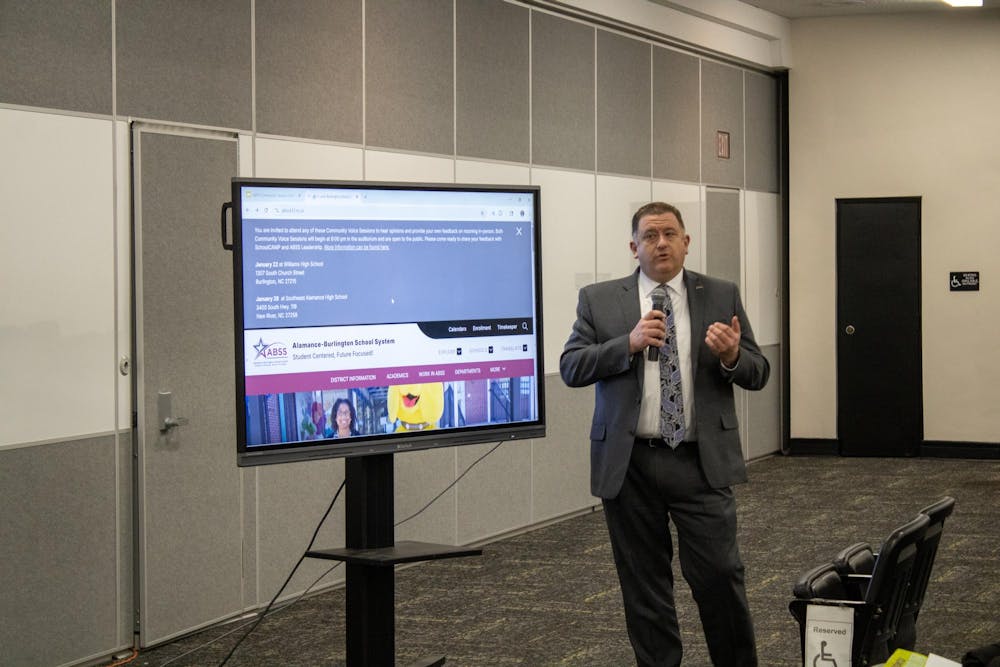
The Alamance-Burlington School System has a six-step plan for its district-wide rezoning, developed in collaboration with SchoolCAMP, a professional consulting firm affiliated with North Carolina State University’s Institute for Transportation Research and Education.
The plan, currently in its second phase, is expected to be complete by spring 2026. It includes a land use study, community engagement, zonal mapping, a board vote, family notification and implementation. The rezoning will then take effect in the 2026-27 academic year.
By using community feedback and careful analysis, the rezoning plan is intended to balance enrollment and access, efficient transportation and long-term stability, according to the ABSS School Capacity & Student Assignment page. In the second step, zonal mapping, new district maps will be developed. Families will be notified about new student assignments in April and May 2026.
During the community engagement phase, the district surveyed the community to gather feedback about the rezoning. ABSS Chief Communications Officer Emily-Lynn Adkins said the survey received over 3,000 responses.
“That just means that folks are engaging,” Adkins said. “In that survey, I think there were over 900 qualitative remarks. So that meant that over 900 people took the time to write comments. They didn’t just answer the survey questions easily. They actually wrote in comments that we will be able to take and use going forward.”
The rezoning plan is intended to balance enrollment across the district, according to Adkins.
“We have schools that are overcrowded and schools that are, for a better word, undercrowded,” Adkins said.
The rezoning plan comes amid the North Carolina Department of Public Instruction and State Board of Education’s goal to make North Carolina’s public schools the best in the nation by 2030. With help from State Superintendent of Public Instruction Maurice “Mo” Green, the plan has measurable goals and timelines for implementation of educator compensation, student achievement, mental health support, infrastructure modernization and community engagement, according to the DPI.
ABSS also hosted two Community Voice Sessions, where community members could learn about the rezoning plan and provide feedback directly to district officials. During the Jan. 22 session, SchoolCAMP Senior Research Scholar Mathew Palmer shared three comments from the initial survey describing how overcrowding affects students, families and staff.
“It is neglectful that the Audrey Garrett elementary school is 100+ over capacity, but the council continues to approve 400+ new housing structures (apartments and single family homes, and townhomes) that will continue to overcrowd the same area,” an Alamance County resident wrote in the survey. “Traffic cannot handle the increase, and school drop-off lines are backed up and impacting regular traffic as well as causing stress and safety issues for students and parents.”
“Garrett has entirely too many kids in that school,” an ABSS parent and staff member wrote in the survey. “There is no reason the 5th graders should be housed with the middle schoolers.”
“We had two classes of 18 students with two teachers in one classroom,” an ABSS teacher wrote in the survey. “The kids’ cubbies were in the hallway.”
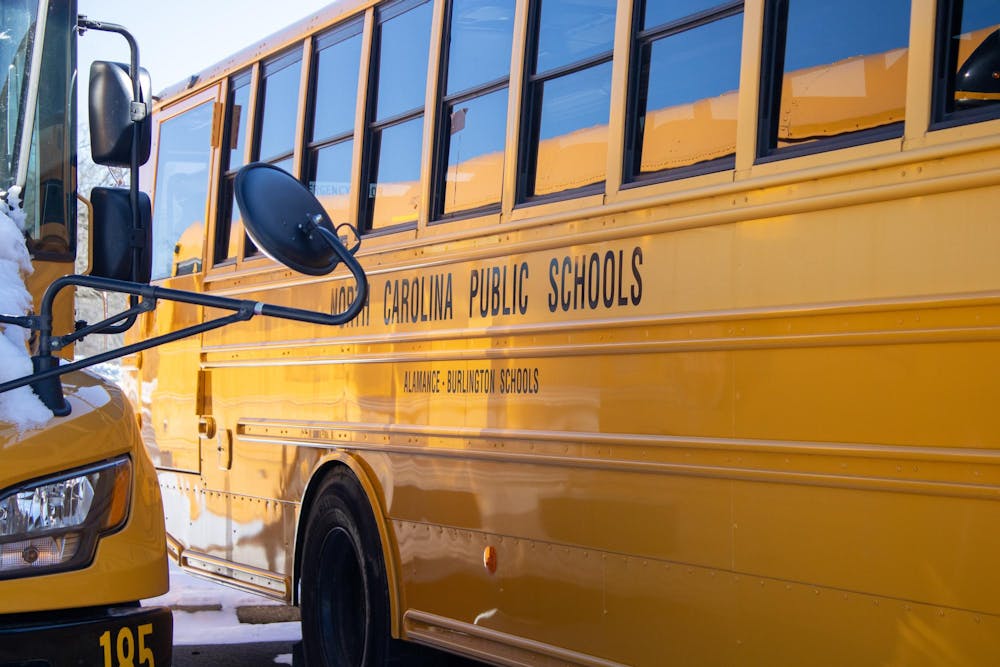
Bus routes were a major topic during the community session on Jan. 22. ABSS Superintendent Aaron Fleming said the routes will be adjusted once new zones are finalized.
“It’s my hope that we’ll have more reliable bus transportation services, because our students will be going to a school a little closer to them, potentially,” Fleming said at the community session. “In some cases, it may not be that they’re closer to the school, but maybe we can have less bus routes because we have more of an optimized school attendance zones, and so I’m hoping it will be easier.”
Burlington resident and ABSS parent Nicole Jones said she has witnessed district transitions throughout the years.
“Nowadays, there’s hardly any teachers, there’s hardly any bus drivers, but the population is increasing,” Jones said. “Let’s say, even if we did get a new school or whatever, who’s going to be in it to teach the kids?”
Jones said her daughter’s bus currently has three students sharing a seat.
“If they turn the corner, it’s just a lot of issues,” Jones said. “I don’t think rezoning is going to help them all, of course, but I think it’s a start.”
Fleming said the district is exploring how they can utilize all the buildings while not busing students across the county.
“We still want to make sure they’re going to a school that’s as close to their home as possible, and so that’s the biggest thing, is to make sure our students aren’t spending all day on a school bus, or that their parents aren’t having to drive them all over the community,” Fleming said.
Burlington resident Courtney McQueen has three students in ABSS: one in elementary, middle and high school. She said she is concerned about the timeline of the changes and how to prepare her students for when that comes.
“Fourth grade, seventh grade, eleventh grade, because I think they have the hardest when they have to change schools, and they’re almost at the end of their particular school,” McQueen said.
Fleming said that although there are no final decisions for transitions, the idea is that students who are in the upper grades of their school level will probably be allowed to stay at their home school.
“I think that’s the most fair thing to do,” Fleming said. “Probably the negative to that is if they do stay in their home school or in their old home school, if they live out of zone, we may not be able to provide transportation, but we would give them an opportunity to attend that school.”
The next Community Voice Session will take place at Southeast Alamance High School at 6 p.m. Feb. 9.