

House Bill 318 now requires North Carolina sheriffs to work more closely with U.S. Immigration and Customs Enforcement agents. Originally vetoed by Gov. Josh Stein, the NC House of Representatives and Senate overrode the veto and the bill took into effect Oct. 1.
The Criminal Illegal Alien Act requires sheriffs to contact ICE if a person without legal immigration status is to be charged with a felony, such as certain sexual offenses or DWI. It also requires local sheriffs to notify ICE two hours after the time they would normally be released. If ICE responds, then those detained can be held up to an additional 48 hours until ICE arrives. If they don’t respond, the sheriff releases the person according to bail conditions.
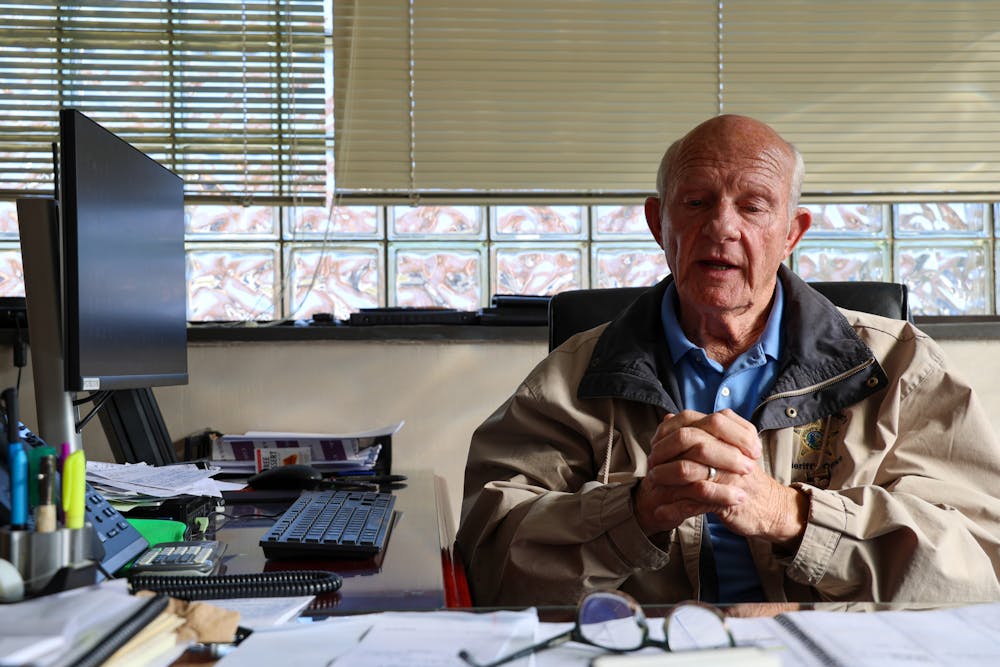
“It forces some sheriffs that didn’t want to work with ICE to have to work with ICE,” Alamance County Sheriff Terry Johnson said.
Gov. Josh Stein vetoed the bill, saying that the bill is unconstitutional since it violates a person’s right to due process by holding someone past their designated detainment time.
Over the weekend, masked Border Patrol agents arrived in Charlotte, arresting more than 200 people as of Nov. 18, according to CNN. On Saturday Nov. 15, federal agents detained people in public places as protestors marched down the streets of uptown Charlotte. During the Nov. 18 Raleigh City Council’s session, Raleigh Mayor Janet Cowell said there have been confirmed sightings of border patrol agents in the area.
Stein criticized the federal agents in a video posted on social media Nov. 16.
“We’ve seen masked, heavily armed agents in paramilitary garb driving unmarked cars, targeting American citizens based on their skin color, racially profiling and picking up random people in parking lots and off of our sidewalks,” Stein said in the video.
Dillan Bono-Lunn, a professor of political science and public policy, said that this law is applying a standard to people who have been accused, but not convicted of a crime.
“We’re thinking about innocent until proven guilty,” said Bono-Lunn. “By compelling sheriffs to hold people longer than they otherwise would be under the law, would essentially be not affording due process to everyone.”
Bono-Lunn said this new policy reminded her of the Laken Riley Act passed on the federal level Jan. 29 of this year. This bill allows for the detainment of persons without legal immigration status who are arrested for particular crimes such as burglary and larceny.
That law was challenged by the American Civil Liberties Union in court and a federal judge declared the Laken Riley Act unconstitutional because it violates due process. The judge ordered mandatory bond hearings for those detained.
Bono-Lunn said that she expects that this same process will happen again — that HB 318 will be challenged and then reviewed for whether or not it is constitutional. However, she said that since the bill has only been in effect for just over a month, it is too soon to tell. If the bill is found to be unconstitutional, Bono-Lunn said this could be a fraught situation for local sheriffs.
“I can imagine a situation where local law enforcement in following this state law end up potentially seeing cases thrown out if this piece of legislation is found to be unconstitutional,” she said.
Regardless, as of now, Bono-Lunn said that she sees local law enforcement as “a rock in a hard place.”
“They are duty bound to enforce the laws and to protect communities and follow this particular piece of legislation, regardless of how they feel about that,” she said. “It could, ultimately, end up with some of their efforts in actually prosecuting crimes being overturned.”
Johnson said if the North Carolina courts find this law to be unconstitutional, then he is not going to hold detainees an additional 48 hours.
“But if the law requires me to, and it abides with the Constitution, I will hold,” he said.
Johnson said ICE will reimburse his departments for the additional costs for housing these individuals, but what he is worried about is his jail overcrowding. Right now the sheriff’s department has 400 beds in their detention center, with about 390 of them currently full, according to Johnson.
Johnson said if overcrowding continues, he might have to have people sleep on the floor. He worries this might lead to a lawsuit.
Johnson also said that it’s too soon to see how the Criminal Illegal Alien Act will affect his station, but he’s already seen the repercussions of overcrowding due to Iryna’s Law, which was passed in October 2025. This law removes cashless bail for some offenses, which means if someone can’t make bail they have to stay in jail until their trial has concluded.
Johnson said he has sent a message to Washington, D.C., to notify them about the overcrowding, but as of now they are not accepting any more people other than who his officers arrest. Despite this, with the additional time requirement added to the Criminal Illegal Alien Act, Johnson is worried they won’t have beds to accommodate this provision.
With the recent crackdown on noncitizen policies, Johnson is aware that the immigrant community in Alamance County could be scared.
“I hope our legislature, before passing laws such as this, looks at a total overall picture of the immigrant population coming into North Carolina or even Alamance County,” Johnson said. “I think it is going to concern some of the immigrants that have come here. They’re going to be afraid, and I hate that.”
Johnson said he knows there are people within Alamance County that didn’t enter this country with the proper paperwork, but as long as they are abiding by the law then they should not worry. His concern is the cartel members smuggling drugs here, something that has been on the Drug Enforcement Administration’s radar.
“DEA calls it the drug hub of the southeastern United States, and that’s a slap in my face,” Johnson said.
According to Johnson, this is a result of major interstates such as I-40 and I-85 running through Alamance County.
“They can come up to get the drugs here, but once they drop the drugs here, they’ve got Highway 54, Highway 87, Highway 62, Highway 70 and Highway 49,” said Johnson. “They can take those drugs on secondary roads anywhere in the southeastern United States.”
Johnson said that ever since he took office in 2002, he said it’s been an uphill battle in trying to get the drug cartel business here in Alamance County eradicated. He said he sees HB318 as a way to help create a safer community from illegal cartel members.
“These are the type people that I want out of my county, not necessarily the people that are trying to make a better life for themselves,” Johnson said.