

Fact-checker Bill Adair once lied on C-Span to a “Brian” from Michigan about whether Republicans lied more than Democrats. To appear unbiased, Adair said fact-checkers did not “keep score.” Thirteen years later, Adair found Brian’s daughter and apologized.
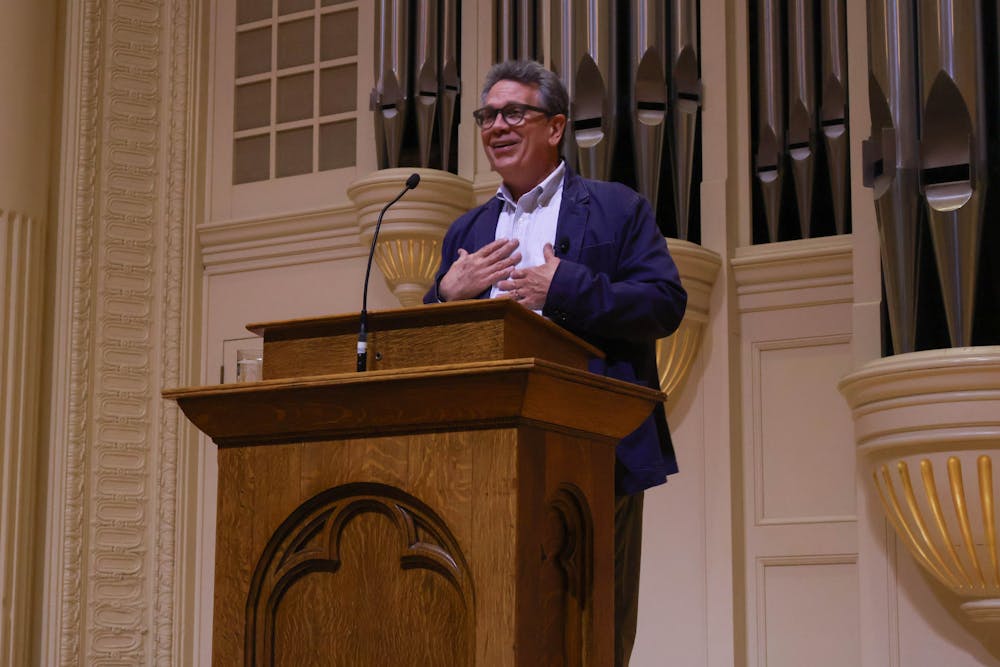
Adair, the founder of PolitiFact, visited Elon University’s Whitley Auditorium March 16 for the Liberal Arts Forum, a student-run organization that arranges for a variety of academic speakers to address the Elon community.
The analogy about the search for Brian opened both his recent book, “Beyond the Big Lie,” and the evening’s discussion.
“There is a tremendous imbalance in our political system between the parties and their records for lying,” Adair said. "Both parties lie a lot, but one party lies a lot more, and it’s important to face that.”
In his 1997 career as a journalist in Washington, Adair and his colleagues did not think calling out the lies was something journalists had to do.
Now, Adair said PolitiFact and other fact-checking organizations inspired by it are pertinent in giving consumers a place to check their information before making a decision. He said fact-checking is so important that even journalists in Iran work remotely from Canada because calling out false information risks their safety.
In recent years, however, Adair said fact-checking has fallen under a negative light as a result of what he describes as shameless politicians who continue to lie and attack those who oppose them.
“It turned out that the bad guys figured out how to harness the power of the Internet to spread lies better than the good guys could spread facts,” Adair said.
The Truth-o-Meter and Pants of Fire! are engaging fact-checking tools created to call out politicians and force accountability. The problem he faced was that not everyone received this well, Adair said.
“Here we are calling fouls on people’s favorite players, and that may not be the best way to give people correct information,” Adair said.
In this analogy, Adair compared fact-checking journalists to umpires the crowd hates. He said to combat this, journalists will have to shift from calling someone a liar to giving people the correct facts.
“Red and blue are no longer so much the colours of our flag as they are symbols of how divided we are,” Adair said.
He said making sure that bias cannot be argued by politicians or consumers is key to this solution.
Retired physician Bob Carter attended the event to learn how he could improve his personal fact-checking skills.
“We’re interested in the truth, and I’m finding it difficult watching whatever I watch and read, to see what is the truth,” Carter said.
Emerging technologies have both improved and complicated the future of fact-checking, Adair said.
Former Elon professor and psychologist, Ben Williams, who attended the event to learn something new, is skeptical of AI. He said he favors personal interactions over digital ones.
“I will recognize and know you as a person,” Williams said, “but to assume that AI is going to be my best buddy. That’s pretty tough.”
While artificial intelligence has proven difficult and somewhat scary with its hallucinations of information, Adair said large language models can be useful in the future.
“AI is good at organizing things, grouping things and summarizing things that you give,” Adair said.
Large language models will require the work that human journalists and fact-checkers put into creating factual content to succeed as a useful tool.
Adair recognized that fact-checkers eventually fail commercially. He said it is the job of larger corporations like the New York Times and Associated Press, or other donors, to support and encourage factual information.
“Journalists can now debunk falsehood faster than ever,” Adair said. “Journalism, particularly fact-checking, remains vitally important. We need to stick with it. Donate to it and keep it fast.”