

CORRECTION: Α quote was corrected after a transcription error was identified. The roles of the hosting organizations and Eksteen’s career were also clarified. Elon News Network regrets these error.
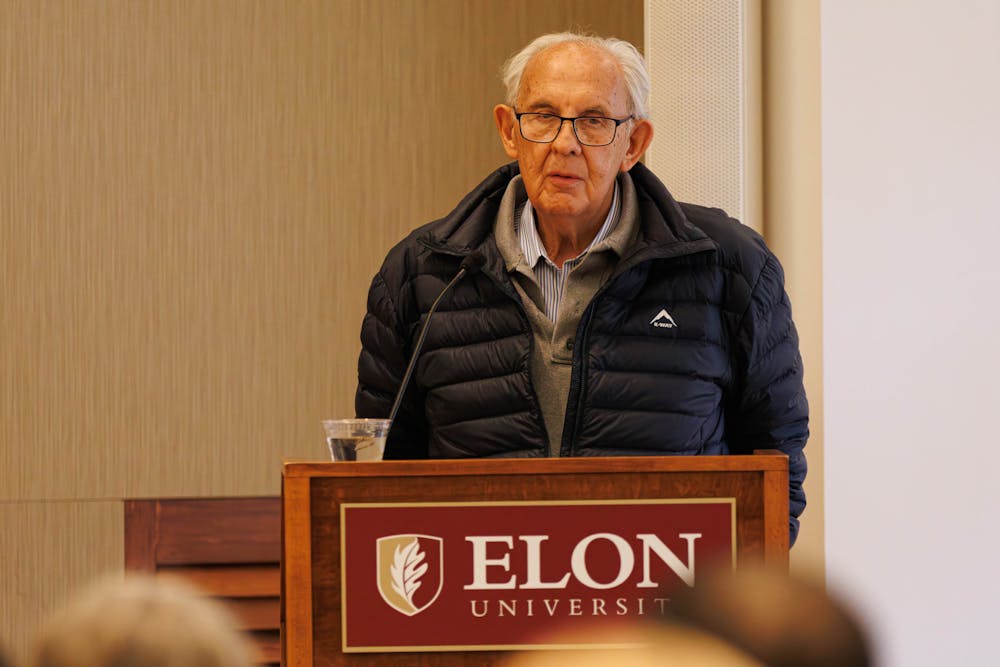
Former ambassador Riaan Eksteen, a diplomat from South Africa, reflected on his 27 years of experience with the Elon community, before opening the floor for students and community members to ask questions.
Eksteen was hosted by Elon University’s political science and public policy department and the Turnage Fund for the Study of Political Communication in collaboration with African Studies Center at the University of North Carolina at Chapel Hill Nov. 10 in the McBride Gathering Space.
Eksteen has held numerous positions across various ministries and embassies throughout his service. Including working at the South African Embassy in Washington D.C. and the United Nations in Geneva as many other roles throughout his career.
From 1948—1994 South Africa was under apartheid rule. Apartheid is a system of institutionalized racial segregation and discrimination in South Africa where the white minority government deprived non-white South Africans of their rights. Eksteen was involved in diplomacy during apartheid and after apartheid ended.
Eskteen spoke about his role as an ambassador. He explained that as an ambassador the difference between explaining and defending when it comes to policy.
“I never defended apartheid,” Eksteen said. "I believe it was not my job to defend the party. That’s for the politicians of South Africa to defend policy, I was there to explain the policy and why they're doing it. There's a big difference between acceptance and explaining what is happening.”
During his speech, Eksteen reflected on what it was like to serve South Africa as the country reconnected with the world in 1994 during the transition period after apartheid. He said he only served three years in this democratic era, but found it difficult to represent South Africa when so many countries were reluctant to engage with the country.
“It was not moonlight and roses to represent South Africa during those times especially, it was very very difficult people didn't want to speak with you,” Eksteen said.
Eksteen finished his speech by offering advice to students. He emphasized that students can’t rely on their degrees alone.
“This is why I say degrees are not directions, we need strong fundamentals; and proper tools. I learned it the hard way” Eksteen said.
He said degrees aren’t an automatic direction to success and students need to take ownership, develop practical skills and create opportunities for themselves rather than wait for one to appear.
“I didn't go to Harvard or any top school specializing in international affairs,” Eksteen said. “I didn't have a godfather in foreign policy. I started as a young student in political science at the University of Pretoria.”
Freshman Gia Joslin said she enjoyed hearing the perspective of somebody so experienced in diplomacy and global relations as a student in international global studies.
“I thought it was just great to hear perspective from somebody that's so experienced with true international issues," Joslin said. “As a student in international global studies, I think it's just invaluable to really have a deeper comprehension of these things.”
Sophomore Ghufran Abd said that Eksteen speech made her hopeful,that one day we may return to when global relations were more cohesive and actually worked
“It was cool to see a more optimistic perspective of when it was more cohesive and actually worked and hopefully we can one day restore it back to that,” Abd said.