

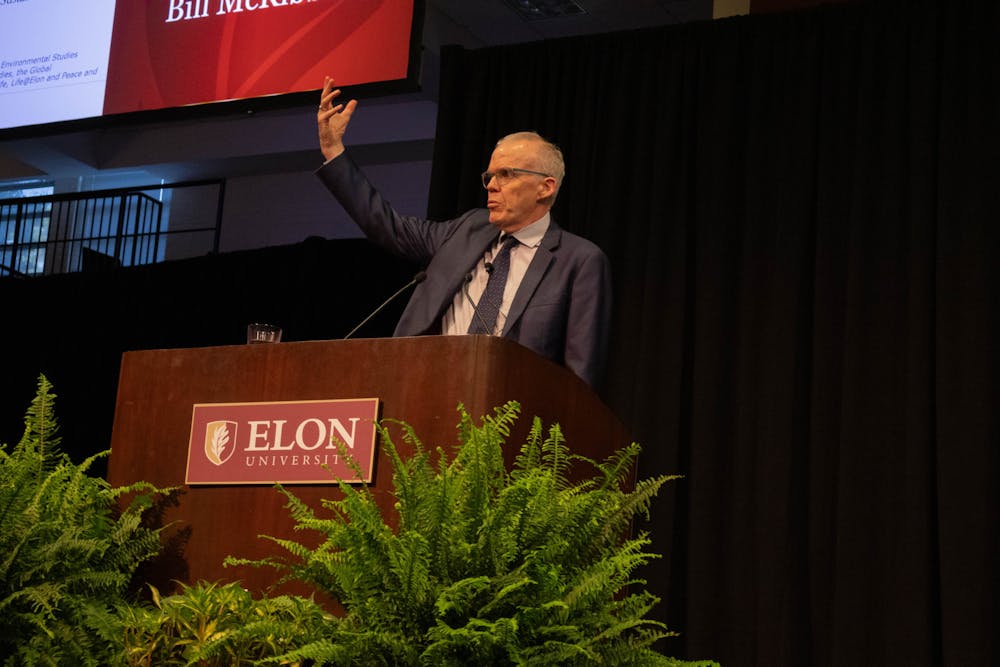
The cost of solar and wind energy decreased by 90% over the last decade, so price is no longer a factor when it comes to renewable energy in today’s world, according to environmentalist Bill McKibben. McKibben, an author of 18 books on climate change, gave Elon University’s Earth Week keynote address April 23.
A couple hundred students and community members attended the speech in Alumni Gym. McKibben said that since June 2023, every month has been the hottest of its kind. Last year, 14 months in a row saw record high temperatures according to the National Oceanic and Atmospheric Administration.
The effects of climate change can be felt anywhere in the world, McKibben said. McKibben said flooding in Libya in 2023 caused two dams to collapse, leaving at least 11,000 dead and another 10,100 missing, according to the United Nations. Rising sea surface temperatures contributed to the storm’s intensity and extreme rainfall, the storm was 50 times more likely to occur and 50% more intense due to human-caused climate change.
“We didn’t care about it much because there aren’t a lot of cameras in Libya, at least compared to Los Angeles,” McKibben said. “But something like that happens all the time now, all over the world, and it happens the most in the places that did the least to cause the problem we’re now in.”
McKibben shared some solutions that focused on solar and wind energy. He said California is the best state when it comes to renewable energy because it produces 100% of its electricity from renewable energy for periods of 10 minutes to over 10 hours a day.
“I think we think of the sun and wind still in our minds as like the Whole Foods of energy: It’s nice stuff but pricey,” McKibben said. “It’s the Costco of energy. It’s cheap, it’s available in bulk and it’s on the shelf.”
McKibben said if society could make numbers like California happen around the world, then it would have a plausible chance to stop global temperatures from reaching a tipping point. Forty percent of all ship traffic on Earth is just carrying coal and gas back and forth across the planet, McKibben said. McKibben explained that if a ship went over one time with solar panels, that shipload would produce 500 times as much energy in its lifetime compared to gas or coal.
McKibben said the last time the U.S. worked together as a country was to get to the moon in the 1960s — a unifying goal in a chaotic and divisive time.
“This time we’re not talking about putting two guys on a different planet,” McKibben said. “We’re talking about bringing our local star down to Earth, so we can power, protect and preserve this incredibly beautiful place that we were blessed to be born into. That is the job of people in our moment on this Earth.”