

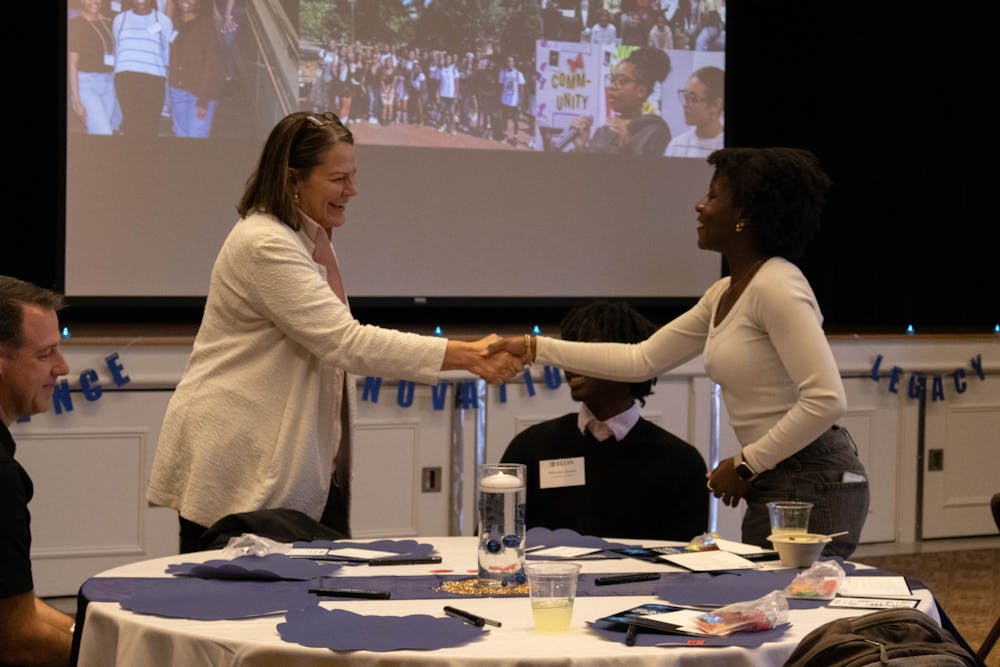
For the 11th year, the Center for Race, Ethnicity and Diversity Education at Elon University hosted the Black Solidarity Conference on Feb. 28. An event welcome to all students, this year’s message focused on how the Black population creates a legacy and inspires a sense of community. The words “influence, innovation, and legacy” were draped across the front of McKinnon Hall which summarized the essence of the conference.
Abdul-Malik Harrison, assistant director of the CREDE, said events such as the Black Solidarity Conference allow students to gain a sense of the real world.
“When you put yourself in situations like this, coming to honor and pay respect to Black history, you learn about Black history, you’re making yourself a more well-rounded person, which is exactly what Elon wants you to do,” Harrison said.
The theme for the conference was centered around the CREDE’s Black History Month theme, “This Is How We Do It: Honoring Blackness Through Influence, Innovation, and Legacy.”
The keynote speech began with Vanessa Drew-Branch’s, professor of human service studies, interpretation of this year’s theme.“It invites us to see ourselves, not just as individuals navigating a world shaped by struggle, but as a collective architect of a revolutionary time,” Drew-Branch said.
As keynote speaker, Drew-Branch wrote her speech inspired by poet Nikki Giovanni.
“It’s a meditation on the evolution of resistance, power and purpose,” Drew-Branch said.
To make her speech interactive, Drew-Branch led an activity where she instructed attendees to consider a personal commitment to equity and inclusivity and write them down a quilt square. These quilt squares will then be combined and displayed in the CREDE for students and attendees to be reminded of their promise.
“Let’s take our influence, our innovation and our legacy, and weave them into a future where Black excellence is not exceptional, but expected,” Drew-Branch said.
Drew-Branch wanted students to take away the message that the effort to promote Black Solidarity comes out of love.
“Let them know that our revolution was and will always be rooted in love,” Drew-Branch said.
Black Solidarity Day originated in 1969 as a showcase of Black liberation led by Brooklyn College professor Carlos Russell. This day was brought to Elon University intending to unite Black-identifying students, faculty and staff in 2014, extending a platform to explore the Black identity and intersectionality of Black experiences.
For Black History Month 2025, the CREDE has worked to plan various events throughout the month, relevant to the theme and our world today. Specifically for this event, the assistance of three student chairs on the planning committee informed students, faculty and speakers about the event, according to senior Kyla Maxwell, marketing chair for the Black Solidarity Conference.
“We started planning way back in December to figure out who our guest speakers were, what our educational sessions were going to be about, and what our theme was going to be,” Maxwell said.
The other two student chairs focused on developing the educational and logistical aspects of the conference, said senior Jordan Smith, education chair for the conference.
“We did tabling in Moseley, we would have our fliers set up asking students to come out,” Smith said. “We also reached out to different advisors, as well as professors, to get them to introduce the idea to their students.”
In working to promote this event to students, junior Kashawn Myers, logistics chair for the conference, said the chairs had a goal for the message and lesson they wanted students to take away from the event.
“I wanted students to be able to take away the importance of the event and what it’s supposed to mean for Black students on campus, and then also be able to share it with their friends who weren’t able to make it,” Myers said.
Myers also expressed the importance of creating a community among the Black population on campus and around the world among the political situation currently occurring.
Following the keynote speech, breakout sessions were held on a few topics and issues currently relevant to the Black community. All of them were led by faculty and staff at Elon University.
Freshman Makila Boyce attended the session on “School Daze: Celebrating the Legacy, Impact, and Influence of Historically Black Colleges and Universities,” led by Anna Kyles, community director for the Station at Mill Point.
“It was really insightful to get the history and how they came about, more in-depth than the glitz and glams on social media, the homecomings, and the festivities,” Boyce said. “I’m glad that I went because I got to see it from a different perspective.”
Freshman Jaydon Jefferson attended the session on “Wellness in Black Communities,” led by Charles Evans, counselor at Elon University.
“We really unpacked that the big picture is that us Black people need to learn how to actually deal with their issues and stop trying to busy ourselves out of it or just bury them under a rug because it’s going to be there until you deal with it,” Jefferson said.
The CREDE and planning committee hope to continue this event for years to come to uplift and spotlight the Black community here at Elon. Senior Kyla Maxwell reflected on her hopes for the future planning committee as she has been involved for the past three years.
“We really hope to have people who are dedicated to the mission and ensuring a sense of community at Elon,”Maxwell said.
As Assistant Director of the CREDE, Harrison said he hopes students from various backgrounds can feel welcome to this event to fellowship and gain useful knowledge to grow within the Elon community.
“Attend events like this and other events around campus that the CREDE puts on, in order for you to have a broader worldview and take yourself out of your comfort zone, and see other people’s experiences and histories,” Harrison said. “We put on great events and we’re going to make sure that you’re well fed, you’re well educated, and well-rounded.