

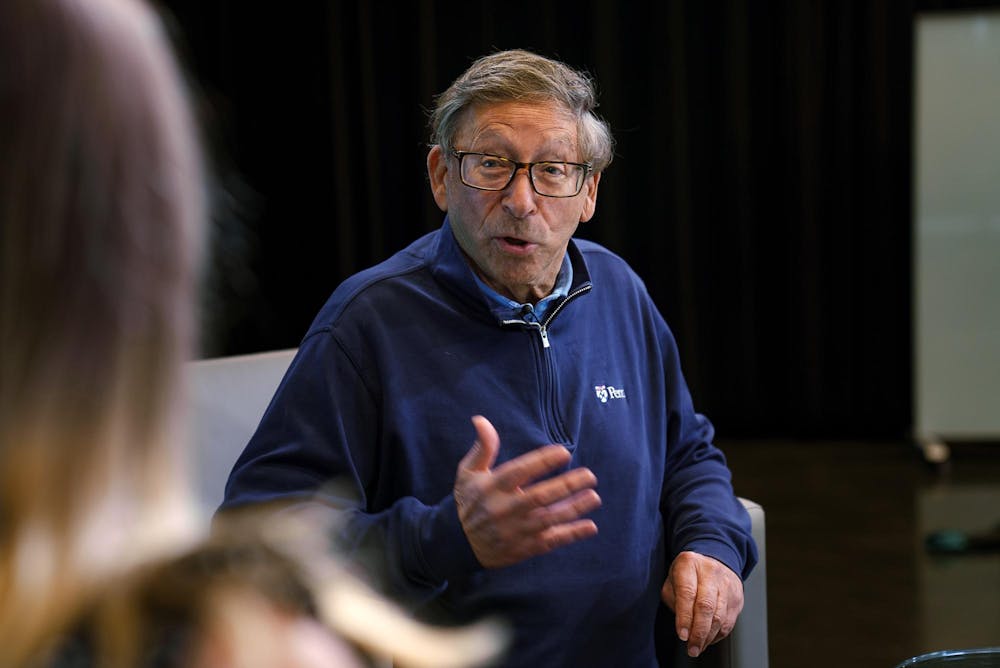
Stuart Weitzman is a renowned footwear designer who has built a reputation for designing shoes that balance both comfort and elegance. His brand has been worn by celebrities such as Taylor Swift, Angelina Jolie, Tate McRae, Beyoncé and more. Weitzman visited Elon University on Feb. 26 to talk to students and share his passion for designing and navigating the changing fashion industry.
The length of this interview has been shortened for space.
How did you get to where you are today?
I had a passion to draw. I was going to Wall Street, and something serendipitous happened that led me to design some shoes. Women loved them, and I thought this is like when Frank Sinatra probably heard the first recording on the radio of his song. It was so exciting for me to see that something I made was being bought, enjoyed and reordered. It was successful.
I said, “I'm going to try it,” and I started to build a brand. And that was my goal — to build a brand, even before I perfected the product. Even before that, all of my publicity and advertising was brand building and name recognition on a high, high level. So I was particular to associate Stuart Weitzman with companies, events and people that were very well established, very well known and dragged me along with them. In a sense, celebrities became my playground. You can't do it alone. And whenever I found someone to help me do it, I always sought the absolute best, most experienced, most talented. I didn't care if it cost twice as much. In the end, I found out it cost me so much less because of what I got out of it. And that's pretty much how we did it. After that recognition, you need the product. My DNA became function and fashion and our shoes were comfortable, recognized as such, and when you have great marketing and recognition and a product that keeps your promise.
How has your brand grown with several celebrities wearing your designs?
They have been very helpful. They're part of me. I can't wear the shoes. I'm not going to look great in them. So I needed some other people. It started many, many years ago with Kate Moss, who was one of the most iconic models. And from there, Giselle used our shoes and her shots and videos, and that was the beginning of the influencer movement in articles. And then, of course, we grew into social media. Taylor Swift has two big tours, the 1989 tour, and the current tour. Our shoes are all over what she's wearing. She made one of our boots, the most famous boot in the shoe business, because of her love for it. And I have always recognized the power of that, but they don't pay for anything. It's marketing. And we hope they'll talk about us, and we're proud if they remember these women, they can have anything they want, whether they buy it or don't buy it, they can have it. So if they pick yours, it's a compliment. My real strength is the consumer.
When you first started, what kind of obstacles were in your way, and how did you overcome them, beginning in the fashion industry?
The truth is, I didn't run into obstacles. I had a pretty clear plan. I knew that I was entering an industry. I went to the Wharton School at the time. It was as good a business, I guess it may still be, but it certainly was that as existed, I learned nothing about the shoe industry in it. I don't know where you could go to learn the shoe industry. You could learn about the fashion industry in schools like FIT and Parsons, RISD, but footwear, maybe we're not big enough to merit our own university programs, so you have to learn it on the job. I was working on someone else's dime, and learning from that. I met people who I took with me when I started my own business. So I guess we would be defined as a startup, but we weren't. We already knew who we were going to sell. I knew the type of product I wanted to create. I had six years of experience toying with and I had a team that I didn't have to go out and interview and search and hope that they were right. I had years of experience with them, so it didn't have obstacles.
What is one of the biggest differences between your brand and other designers’?
Well, the big difference was the way we made them feel. Many women bought shoes for the look only. This was before the sneaker revolution, and you learned that shoes can also be comfortable. So before the sneaker revolution, you were stuck with shoes, quite honestly, almost exclusively designed by men who never had a chance to see how they felt and only could rely on third hand. We call it hearsay, really. But I paid attention to that, and I kept hearing, “Oh, this kills my foot, but I love it,” “It's this,” and “It’s that.” I thought, there's a problem here and I'm going to solve it. And I’ll tell you, if you can solve a problem in an industry, you've hit your home run just your first time at bat. We cushioned the shoes, and we made them a little wider, without them looking clumsy. When the toe was narrow, we lengthened it so it didn't pinch your toes. It was actually designed to be past the length of your toes. We did all the things necessary to make the most comfortable shoe for the height of healing. That's what separated us. There are 1,000s of great-looking shoes of all types. How do you decide, and in the end, how they feel plays a big role, and that was what separated us.
Do you have anything else you’d like to add to the interview?
I do visit many universities. I'm very impressed with Elon. It's up there with those that I visit, the students in particular. I hear so many students say they're studying finance and they're studying accounting. And I'm going to make a little pitch for the fashion industry. It is fun, it is exciting, it’s always changing, and you're never bored. I was going to go into finance, so I have a feel of what that's about, and I can't imagine trying to pick stocks when I can make beautiful shoes for gals like you, it's fun, and it can be clothing, it can be handbags, it can be accessories. And all the aspects of business that go with any industry. We need them even more so because marketing is a very key thing in fashion, and that's a pitch for people to think about fashion. It may be the hobby of lots of people, and they don't think about it as a career. That's the way it was with me, it became my career, and I worked at my hobby my whole life. I hope you can as well.