

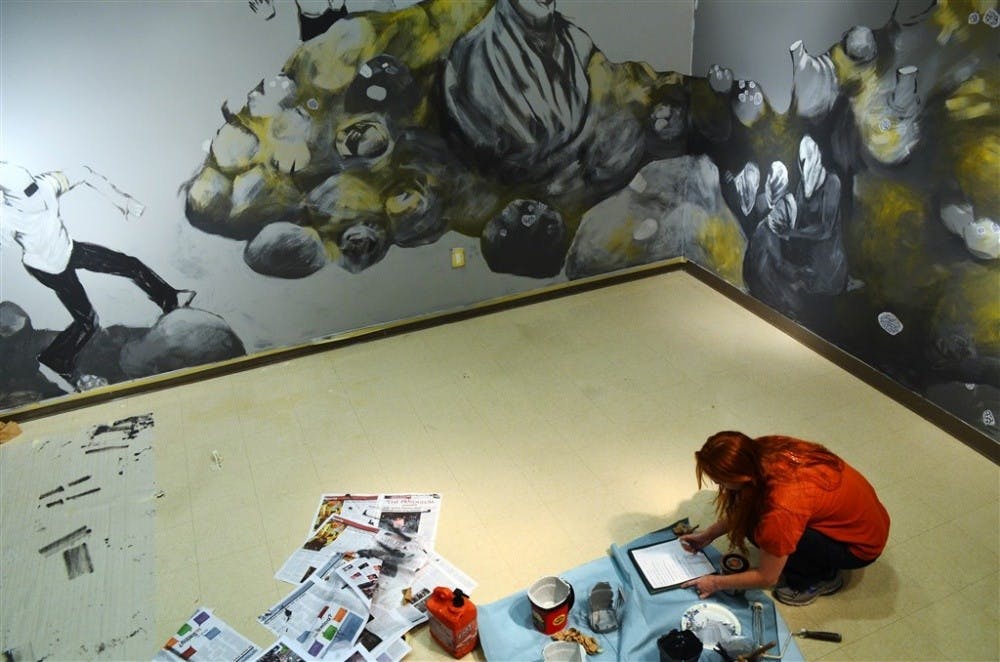
The definition of heroism is constantly changing, since competitors are judged on their background, nationality and personality. Heather Layton, a senior lecturer in art at the University of Rochester, opened the doors to Arts West display room and revealed how the hero is not always the person we think.
Layton's opening reception Nov. 9 wasn't a showcase of sculptures or a handful of her best canvas paintings. Instead, she cracked open cans of paint and painted directly on the display room walls. After presenting her work, Layton invited students to stay and paint the room with her. But first, she wanted to explain the work she was doing.
"I've always been interested in conflict, who is in conflict, why are they in conflict and the idea that a lot of it can be saved by communication and understanding somebody else's perspective," Layton said.
She said she aims to provide opportunities to understand the person whose opinion was not supported by the majority. She also wanted students to explore the process of choosing the ally and the enemy in a conflict, naming the exhibit "Ally/Enemy."
The walls of the room display three conflicts: the Los Angeles conflict, the Egyptian revolution and the occupation of Indian army forces in Nagaland.
"All three of the situations are situations where I thought I knew who I sided with, and then within an hour of hearing the other person's perspective, I switched," Layton said.
The Indian army in Nagaland is the main scene. This little-known conflict in northeast India is between Indian army forces and the tribal Naga people. India has taken over the area by force and killed more than 200,000 Nagas.
"When you're fighting over the land, you're not just fighting over the dirt, you're fighting over all the memory," Layton said.
After the reception, Layton did a demo on how she painted the room.
"Five or six students stayed and actually worked on it," she said.
She had students flow in and out of the room to contribute to the exhibit Nov. 9-10. But the exhibit will continue to be open for students to add to until Nov. 22.
"Some come in and work for two hours and others will work for two minutes," Layton said.
The opportunity to contribute to this collaborative project is open to all students, not just art students.
Layton's artistic work is not solely focused on large-scale paintings. She said her next project might be a miniature painting, while the following one might be a sculpture. Keeping her work new gives her more inspiration to excel.
Ken Hassell, associate art professor, acknowledges the growth of Layton's projects.
"She doesn't just have this kind of single idea, and then goes with it no matter what," he said. "She sees that maybe the project needs to expand, and be more inclusive. She alters it, which is a really interesting idea."
Sophomore Elizabeth Amontette felt inspired by Layton's work.
"I came in not knowing anything, even about the artist, so I was really surprised and inspired by her work," Amonette said. "She really cares about the impact she has on people that will see her work and their role in her installations, or whatever she does."