

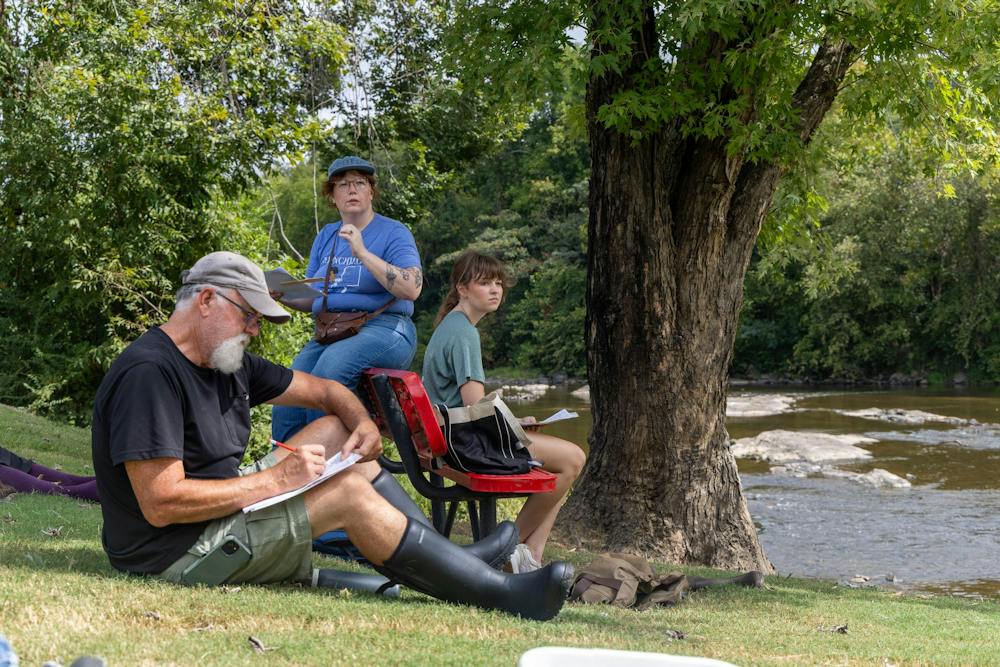
Water Quality Program Manager Kaitlyn Elliot held a pH meter up to the sky to see what color the water is after she added 10 drops of indicator fluid to the sample. She then let a group of locals guess the water's pH before she shared her conclusion.
Securing the pH of a sample is important for determining the health of a site to see how acidic or basic the water is. A water’s pH can effect not only human health, but also the health of those swimming in it.
The water sits at a greenish-yellow, about 7.5, she says. Checking the pH, turbidity and temperature of the water are just a few steps trainees at the River Watch session will learn.
“The main focus of the program is for folks to be able to collect environmental data that will tell us about the quality of the water,” Elliot said. “So it's not just along the main stem of the Haw; it's along the small tributaries too.”
The Haw River Watch program has existed since 199 and has 115 volunteers with 77 unique sites observed. Their responsibility is to collect four seasonal surveys throughout the year that will help measure the health of the Haw River.
However, before someone can dive into protecting their site, they have to attend a training sponsored by the Haw River Assembly. The monthly training is held at a location along the river within Alamance County.
The training goes beyond pH to animals inside the water, both great and small.
“Although the macroinvertebrates are pretty small, they are kind of the basis of our food chain,” Elliot said. “So without them, there's no food for the fish, and if the fish don't have food, then there's no food for the birds.”
Elliot says there are some macroinvertebrates that are sensitive to pollution, like the Mayfly, so if someone finds them in the water, that can indicate a healthy water site. However, sites with only macroinvertebrates, such as leeches and mosquito larvae who are pollution-tolerant, could indicate poor health within the Haw River.
“A lot of these people love their stream, and they always have their eyes on the stream and protecting it because you love what's around you and you don't want it to be polluted,” she said.
Danny Keck drove from Chatham County, where his property goes half a mile along the Rocky River. Though his land is not a part of the Haw River watershed, learning how to protect his water site, he says, is important to him.
“Anything that I can do to help with the river quality, to help monitor it, I'm interested in,” he said.
Keck said he is concerned about PFAS within water streams and how recent laws within the government have made environmental initiatives more relaxed. He said he came out to learn more about how he can make a positive impact within his local water shed.
“I think more and more of our government is not being involved in ecology and saving our planet from climate change and pollution, and on,” Keck said. “We're going to have to do it as smaller groups.”
Though the training doesn’t cover PFAS, it has been a growing concern within the health of the Haw River, especially since it is a drinking source for some communities within the county.
Recently two Swepsonville residents filed a lawsuit against Alamance County including two cities over forever chemicals. The lawsuit includes six private companies over damages for disposing contaminants that sunk into the ground water.
Saxapaw resident Carrie Kirk grabbed a net and walked into the water in four-dollar loafers from her local thrift store. She said she intended to just drop off her teenage daughter to the Haw River Watch training.
“Did not come prepared with water boots and socks,” Kirk said. “I'm in my loafers, but I just couldn't help myself.”
She remembers coming to Redslide Park and getting into the water as a kid. Now decades later, she is searching for macroinvertebrates in loafers.
“I really didn't understand or know how diverse the world is inside the river and how many different macroorganisms there are,” Kirk said.
Elliot has a Mayfly tattooed on the inside of her forearm, which are macroinvertebrates that can be found clinging under rocks.
“They're just so shocked because they had never thought to flip over a rock,” Elliot said. “Then what they find, they're just amazed, and that just brings me a lot of joy that people get to see something new.”
Sitti Widayati, a Pittsboro resident, said that after today she hopes to get more involved with Haw River Assembly by joining their quarterly survey investigation team and education initiatives.
“I really want to learn about it, protect our environment, not just the human part, but also the animals who live there,” Widayati said.
Kirk and Keck both said how important it is to support organizations such as the Haw River Assembly.
“We need to try to step up and help any way we can,” Keck said.
By the end of the training, the group tallied up all the macroinvertebrates and gave the Redslide location a water quality score of 21, meaning “Good,” but Elliot said not every water site generates this positive result.
“So we don't want to just protect the Haw itself, but all those smaller streams that feed into those reservoirs,” she says. “Some people get their water directly from the Haw, like Pittsboro and so it's such an important asset, because we use it every day.”