

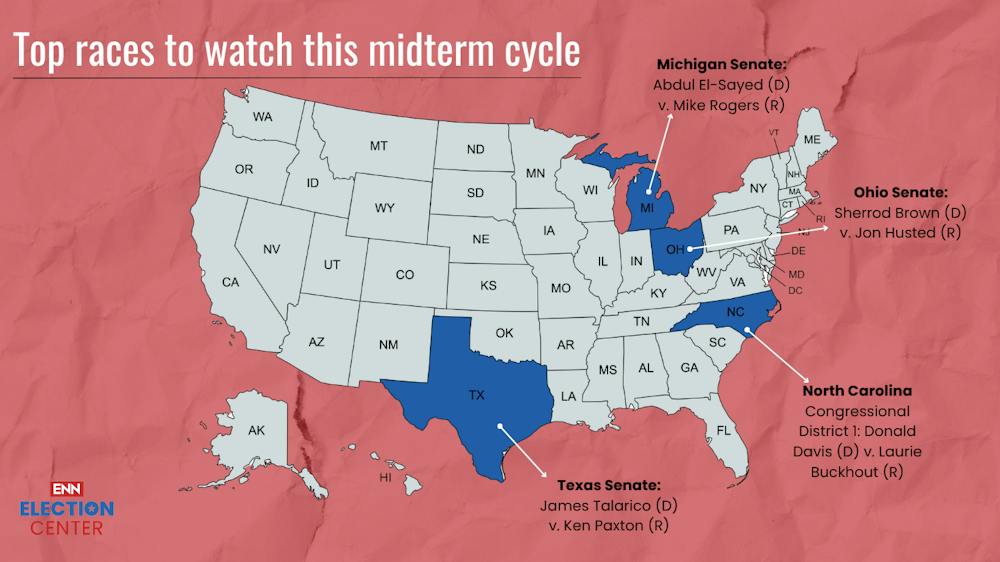
With just under five weeks until Nov. 3, all eyes are looking toward some key races both inside and outside of Alamance County and North Carolina.
Steven Greene, professor of political science at North Carolina State University, gave his thoughts on what trends to expect during the midterms.
“Donald Trump is so unpopular and this party is so unpopular right now that Democrats have a real chance, probably better than ever at this point, of taking the majority of the senate," Greene said. “Which is not something many people thought Democrats were going to have a good chance at a year ago.”
North Carolina Congressional District 1: Donald Davis (D) v. Laurie Buckhout (R)
North Carolina’s first congressional district is considered to be a battleground election, made particularly compelling due to a recent redistricting that changed the congressional boundaries from the 2024 election.
The district used to be a safe win for Democrats.Now, incumbent Donald Davis could face a tough race against Republican Laurie Buckhout.
The outcome of this election could affect the partisan balance in the United States House of Representatives, which currently has a 219-214 majority for the Republicans and two vacancies.
Despite the redistricting, Greene believes that the Democratic party and Davis still have a strong hold on District 1, especially considering dropping approval ratings for the party currently in power.
“In this very favorable to Democrat political climate, I'd say he's got a good chance,” Greene said. “If this was just a neutral political year as opposed to a clearly pro-Democratic political year, I think it'd be really tough for him to hold on to that seat.”
Michigan Senate: Abdul El-Sayed (D) v. Mike Rogers (R)
The race for Michigan’s U.S. Senate seat has become key for the Democratic party, especially as their attempts to flip the Senate might be compromised by the Republican party gaining traction in Maine. Michigan is a true battleground state. Trump endorsed Republican Mike Rogers, , and former Vice President Kamala Harris recently endorsed Democrat Abdul El-Sayed. Democrat incumbent Gary Peters is not seeking re-election.
“Democrats nominated somebody very much from the left of the party who doesn't have the same kind of mainstream appeal and is locked in a close race,” Green said. “One that I suspect he will win anyway because it is a very good democratic year, but that took a real chance.”
Texas Senate: James Talarico (D) v. Ken Paxton (R)
Ken Paxton defeated incumbent John Cornyn in the Republican primary runoff, giving him plenty of momentum coming into the midterm election against Democrat James Talarico. As of September 2026, this election is forecasted as leaning Republican or a toss-up. Similar to the races in Michigan and Maine, the Texas seat has the potential to close the gap between Republicans and Democrats in the senate, making it a key battleground for both parties.
“The biggest factor in Texas is that Texas Republicans just committed a massive own goal in nominating Ken Paxton to this seat, which was held by John Cornyn, who I think might have had to put up some of a fight,” Greene said.
Ohio Senate: Sherrod Brown (D) v. Jon Husted (R)
Ohio’s Senate seat is part of a special election to fill the seat vacated by current Vice President J.D. Vance, who resigned to join Trump’s presidential ticket back in 2024. Jon Husted, the Republican incumbent, was appointed by Ohio’s governor in the aftermath of Vance leaving office. Sherrod Brown has previously served three terms as senator, but lost re-election in 2024 to Bernie Moreno.
“It's a state that very much trended Republican,” Greene said. “It's not completely unwinnable for a Democrat. In a year when voters are very dissatisfied with President Trump and the Republican party that's got unified control in Washington, it means a strong Democratic candidate like Sherrod Brown has got a really good chance of winning that race.”