

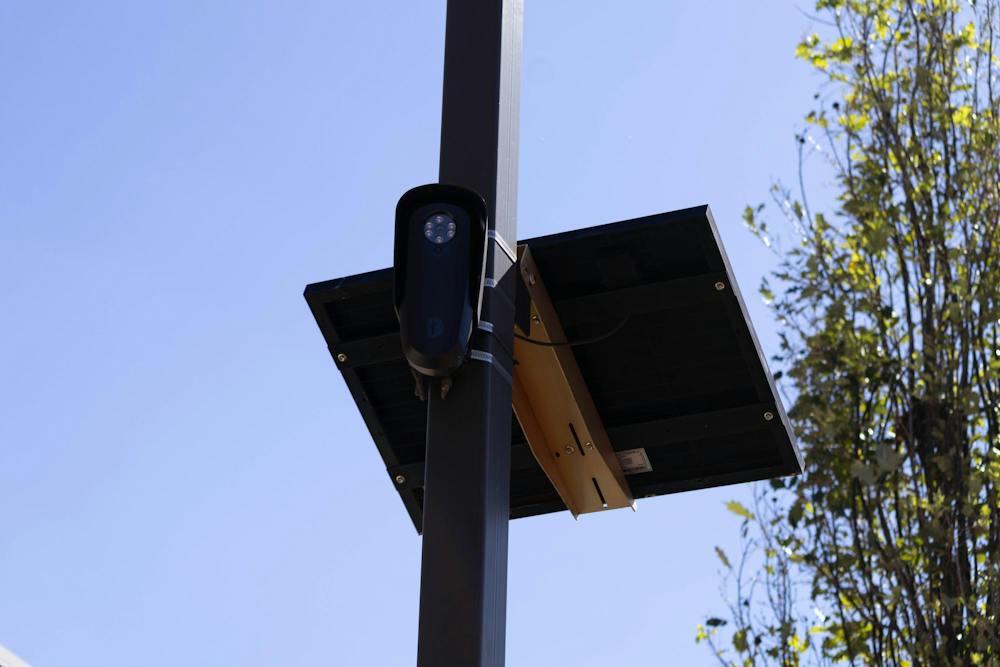
Someone is standing behind McEwen Dining Hall. When you drive through downtown, they take out a notebook, jot something down, and do it again when you come back. They are there all day, all night, seven days a week.
But it isn’t a person; it’s a Flock camera. Every time you drive past one of these Automated License Plate Readers (ALPRs), it snaps several pictures of your car, and according to Elon University Campus Safety & Police interim police chief Doug Dotson, the data it collects is kept in a database for up to 30 days, regardless of whether you’re suspected of a crime.
Despite the extent of this data collection on the Elon community, there is little transparency from the university. We don’t know all the details of how the system works, how it’s audited or what it costs, and as a private university, the administration doesn’t need to tell us anything.
Elon operates several of these Flock Safety ALPRs at locations including the intersections of West Haggard Avenue and Church Street, West Haggard Avenue and North Manning Avenue, and along North Williamson Avenue and South Williamson Avenue, according to the department. These cameras are only a few of more than 120,000 that Flock Safety says make up its ever-growing surveillance network across the United States.
This summer, you may have seen Instagram and TikTok videos of ALPRs being toppled with circular saws, shot with paint balls and blinded with green lasers. Flock’s suite of surveillance systems came to the forefront of public debate after concerns related to their use in immigration enforcement, warrantless surveillance and abuse surfaced.
Elon University’s Flock Cameras
Elon University has operated ALPRs since at least 2015, when the university deployed 14 high-definition cameras.
As Dennis Franks, chief of Elon University Campus Safety & Police at the time put it in a 2015 Today at Elon article, “You’d be hard pressed to get onto campus without us getting your license plate.”
At some point during Flock’s rapid post-pandemic expansion, Elon jumped on the bandwagon. Unfortunately, we cannot know exactly when and how these cameras were installed, with Dotson saying that as a private institution the university does not disclose its agreements with third-party vendors. In fact, as a private institution, records of Campus Safety & Police are generally not considered public under North Carolina state law. State and federal law only require Elon to make certain information available, including a daily crime log and an annual security report. Because of this, Elon community members have few ways to understand how the system was set up, how it operates and even how much the university spends on these cameras.
According to Dotson, its ALPRs are not equipped with live-video capabilities, instead capturing still images of passing vehicles. This may sound less creepy, but in reality it contributes to an even more encompassing surveillance regime. Whereas long cuts of video feed are difficult to search through, images can be associated with exact times, license plates and locations, allowing your vehicle to be cataloged. If your car is captured enough times, it would be fairly simple to map out your routines, habits and movements around campus.
These databases can become expansive, even with the image retention period limited to 30 days. In September 2026, hackers at an unknown location in the United States ripped a Flock camera from above a roadway and reproduced a near-complete copy of the data within it, along with its software. Analysts at WIRED found that over 21 days of activity, the camera logged 1.6 million images of 50,200 vehicles. They further discovered that on average, a Flock camera takes 28 images of a passing car, and occasionally more than 100.
Police departments across the country tend to cite the usefulness of ALPRs to justify their deployment. Elon is no different, stating that the cameras have been “invaluable” in investigating cases. While ALPRs might make the police’s job easier, the technology comes at a steep price for everyone else. Your movements, as an innocent person, can be consistently monitored and cataloged into a database and stored for a month.
At Elon, only authorized officers can access the database, and they are required to log a reason for their search and enter the case number for the incident they are investigating. Dotson said that periodic audits are done to ensure the database is being used for legitimate purposes, but they are being conducted by the university itself. Members of the Elon community are essentially being asked to blindly trust that this database is not being abused, with no publicly disclosed audit results or independent oversight to back that up.
But even if you are completely innocent, Flock cameras misreading license plates have caused serious issues in other areas. In February 2026, KATV ABC 7 reported that a Sherwood, Arkansas, police officer pulled over a mother and her 1-month-old in a Kohl’s parking lot, drawing his weapon and detaining the driver, but the Flock camera that flagged the vehicle had been off by one letter. While Flock Safety claims that its cameras correctly read license plate characters more than 96% of the time under optimal conditions, an analysis of 1,427 Flock alerts sent to the Roseville Police Department in California from 2023 to 2024 found that 71% of alerts sent to the department involved misread license plates. Fortunately, officers of the Roseville PD are required to verify these alerts before taking action, but because of Elon’s lack of transparency, it is unclear how officers of Campus Safety & Police are trained to deal with such alerts.
And what can we do?
In the fight against mass surveillance, we’ve seen the overwhelming power of community. In August, the city of Asheville and Davidson County both voted to terminate their contracts with Flock, with Davidson reallocating the freed $76,000 to their emergency services. Both of these actions occurred in the wake of packed public meetings and intense community-wide backlash.
You are a member of the Elon community. You have every right to know how surveillance technology is used on your campus. Our safety does not require a shadowy network of mass surveillance. As members of the Elon community, we must demand a commitment from the university administration to disclose its contract with Flock Safety, explain how it operates its cameras and allow third-party audits of its ALPR systems. Until Elon University’s ALPRs are brought into the light, they will remain creepy.