

Candidates won’t be the only thing on voters’ ballots this November.
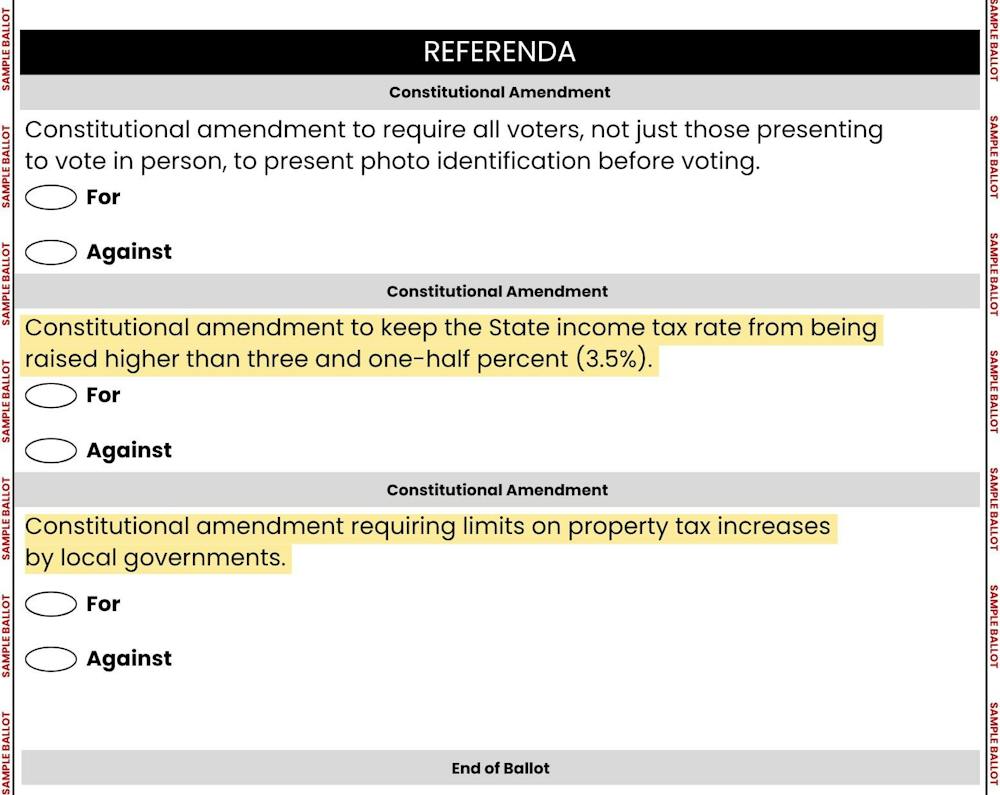
Two tax-related constitutional amendments will be on the ballot, alongside an amendment that would require a photo ID to be able to vote. The tax-related amendments would prevent the income tax rate from exceeding 3.5% and would limit local governments from increasing property taxes.
Lawmakers who support the amendments said that they would protect taxpayers from future tax increases. Advocacy groups across North Carolina are campaigning against the amendments, saying that the amendments would restrict local governments from raising revenue and their ability to fund public services.
Progressive advocacy group, the Carolina Federation, is advocating against the amendment and is planning on knocking on more than 500,000 doors to talk to voters about the issue. Mel Norton, the research & policy director at the Carolina Federation, said she believes that the amendments are going to take power away from municipalities and not help the affordability crisis.
“These amendments are going to make wealthy people and corporations and power-hoarding politicians the biggest winners,” Norton said.
Norton said the amendments take away the power from local governments to set property tax rates to cover the cost of what is needed.
“Taxes make modern life possible,” Norton said. “It’s how we have water coming out of our faucet. It’s how we have sewer lines. Taxes also facilitate community and opportunity. It’s what funds our public schools and libraries and community centers.”
Despite the opposition to both tax amendments, a recent Catawba College poll found broad support for the amendments. Almost 80% of respondents supported the amendment limiting property tax increases, but only 69% supported it when told about the arguments for and against the amendment. The other amendment that would prevent the income tax rate from exceeding 3.5% did not see much change when context was given to respondents, and stayed around two-thirds support.
Politics and history professor at Catawba College, Michael Bitzer, said that since the amendments will be so far down the ballot, many voters won’t pay attention to it as much. Bitzer said when an amendment is asking a basic issue like tax cuts, most North Carolinians are going to be for it.
“Getting a respondent to think more broadly, unless it’s a highly engaged respondent regarding politics, may be a real challenge,” Bitzer said. “So I think just the topic itself, the context of ‘Do you want property taxes capped or income tax limited?’ The way the question is framed certainly has an impact on how people are thinking about the issue.”
Norton said the Carolina Federation has been working to inform voters that the issue extends beyond just raising taxes.
“Once we get to have the conversation with people, we find that overwhelmingly they understand what’s at stake and who’s going to benefit, and that it’s not them,” Norton said.
Public education advocates are also worried about how it could impact school funding. Isabell Moore, one of the lead organizers for North Carolina Families for Public Schools, said the amendments would shrink public school funding that is already being impacted by private school vouchers.
Norton said that the amendments will hurt public schools.
“North Carolina is right now dead last in the entire country for per pupil public school funding. We put less money per pupil into our public schools than any other state in the country,” Norton said. “This is going to cut off the options that we have for rebuilding our public school system to be the public school system that we all deserve.”
At the Sept. 28 Alamance-Burlington School Board meeting, community members expressed concern over the amendments. During the public comment portion of the meeting, Shannon Fitzgerald, a team lead for the North Carolina Families for Public Schools, urged the board to pass a resolution in opposition to the amendments, which the Durham Public Schools Board of Education did Sept. 24.
“Collectively, you have the power to send a message about the dire straits the tax amendments would put our public schools in — the same public schools that you spend your time and energy in support of,” Fitzgerald said to the board.
Two other members of the public expressed similar sentiments, including Mebane City Council member Sean Ewing, who is running for a seat on the Alamance County Board of Commissioners.
Moore said that North Carolina Families for Public Schools’ campaign has been successful, and said that many voters are receptive to their message.
“What this comes down to is what kind of state we want to live in, and what kind of responsibility we feel like North Carolinians have to each other, and what kind of responsibility we feel like the wealthiest and corporations have to the communities whose resources they use to run their lives and run their businesses,” Moore said.