

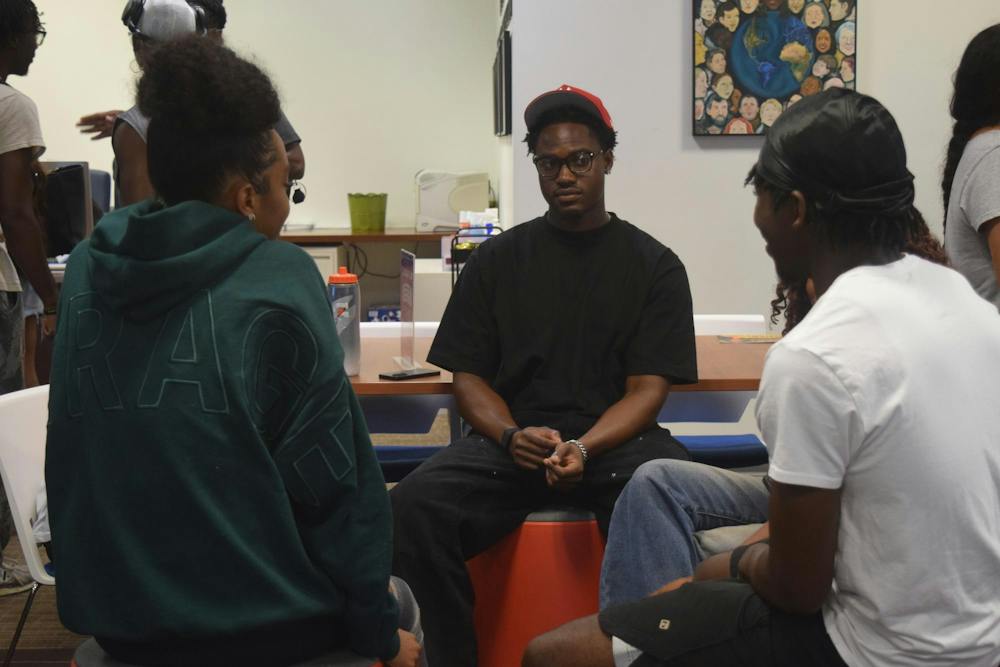
When Adriana Clarke first arrived at Elon, she found herself spending much of her time in the Center for Race, Ethnicity and Diversity Education, or CREDE. She kept returning to the space often and was drawn to the welcoming environment provided to students.
Eventually, Simone Royal ’17, the associate director of CREDE, encouraged Clarke to apply for a job with the Student Mentors Advising Rising Talent, or better known as the SMART Mentor Program.
Before that, Clarke had already found her way into SMART as a first-year mentee.
Coming to Elon from Florida as a first-generation college student, Clarke said she had a lot to figure out on her own. Her mother is an immigrant, and Clarke said navigating college often meant learning things without having someone at home who had gone through the same experience.
Clarke said SMART gave her another place to turn to when her family was not able to provide support.
“I feel like SMART really helps you find that space of belonging, find that space for you to thrive in the way that you want to,” Clarke said.
Clarke’s experience reflects the kind of progression SMART hopes to create for students who arrive looking for connection, finding guidance from someone who has already navigated Elon and eventually have the opportunity to help shape that experience for someone else.
SMART is one of CREDE’s signature initiatives and was originally created in 1994 to support Black students at Elon. It has since expanded to support freshman and transfer students more broadly, while continuing to center students from historically marginalized racial and ethnic backgrounds.
The program is open to all students, but its recruitment efforts focus on ALANAM students, meaning African American, Latine, Asian, Pacific Islander, Native American, Alaskan Native and multiracial students.
Jinelle Gonzalez, a senior and current SMART mentor, first learned about the program while she was looking for ways to become more connected to Elon’s Latine and Hispanic community.
When she arrived at Elon, she found herself drawn to events hosted through the CREDE to meet others with similar backgrounds. As a Mexican-American, she said she was looking for a community where she could see parts of herself reflected in the people around her.
“The Hispanic population here is small, but mighty,” Gonzalez said.
This search eventually led Gonzalez to SMART, where she was paired with a mentor during her first year.
SMART is built around four areas of development including personal, social, academic and professional. Clarke said those areas can look different depending on the student.
“Depending on who you are as a person, you might need more help in one area than the other,” Clarke said.
Students begin meeting mentors through SMART events before they are paired. They can share their interests, majors, hobbies and what they hope to find in a mentor, allowing student coordinators and staff to make connections based on what students are looking for.
The program currently has about 30 mentors divided into three mentor families. Three student coordinators oversee the families, with Clarke serving as the lead student coordinator.
The structure gives students more than one person to turn to and allows them to find a community during a period when nearly everything about college is new.
“I think the first year is a really hard transition for everybody,” Royal said. “Knowing that somebody is there to support you, knowing that somebody’s there that cares about you and cares about your well-being and development.”
Before overseeing the program, Royal was a SMART mentor herself while a student at Elon. Her experience as a mentor later became part of what brought her back to the program as a staff member.
Now, she works with the student coordinators to oversee mentors, help with accountability and make sure students have the resources they need. According to Royal, she has seen many students enter as mentees and return as mentors, taking what they learned from their own experiences and using it to help someone else.
“It’s passing the torch,” Royal said.
For Sylvia Muñoz, director of CREDE, the relationships created through SMART are what make the program necessary more than three decades after it began.
Muñoz joined CREDE in 2014, after SMART was already established. Since then, she has helped shape the program as it has expanded its focus beyond its original population and developed a more intentional structure through adding more faculty and student help.
She said students are not meant to navigate college by themselves.
“We’re not meant to be alone,” Muñoz said. “We’re social beings.”
Muñoz also uses the idea of “mattering” when describing what she hopes students experience through SMART.
Belonging, she said, is being part of a community. According to Muñoz, that can be especially important for students who arrive at Elon and are trying to find people who understand parts of their identity or experiences. “Mattering” is knowing that people notice you, care about you and value your presence, according to Muñoz.
“Do you feel that you matter?” Muñoz said. “Are people showing you that you matter?”