

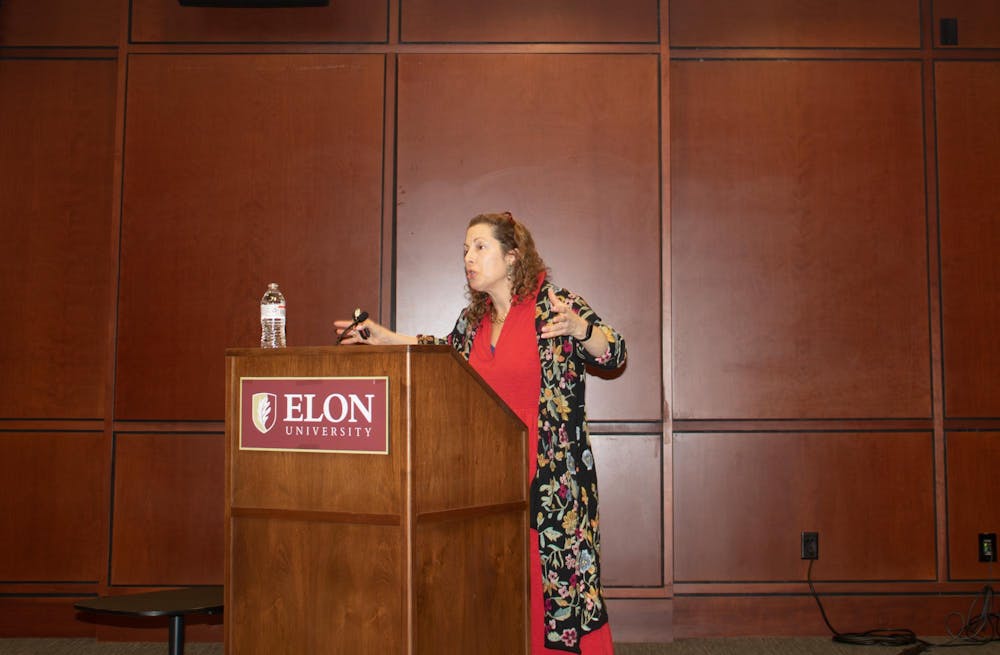
A show of hands inside Elon University’s LaRose Digital Theatre on April 15 revealed a clear mood — more students felt concerned about artificial intelligence than excited.
That tension framed a campus conversation as Northeastern University professor of law, engineering, policy, communications and computer science Beth Noveck challenged students to rethink AI not just as a threat but as a potential tool to strengthen democracy.
Noveck, director of the Burnes Center for Social Change and founder of InnovateUS, spoke about what she called a growing “crisis of democracy,” pointing to declining trust in government, rising political polarization and limited public participation. While many of those concerns are often tied to emerging technologies, she argued AI could also help address them.
“We have to have this conversation because these tools aren't going anywhere,” Noveck said. “They're here.”
The event drew students and faculty across disciplines. Elon political science and public policy professor Dillan Bono-Lunn said the talk resonated with how she teaches public policy.
“I loved that it fit the disciplinary framing that I'm used to in public policy, where you think about policy and then you think about solutions to those problems,” Bono-Lunn said.
In her speech, Noveck outlined several ways AI is already being used globally, from improving voter access to helping governments analyze public input more efficiently. She cited projects in countries such as Brazil and Colombia where AI tools are used to manage citizen feedback or expand participation in policymaking.
Still, the conversation did not ignore the potential risks of new technology.
Students raised concerns about corporate control of AI, misinformation and the potential erosion of civil liberties. Noveck acknowledged those challenges, emphasizing that the impact of AI depends on how it is used, designed and governed.
“We have very little transparency or accountability over these technologies,” Noveck said in an interview with Elon News Network. “And they are really the infrastructure by which we communicate and think.”
Sophomore political science major Soren Peterson said the lecture complicated his initial skepticism.
“I came in with a pretty pessimistic view of AI and government,” Peterson said. “Looking at it globally, there are some cases where that pessimism isn’t founded, but also it’s not entirely unchallenged.”
For Peterson, one of the most valuable takeaways was the importance of hearing from experts, rather than relying on industry narratives.
“A lot of what we hear about AI is from people who are trying to sell a product,” he said. “Having conversations like this is more valuable.”
Throughout the talk, Noveck returned to a central argument: optimism about AI is only justified if people actively shape how it is used.
Her proposed path forward includes expanding public understanding of AI, increasing training for ethical use of AI and designing tools alongside the communities they affect.
“It's only by understanding both the risks and the opportunities that we can use these tools responsibly,” Noveck said.
Noveck said that at a university known for its emphasis on civic engagement, those conversations are especially important.
“Places like Elon are exactly the right place to drive this conversation,” Noveck said. “How do we use these tools to strengthen our communities, not make them less effective?”
Noveck surveyed the crowd again toward the end of the event, and students said they remained divided between optimism and concern. But Noveck framed that uncertainty as a call to action.
“We can throw up our hands,” Noveck said. “Or we can do something.”