

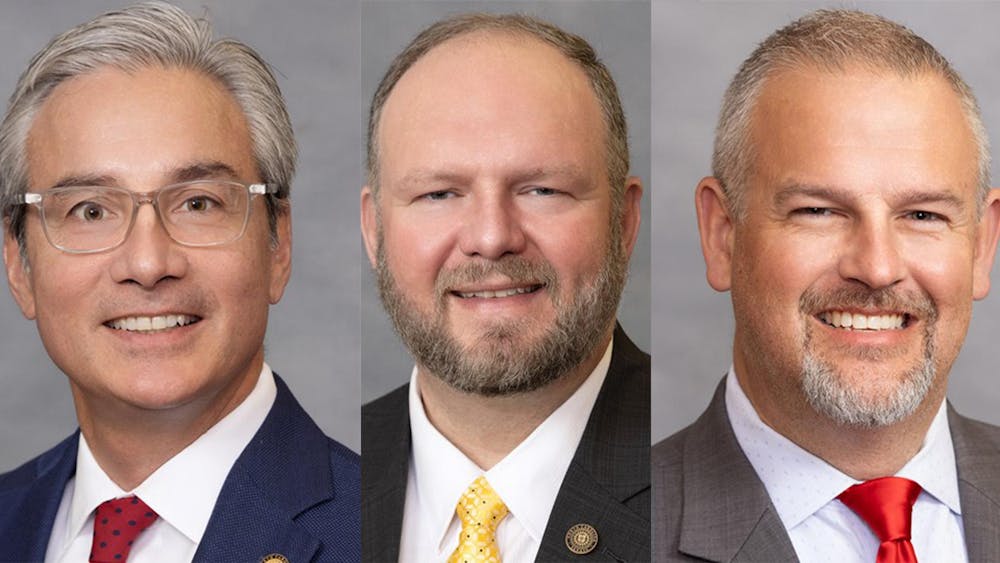
With North Carolina Senate leader Phil Berger conceding his primary against Rockingham County Sheriff Sam Page, the political structure of North Carolina has been flipped on its head and several Republican senators are putting their names up for consideration to be the next Senate leader.
The Senate leader is often seen as the most powerful position in North Carolina state government and Berger has exerted great influence over his 26 years in the senate and his 15 years as the leader of the Republican senate caucus. Berger’s predecessor as Senate leader was Democrat Marc Basnight, who represented counties in eastern North Carolina and held the top job for a record 18 years.
Senior political analyst for the John Locke Foundation Mitch Kokai said the job lends itself to those long periods of time because of how powerful the position has become. But Kokai said he thinks senators will want to distribute power more openly in the future, so it is unlikely the next Senate leader would serve as long as Berger or Basnight.
One thing Republicans will be looking for in a new Senate leader is fundraising ability, according to Eric Heberlig, a political science professor at the University of North Carolina, Charlotte. Berger’s fundraising network was strong and he was skillful at raising money for other Republican candidates. Heberlig said just being an effective legislator won’t be enough in the evaluation process.
“Who has that capacity to shake the money tree in the same way that Berger did to produce those campaign funds?” Heberlig said. “Because if you’re a Republican senator, and you think, ‘Well, what happens if I do have a competitive race, including in a primary. Am I going to have to raise all that money on my own?’ You’re going to feel a whole lot better if you think, ‘Well, the majority leader is good at this. They’ll have ample funds to help me protect my back if it’s needed.’”
There are a few frontrunners who have emerged as those who would be willing to take on the role of Senate leader.
Sen. Michael Lee of New Hanover County is one of the top candidates who has expressed interest in the role. Lee currently serves as the Republican majority leader, and is a close Berger ally. But Kokai said he might not be the first choice because he was a replacement for former majority leader Paul Newton that left in the middle of the session for a university job, and because his district is purple and prone to flipping to Democrat.
Sen. Ralph Hise, another one of Berger’s allies and the current deputy president pro tempore, has also said he intends to seek the position. He is the second highest ranking senator and is a top budget writer, meaning he is very involved in negotiating and drafting the state’s spending plans. Kokai said he has been one of Berger’s top lieutenants when it comes to election issues.
Sen. Todd Johnson, a majority whip, has only been in the Senate for seven years but plans to seek the job, too. Johnson is not one of Berger’s top allies, so Kokai said he could shake things up.
Kokai said that even if the next Senate leader were to be one of Berger’s closest allies, they would likely bring new ideas to the table.
“Even if they were inclined to go along with many of the same policy ideas and even the way that the Senate is structured, if they would go along with the way that Berger has run things, they would be a little bit different, just because it’s a new person and it’s a new personality in that job,” Kokai said.
Heberlig said that a new Senate leader gives the Republicans an opportunity to act more independently and bring in different ideas than Berger’s.
“If you do have a variety of candidates offering alternatives, that really almost forces them to think through what the merits of those different approaches to leadership would be,” Heberlig said.
But Heberlig said Berger’s influence won’t completely go away. Berger will still have supporters in Raleigh and his lobbying networks will remain, according to Heberling. Much of it will depend on how Berger decides to approach the rest of his career.
“Part of the dynamic will be how much he stays on as a party leader behind the scenes,” Heberlig said. “The other element of that is how much the new senate majority leader tries to strike out their own path, whether they intentionally or purposely try to stake out a different route than Berger or whether they’re comfortable with continuing on the status quo.”
Unifying the GOP and replicating Berger’s ability to keep his caucus cohesive will also be important, Heberlig said.
Other potential candidates that have not expressed interest publicly include Sen. Brent Jackson, one of the longest serving members of the Senate and Sen. Amy Galey of Alamance County. Galey is one of Berger’s top allies and tried to convince Page to drop out of the race against Berger. She is the only woman in Senate Republican leadership.
Galey declined to comment on her potential candidacy, but told Elon News Network that she is focused on constituent work and preparing for the upcoming session.
Kokai said the GOP may come up with a succession plan in the next few months, but could see it waiting until after midterm elections in November.
“The key thing for the Republicans is to rally around a particular person and not have a fight that would stretch into the next legislative session and cause them trouble in terms of getting anything done,” Kokai said.